

When Should Your Business Count the Money?
Imagine this:
You complete a $5,000 HVAC installation in December.
You send the customer an invoice, but they don’t pay you until January.
So which month should that $5,000 belong to?
December, when you earned it?
Or January, when you received the cash?
The answer depends, in part, on the accounting method your business uses.
This is where cash vs accrual accounting becomes important.
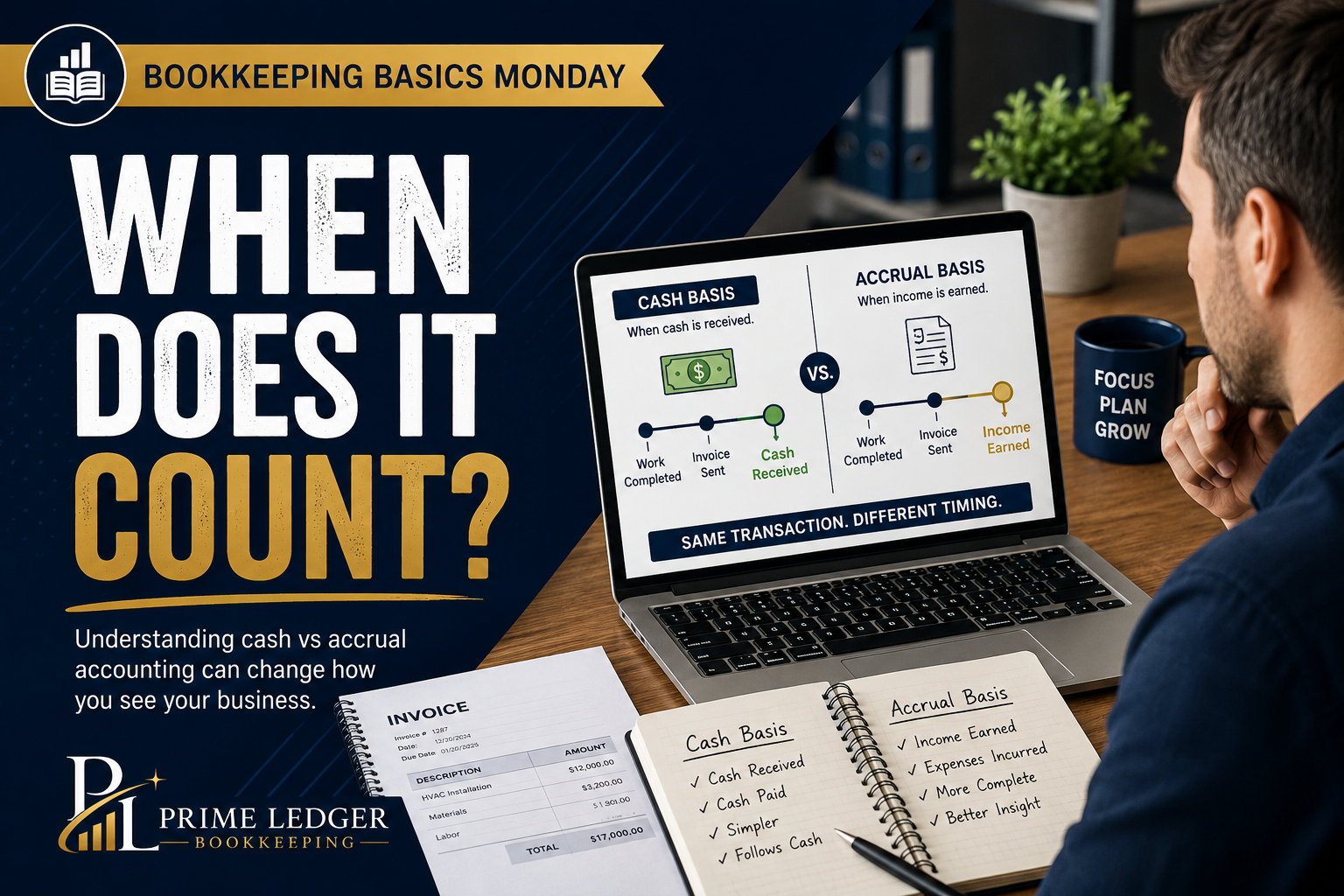
The two methods approach the timing of income and expenses differently. Under the cash method, income is generally reported when received and expenses when paid. Under the accrual method, income is generally reported when earned and expenses when incurred.
For a business owner, this isn’t just an accounting technicality.
The method you use can affect how you understand your revenue, expenses, profitability, accounts receivable, and accounts payable.
In this guide, we’ll break down cash vs accrual accounting in plain English so you can understand how each method works, why the difference matters, and what to consider for your business.
Important: This article is for general educational purposes and isn’t tax advice. Accounting-method rules can depend on your business structure and circumstances. Consult your tax professional for advice specific to your situation.
Table of Contents
- What Is Cash-Basis Accounting?
- What Is Accrual-Basis Accounting?
- Cash vs. Accrual Accounting: What’s the Difference?
- A Simple HVAC Example
- Why the Accounting Method Matters
- Is Cash or Accrual Accounting Better for a Small Business?
- What About Accounts Receivable and Accounts Payable?
- Can You Change Your Accounting Method?
- What Accounting Method Should Your Business Use?
- How Your Bookkeeping Supports Your Accounting Method
- Key Takeaways
- Frequently Asked Questions
- Conclusion
What Is Cash-Basis Accounting?
Cash-basis accounting is generally the simpler of the two methods.
Under the cash method, income is generally reported when you actually or constructively receive it, while business expenses are generally deducted when you pay them, subject to applicable rules.
In simple terms:
Cash basis generally follows the movement of money.
Here’s an example.
You complete a $5,000 HVAC repair in December.
You invoice the customer on December 20.
The customer pays you on January 10.
Under the cash method, the $5,000 would generally be recognized as income when you receive the payment in January.
The work happened in December.
The cash arrived in January.
Cash accounting generally follows the cash.
Why some businesses like cash accounting
Cash-basis accounting can be easier to understand and maintain, which is one reason many individuals and small businesses use it.
It can provide a straightforward view of:
- Money received
- Money paid
- Cash activity during the period
But there’s an important limitation.
Cash in the bank doesn’t necessarily tell you everything about your business’s financial performance.
What Is Accrual-Basis Accounting?
Accrual accounting approaches the timing differently.
Under the accrual method, income is generally reported when it is earned, regardless of when payment is received, while expenses are generally recognized when incurred, subject to applicable rules.
In simple terms:
Accrual basis generally follows when economic activity happens, not simply when cash changes hands.
Let’s return to our HVAC example.
You complete the $5,000 installation in December and invoice the customer.
The customer pays you in January.
Under accrual accounting, the revenue would generally be recognized in December because that’s when the income was earned.
The cash arrives later.
Why does that matter?
Because the December financial statements can show the revenue associated with the work completed in December.
This can give the owner a different view of business activity than cash-basis reporting.
Cash vs. Accrual Accounting: What’s the Difference?
Here’s the simplest way to think about it:
| Cash Basis | Accrual Basis | |
| Revenue | Generally recognized when cash is received | Generally recognized when earned |
| Expenses | Generally recognized when paid | Generally recognized when incurred |
| Accounts Receivable | Less central to revenue recognition | Important |
| Accounts Payable | Less central to expense timing | Important |
| Complexity | Generally simpler | Generally more involved |
| Timing | Follows cash movement | Follows economic activity |
The IRS describes cash and accrual as the two most commonly used accounting methods and notes that businesses generally must use a consistent method that clearly reflects income.
Think of it this way:
Cash basis asks:
“Did we get paid?”
Accrual basis asks:
“Did we earn it?”
Neither question is inherently wrong.
They’re simply looking at the financial activity from different perspectives.
A Simple HVAC Example
Let’s make this even more practical.
Imagine an HVAC company completes a $12,000 system installation in December.
The customer is invoiced in December but doesn’t pay until January.
At the same time, the HVAC company receives a $4,000 supplier bill in December but doesn’t pay the vendor until January.
Under cash basis
The timing generally follows when the money actually changes hands.
The customer payment is generally recognized in January, when received.
The supplier expense is generally recognized when paid, subject to applicable tax rules.
Under accrual basis
The revenue is generally recognized when earned, and the expense is generally recognized when incurred, subject to the applicable rules.
So the December financial statements can reflect both the revenue from the completed installation and the related expense.
This is one reason accrual accounting can provide a more complete picture of activity during a particular period.
Why the Accounting Method Matters
You might be wondering:
“Why should I care when the transaction is recorded if I know how much money I have?”
Because cash and profitability are not the same thing.
Imagine your business has:
- $100,000 in completed work
- $80,000 in expenses
- $50,000 still waiting to be collected from customers
Your bank balance won’t necessarily tell you the full story.
You could have a profitable business while experiencing tight cash flow.
You could also have plenty of cash in the bank because of a loan or other financing without that meaning the business is profitable.
Understanding your accounting method helps you interpret your financial reports correctly.
Is Cash or Accrual Accounting Better for a Small Business?
There’s no universal answer.
The better question is:
Which accounting method is appropriate for your business and circumstances?
Cash basis may be attractive when:
- The business has relatively simple transactions
- The owner wants a simpler bookkeeping process
- There isn’t significant complexity around receivables and payables
- The business meets the applicable requirements for using the method
Accrual basis may be useful when:
- The business has significant accounts receivable
- The business has substantial accounts payable
- The timing of revenue and expenses matters for understanding performance
- The business has become more financially complex
- The owner wants financial statements that reflect activity when it occurs
However, don’t choose an accounting method simply because one sounds easier.
Tax rules can affect which method a business may use.
The IRS states that businesses generally use a consistent accounting method that clearly reflects income, and certain businesses or transactions may be subject to additional rules.
What About Accounts Receivable and Accounts Payable?
This is where the difference can become especially noticeable.
Accounts Receivable
Accounts receivable represents money customers owe your business.
Under accrual accounting, revenue can be recognized before the customer actually pays, which means accounts receivable can play an important role in understanding the business’s financial position.
For example:
You complete a $10,000 job in March.
The customer pays in April.
Under accrual accounting, the revenue is generally recognized when earned, while the unpaid amount remains an account receivable until collected.
That gives the owner visibility into both:
Revenue earned
and
Money still owed.
Accounts Payable
Accounts payable represents amounts your business owes to vendors and other parties.
Suppose you receive $3,000 worth of materials in March but don’t pay the vendor until April.
Under accrual accounting, the expense or liability is generally recognized based on when the applicable requirements for recognition are met, rather than simply waiting for the cash payment.
This helps the financial statements reflect obligations associated with the period in which they arise.
Can You Change Your Accounting Method?
This is where business owners need to be careful.
Changing from cash to accrual—or from accrual to cash—isn’t necessarily something you should simply switch inside your bookkeeping software and move on.
The IRS says that once an accounting method is established, a business generally must obtain IRS approval to change methods, although certain automatic change procedures may apply.
A change can affect:
- Tax reporting
- Timing of income
- Timing of deductions
- Financial statements
- Accounts receivable
- Accounts payable
- Opening balances
That’s why you should discuss a potential accounting-method change with your CPA or tax professional before making the switch.
Authoritative resource
The IRS provides detailed information about accounting periods and methods in Publication 538, Accounting Periods and Methods.
This is the authoritative resource we’d recommend reviewing for the tax rules surrounding accounting methods.
What Accounting Method Should Your Business Use?
If you’re not sure which method your business uses, start by asking your bookkeeper or tax professional.
You can also look at how your financial records behave.
For example:
Ask yourself:
Do invoices affect my income before customers pay?
Do unpaid vendor bills appear in my expenses or liabilities?
Do my reports show revenue when I earn it or when I collect it?
If you’re still unsure, don’t guess.
Your bookkeeping and tax reporting should be consistent with the accounting method your business is using and the applicable rules.
And remember:
Your bookkeeping software doesn’t automatically determine the correct accounting method for your business.
The setup and reporting basis need to be appropriate for your circumstances.
How Your Bookkeeping Supports Your Accounting Method
Your accounting method is only useful if your bookkeeping records are maintained consistently.
That means your books need to correctly handle things such as:
- Customer invoices
- Customer payments
- Vendor bills
- Vendor payments
- Bank transactions
- Credit card transactions
- Reconciliations
- Adjustments
- Financial reporting
If these records aren’t maintained properly, your financial reports may not give you a reliable picture of the business.
That’s why accurate bookkeeping matters regardless of whether your business uses cash or accrual accounting.
For a deeper look at why reliable records matter, see our article:
Key Takeaways
Cash vs accrual accounting is primarily about timing.
Cash basis
Generally recognizes income when received and expenses when paid.
Accrual basis
Generally recognizes income when earned and expenses when incurred, subject to applicable rules.
Neither method should be viewed as automatically “better” for every business.
The right method depends on your business, its circumstances, applicable tax rules, and the financial information you need to manage it.
Most importantly:
✅ Know which accounting method your business is using.
✅ Understand how that method affects your financial reports.
✅ Keep your bookkeeping consistent.
✅ Don’t change accounting methods without understanding the tax and reporting implications.
✅ Ask your CPA or tax professional before making a tax accounting-method change.
Understanding your accounting method is one more step toward understanding your numbers.
Frequently Asked Questions
What is the difference between cash and accrual accounting?
Cash accounting generally recognizes income when cash is received and expenses when they are paid. Accrual accounting generally recognizes income when earned and expenses when incurred, subject to applicable rules.
Is cash or accrual accounting better?
Neither method is universally better. The appropriate method depends on the business, its circumstances, applicable rules, and the type of financial information needed.
Do small businesses use cash accounting?
Many small businesses use the cash method, but eligibility and requirements vary. The IRS provides specific rules governing accounting methods and certain exceptions.
Why does accrual accounting show income before I receive the money?
Under accrual accounting, income is generally recognized when it is earned rather than waiting for payment. The unpaid amount can then appear as accounts receivable until the customer pays.
Can I switch from cash to accrual accounting?
A change in accounting method can have tax and reporting implications. The IRS generally requires approval for a change, although certain automatic procedures may apply. Consult your tax professional before changing methods.
Does QuickBooks determine whether I use cash or accrual accounting?
Not necessarily. Accounting software can generate reports on different bases, but your business’s accounting method and tax treatment depend on how the books are established and the applicable rules. Your tax professional can confirm the appropriate method.
Does cash accounting mean I don’t need to track unpaid invoices?
Not necessarily. Even businesses using cash-basis reporting may benefit from tracking outstanding customer invoices for operational and collection purposes. Your bookkeeping system should provide the information you need to manage the business.
Why does accounting method matter for financial reports?
The accounting method affects when revenue and expenses appear in financial statements. That timing can change how you interpret profitability and financial performance for a particular period.
Conclusion
Cash vs accrual accounting can sound complicated at first.
But the basic difference is relatively simple:
Cash basis generally follows when money changes hands.
Accrual basis generally follows when income is earned and expenses are incurred.
The important part isn’t memorizing accounting terminology.
It’s understanding how your accounting method affects the numbers you’re looking at.
If your business completed a large job but hasn’t been paid yet, or if you have significant vendor bills waiting to be paid, the accounting method can make a meaningful difference in how that activity appears in your financial reports.
And if you’re considering changing your accounting method, don’t make the decision based solely on which method seems easier. Tax and accounting rules can apply, and the IRS generally requires approval for many accounting-method changes.
When in doubt, talk with your CPA or tax professional about the method that’s appropriate for your business.
And whatever method you use, one thing remains true:
Your books need to be accurate, consistent, and useful.
At Prime Ledger Bookkeeping, we help HVAC and service-based businesses keep their bookkeeping organized and their financial information reliable.
Accurate Books. Clear Decisions. Peace of Mind.
Related Articles
Why Accurate Books Matter
Learn why accurate and current financial records are essential for making better business decisions.
The Monthly Financial Reports Every Owner Needs
Understand the financial reports that can help you monitor profitability, cash flow, receivables, and obligations each month.
Still Using Spreadsheets? Here’s the Risk.
Learn the warning signs that your spreadsheet-based bookkeeping system may no longer be keeping up with your business.
What Does a Bookkeeper Do? A Complete Guide for Small Business Owners
Learn how a bookkeeper helps maintain organized financial records and support your business.
Leave a Reply