

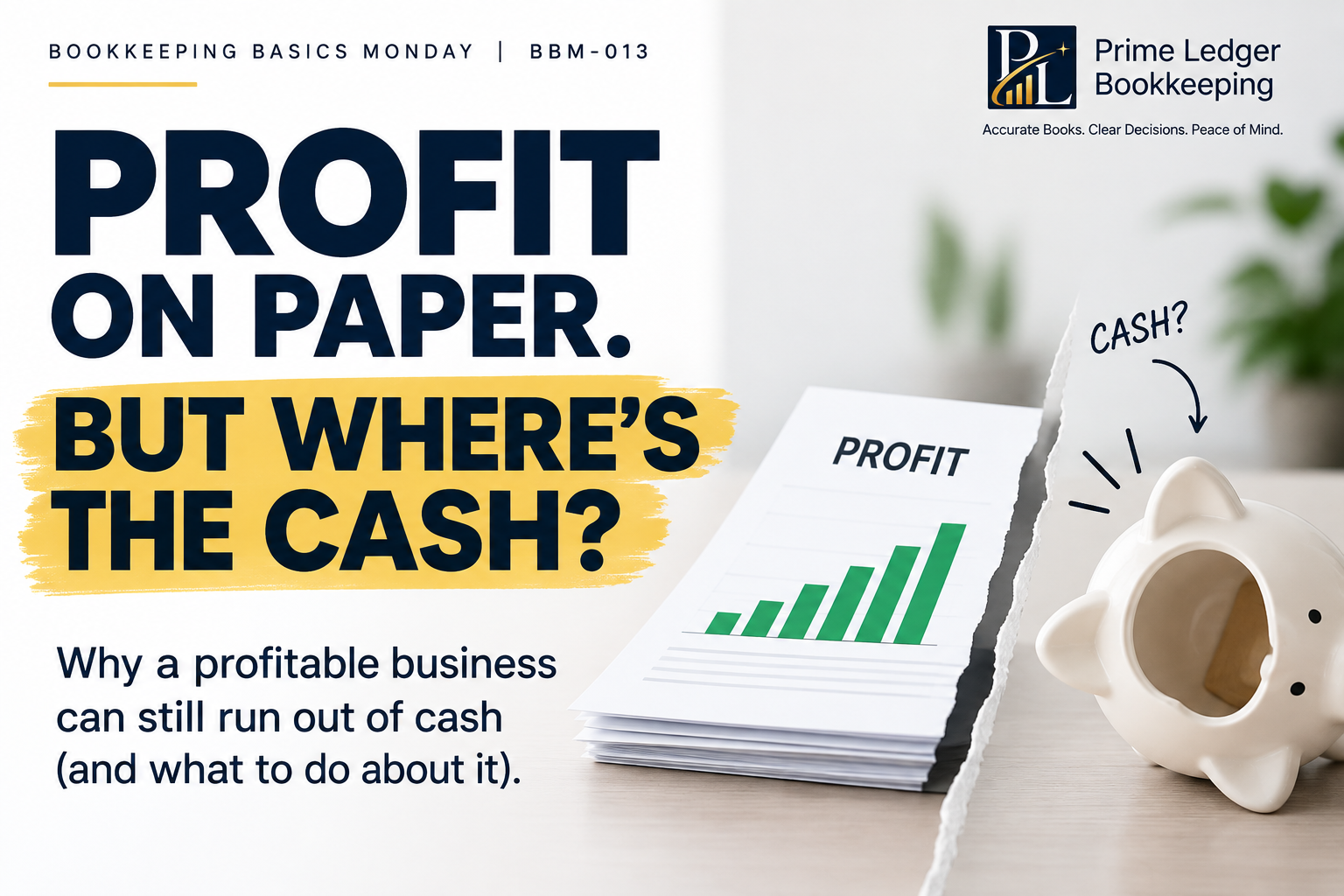
Your business works hard. Make sure your cash flow works, too.
This Labor Day, we’re celebrating the people behind America’s small businesses—the owners and workers who put in the hours, serve customers, solve problems, and keep businesses moving.
But there’s another side to all that hard work: knowing whether the business is actually generating enough cash to support it.
Because here’s something many business owners discover the hard way:
A profitable business can still run out of cash.
If you’ve ever looked at your profit and loss statement and thought, “I made money this month, so why does my bank account feel so low?” you’re not alone.
The answer often comes down to understanding cash flow vs. profit.
These two numbers tell you different parts of your business’s financial story. Knowing the difference can help you spot cash shortages earlier, plan for upcoming expenses, and make better decisions about your business.
Table of Contents
- Key Takeaways
- What Is Profit?
- What Is Cash Flow?
- Cash Flow vs. Profit: What’s the Difference?
- 7 Reasons a Profitable Business Can Still Run Out of Cash
- An HVAC Example: Profitable on Paper, Short on Cash
- What Small-Business Owners Should Watch
- How Good Bookkeeping Helps You See the Full Picture
- Conclusion
- Frequently Asked Questions
- Need Help Understanding Your Numbers?
Key Takeaways
- Profit and cash flow are not the same thing.
- Profit shows whether your business earned more than it spent during a particular period.
- Cash flow tracks money actually moving into and out of the business.
- A business can report a profit while having little cash available.
- Unpaid invoices, equipment purchases, loan payments, owner withdrawals, and timing differences can all affect cash.
- Reviewing your P&L alone isn’t enough to understand your business’s financial position.
- Accurate bookkeeping gives you better information for monitoring both profitability and cash availability.
What Is Profit?
Profit is essentially what remains after your business’s revenue is reduced by its expenses.
For example:
Revenue: $20,000
Expenses: $14,000
Profit: $6,000
Your profit and loss statement, commonly called a P&L, helps you see whether the business generated a profit or loss during a particular period.
The IRS describes an income statement as showing the income and expenses of a business for a given period. Accurate records are important for preparing reliable financial statements and monitoring the progress of a business. (IRS)
Profit is important because it helps answer a fundamental question:
Is the business financially profitable based on its revenues and expenses?
But profit doesn’t necessarily tell you how much money is available in your bank account today.
That’s where cash flow comes in.
What Is Cash Flow?
Cash flow is about the movement of money into and out of your business.
Cash inflows can include:
- Customer payments
- Deposits
- Loan proceeds
- Owner contributions
- Other cash received by the business
Cash outflows can include:
- Payroll
- Vendor payments
- Rent
- Utilities
- Insurance
- Equipment purchases
- Loan payments
- Owner withdrawals
The timing of those inflows and outflows matters.
Imagine you invoice a customer $10,000 today but won’t receive payment for 30 days.
You may have earned revenue, but you don’t yet have that $10,000 available in your bank account.
This is one reason understanding cash flow vs. profit is so important for small-business owners.
The SBA notes that businesses may use either cash or accrual accounting, and under accrual accounting a sale can be recorded when it occurs even if payment comes later. (Small Business Administration)
Cash Flow vs. Profit: What’s the Difference?
Here’s a simple way to think about it:
| Profit | Cash Flow |
| Measures revenue and expenses | Measures cash coming in and going out |
| Appears on the profit and loss statement | Can be analyzed through cash-flow reporting and cash activity |
| Can include revenue that hasn’t been collected yet under accrual accounting | Focuses on actual movement of cash |
| Helps measure profitability | Helps you understand liquidity and cash availability |
| Answers: “Did the business make money?” | Answers: “Do we have enough cash to meet our obligations?” |
Neither one tells the entire story by itself.
Profitability matters for the long-term health of the business. Cash availability matters for keeping the business operating day to day.
You need to understand both.
7 Reasons a Profitable Business Can Still Run Out of Cash
Understanding cash flow vs. profit becomes much easier when you look at what can cause the two numbers to move in different directions.
1. Your Customers Haven’t Paid Their Invoices Yet
This is especially common for service businesses.
Suppose your HVAC company completes $15,000 of work in August and invoices the customers.
If you use accrual accounting, that revenue may be reflected in August even though your customers don’t pay until September.
Your August P&L could therefore show strong revenue and a healthy profit.
But your bank account doesn’t have that $15,000 yet.
Revenue isn’t the same thing as collected cash.
This is why accounts receivable deserves regular attention.
2. You Made a Large Equipment Purchase
Let’s say your business purchases a $12,000 piece of equipment.
Your bank account immediately feels the $12,000 cash outflow.
But the way that purchase affects your financial statements can be different from the timing of the cash leaving your account, particularly when the equipment is recorded as an asset and depreciated over time.
This can create a situation where:
Cash decreases significantly while the expense recognized on the P&L is different.
Large purchases therefore deserve special attention when you’re reviewing cash flow.
3. You’re Paying Down Business Loans
Loan payments can also create confusion.
A loan payment generally contains both:
- Principal
- Interest
The cash leaves your bank account for the entire payment.
But principal repayment isn’t simply another operating expense on your P&L.
That means your bank balance can decline even though your reported profit doesn’t decline by the same amount.
This is another important reason to look beyond the P&L.
4. You’re Taking Money Out of the Business
Owner draws or distributions can reduce the amount of cash available to the business without necessarily appearing as an operating expense on the P&L.
For example, suppose your business earns $8,000 in profit.
You then transfer $5,000 to your personal account.
Your business may still show $8,000 of profit, but there is now $5,000 less cash available to the business.
That’s why business owners need to distinguish between:
“The business earned money.”
and
“The business currently has money available.”
They’re not necessarily the same statement.
5. Your Expenses Are Due Before Customer Payments Arrive
Cash-flow problems are often about timing.
Imagine:
- Customer invoices are due in 30 days.
- Your supplier expects payment in 15 days.
- Payroll is due Friday.
- Your insurance payment is due next week.
Your business may be profitable overall, but the timing of cash coming in doesn’t line up with the timing of cash going out.
That’s a cash-flow problem.
6. You’re Growing Faster Than Your Cash Can Support
Growth sounds great—and it can be.
But growth can require cash.
You may need to:
- Hire additional technicians
- Purchase inventory or equipment
- Increase advertising
- Purchase vehicles
- Carry larger receivables
- Pay vendors before customers pay you
So a growing business can actually experience more pressure on cash, even while revenue and profit are increasing.
Growth doesn’t automatically mean cash is plentiful.
7. You’re Looking Only at Your Bank Balance
The opposite problem can happen too.
A healthy bank balance doesn’t automatically mean your business is profitable.
Your bank account might contain:
- A recently received customer payment
- Loan proceeds
- Owner contributions
- Money set aside for taxes
- Cash needed for upcoming bills
Looking only at the bank balance can therefore give you an incomplete picture.
The bank account tells you what’s there. Your financial reports help explain why it’s there and what your business is actually earning.
An HVAC Example: Profitable on Paper, Short on Cash
Let’s make this practical.
Imagine ABC Heating & Air completes several jobs during August.
August activity
Customer invoices: $25,000
Business expenses: $17,000
Profit: $8,000
At first glance, that looks pretty good.
But there’s a catch.
Of the $25,000 invoiced:
$15,000 hasn’t been collected yet.
Meanwhile, the company has already paid technicians, suppliers, fuel, insurance, and other operating expenses.
The P&L may show an $8,000 profit, while the company’s available cash is much lower than the owner expected.
The owner might ask:
“Where did my profit go?”
The answer isn’t necessarily that the profit disappeared.
Part of the business’s earnings may still be sitting in accounts receivable, waiting for customers to pay.
And other cash movements—such as equipment purchases, loan principal payments, or owner withdrawals—may have reduced the bank balance without reducing profit in the same way.
This is exactly why looking at cash flow vs. profit gives you a more complete financial picture.
What Small-Business Owners Should Watch
You don’t have to become an accountant to keep an eye on your business finances.
Start by regularly reviewing these areas.
1. Accounts Receivable
How much money do customers currently owe you?
More importantly:
How much is overdue?
A growing accounts-receivable balance can eventually create a cash problem.
2. Accounts Payable
What bills are coming due?
Knowing what you owe—and when you owe it—helps you anticipate cash needs.
3. Profit and Loss Statement
Look at:
- Revenue
- Cost of goods sold, when applicable
- Operating expenses
- Net profit
Don’t just look at whether you’re profitable. Look for trends.
4. Bank Balance
Know how much cash is actually available.
But don’t treat the bank balance as your complete financial report.
5. Upcoming Large Expenses
Look ahead for:
- Equipment purchases
- Insurance renewals
- Tax payments
- Loan payments
- Vehicle expenses
- Payroll increases
- Seasonal expenses
6. Owner Withdrawals
Make sure you understand how much money is leaving the business for personal use.
7. Cash Reserves
Ask yourself:
If customer payments were delayed for 30 days, could my business still cover its essential expenses?
That’s a much more useful question than simply asking whether the bank account looks healthy today.
How Good Bookkeeping Helps You See the Full Picture
Understanding cash flow vs. profit starts with having reliable financial records.
If transactions are missing, incorrectly categorized, or unreconciled, your financial reports can become difficult to trust.
The IRS explains that good business records help owners monitor business progress and prepare accurate financial statements. It also notes that supporting documents such as invoices, receipts, deposit slips, and paid bills provide information needed to record business transactions. (IRS)
For small-business owners, that means bookkeeping isn’t just about categorizing transactions.
It’s about creating financial information you can actually use.
A good bookkeeping process can help you:
- Keep revenue and expenses organized
- Track accounts receivable
- Monitor accounts payable
- Reconcile bank accounts
- Identify unusual transactions
- Review financial reports
- Spot trends
- Prepare for tax filing
- Make better business decisions
The SBA similarly recommends maintaining proper bookkeeping and having a basic understanding of business finances, including accounting methods, accounts receivable, accounts payable, available cash, and bank reconciliation. (Small Business Administration)
IRS: Why Should I Keep Records?
SBA: Manage Your Business Finances
Conclusion
Your Business Works Hard. Your Numbers Should Work Hard, Too.
This Labor Day, while we’re celebrating the people who make small businesses work, it’s worth remembering that hard work alone doesn’t tell you whether your business is financially healthy.
You need visibility into the numbers.
Profit tells you whether your business is earning more than it spends.
Cash flow tells you how money is actually moving through the business.
And you need both perspectives.
A business can be profitable and still experience a cash shortage. It can also have plenty of money in the bank and still be losing money.
That’s why understanding cash flow vs. profit matters.
When your books are accurate and your financial reports are up to date, you can see what’s happening before a small cash-flow issue becomes a major problem.
You put in the labor. Let your numbers tell you whether that labor is paying off.
Frequently Asked Questions
Is cash flow the same as profit?
No. Profit measures the difference between revenue and expenses over a period. Cash flow focuses on money moving into and out of the business. The two can differ because of payment timing, financing, asset purchases, owner transactions, and other factors.
Can a business be profitable but have negative cash flow?
Yes. A business can report a profit while experiencing negative cash flow during a period. For example, customers may not have paid their invoices yet while the business has already paid employees, suppliers, or other expenses.
Which is more important: profit or cash flow?
Neither should be viewed in isolation. Profit helps you understand whether the business model is generating earnings, while cash flow helps you understand whether the business has enough cash to meet its obligations.
Why doesn’t my bank balance match my profit?
Your bank balance reflects cash activity, while profit reflects revenue and expenses according to your accounting method. Loan principal payments, owner withdrawals, unpaid invoices, equipment purchases, and other transactions can cause the two numbers to differ.
How often should a small business review cash flow?
At minimum, business owners should regularly review their cash position and upcoming inflows and outflows. Businesses with tight margins, seasonal revenue, rapid growth, or significant accounts receivable may benefit from reviewing cash flow more frequently.
Need Help Understanding Your Numbers?
You shouldn’t have to guess whether your business is making money—or wonder where the cash went.
Prime Ledger Bookkeeping helps small-business owners keep their books organized, understand their financial reports, and make decisions with greater confidence.
From monthly bookkeeping and reconciliations to clear financial reporting, we’re here to help you get a better picture of your business finances.
Accurate Books. Clear Decisions. Peace of Mind.
Ready to understand your numbers better?
Schedule a Free Consultation with Prime Ledger Bookkeeping.
Leave a Reply