
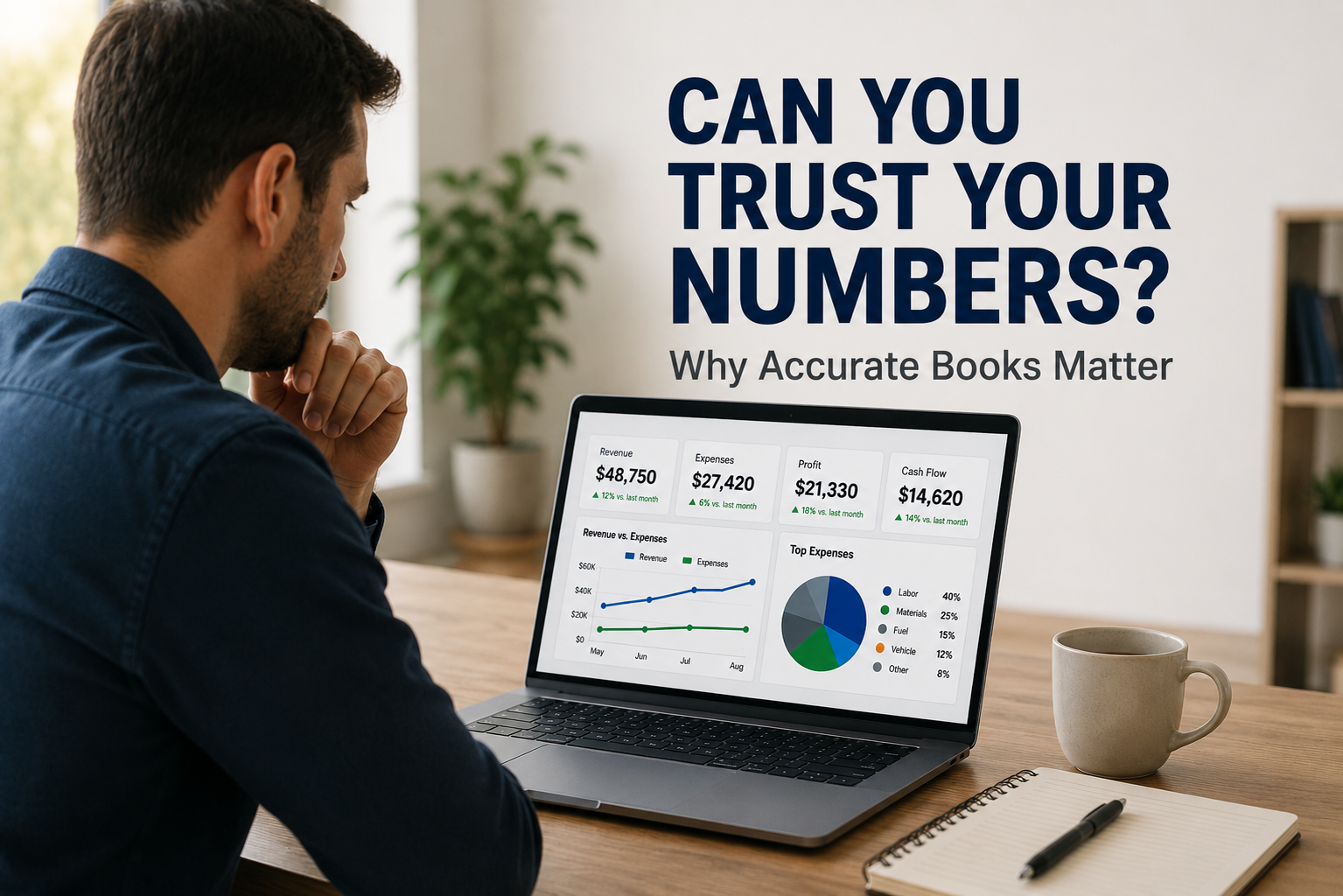
Your Books Are More Than a Record of What Happened
Imagine you’re considering hiring another technician.
You think the business can afford it.
Revenue has been strong. Customers are coming in. Your bank account looks healthy.
But then you look at your financial reports—and you’re not completely sure the numbers are right.
Are your expenses fully recorded?
Have all your customer payments been entered?
Are your bank accounts reconciled?
Are there old transactions sitting in the wrong accounts?
If you’re not confident in your numbers, making an important business decision becomes a guessing game.
That’s why accurate books matter.
Your books aren’t simply a record of what happened in the past. They provide the financial information you use to understand your business today and make decisions about tomorrow.
For small-business owners, especially those running HVAC and other service-based businesses, reliable financial records can help answer some important questions:
Are we actually profitable?
Where is our money going?
Can we afford to hire?
Which parts of the business are performing well?
Do we have enough cash for our upcoming obligations?
Let’s look at seven practical reasons accurate financial records can make such a difference.
Table of Contents
- What Does It Mean to Have Accurate Books?
- 7 Reasons Accurate Books Matter
- What Happens When Your Books Aren’t Accurate?
- Accurate Books vs. Current Books
- How Do You Know If Your Books Are Accurate?
- How Regular Bookkeeping Helps
- Why Accurate Books Matter for HVAC and Service Businesses
- What Can You Do If Your Books Aren’t Accurate?
- Why Professional Bookkeeping Can Help
- A Simple Monthly Bookkeeping Checklist
- Key Takeaways
- Frequently Asked Questions
- Conclusion
What Does It Mean to Have Accurate Books?
Before discussing why accuracy matters, let’s clarify what we mean by accurate books.
Accurate bookkeeping doesn’t mean your financial records will never need an adjustment.
The IRS also emphasizes that businesses should maintain records that clearly show their income and expenses and support the transactions recorded in their books. IRS: What Kind of Records Should I Keep?
It means your records reasonably reflect the financial activity of your business and are supported by the underlying transactions and documentation.
Generally, this means:
- Transactions are recorded completely
- Transactions are categorized appropriately
- Bank and credit card accounts are reconciled
- Customer payments are properly recorded
- Vendor bills and payments are properly recorded
- Duplicate transactions are identified
- Unusual balances are investigated
- Financial reports reflect the underlying records
- Books are updated consistently
There’s another important distinction:
Accurate Doesn’t Necessarily Mean Current
Your books could be accurate through March—but if it’s August and nothing has been recorded since March, those books aren’t very useful for understanding what’s happening today.
For business decision-making, you want both:
Accurate + Current
7 Reasons Accurate Books Matter
1. Accurate Books Help You Understand Your True Profitability
Revenue is only part of the story.
A business might generate $100,000 in sales and still struggle financially because of labor, materials, vehicle expenses, insurance, rent, software, and other operating costs.
Your Profit & Loss statement helps you see the relationship between your revenue and expenses.
But that only works when the underlying records are reliable.
If expenses are missing or transactions are categorized incorrectly, your reported profit may not reflect your actual results.
For an HVAC business, this could make it harder to determine whether the business is truly profitable after considering labor, materials, fuel, equipment, and other operating costs.
Accurate books help you see the difference between making sales and actually making money.
2. They Help You Understand Where Your Money Is Going
Have you ever looked at your bank account and wondered:
“Where did all the money go?”
Your bank statement can show you that money left the account.
But your bookkeeping should help explain why.
Was it:
- Payroll?
- Materials?
- Fuel?
- Equipment?
- Advertising?
- Insurance?
- Vendor payments?
- Owner draws?
- Loan payments?
When transactions are properly categorized, your financial reports can reveal spending patterns that aren’t obvious from a bank statement alone.
That information can help you identify expenses that are increasing, areas where you may be overspending, and opportunities to improve profitability.
3. Accurate Books Help You Make Better Business Decisions
Small-business owners make decisions every day.
Should you hire another employee?
Should you purchase another service vehicle?
Can you afford new equipment?
Should you expand into another service area?
Should you increase your marketing budget?
These decisions have financial consequences.
You don’t need perfect financial information to make every decision—but you need information you can reasonably trust.
When your books are accurate and current, you have a much stronger foundation for evaluating your options.
Instead of asking:
“I think we can afford this.”
You can ask:
“Based on our current revenue, expenses, cash flow, and upcoming obligations, can we reasonably afford this?”
That’s a much better business conversation.
4. They Help You Manage Cash Flow
Profit and cash are not the same thing.
A business can show a profit and still experience cash-flow pressure.
For example, an HVAC company may complete several large jobs and record the revenue, but if customers haven’t paid yet, that money isn’t necessarily available in the bank.
At the same time, payroll, vendor bills, loan payments, and other obligations may still be due.
Accurate bookkeeping helps you understand both sides:
What’s coming in?
What’s going out?
What’s still owed to you?
What do you need to pay?
This gives you a clearer picture of your cash position and upcoming obligations.
5. They Help You Stay on Top of Customer Payments
For many service businesses, getting paid doesn’t always happen at the same time the work is completed.
You may invoice a customer today and receive payment weeks later.
That’s why accounts receivable matters.
Accurate records can help you see:
- Which invoices are outstanding
- How much customers owe
- How long invoices have been outstanding
- Whether payments were properly applied
- Which customers may need follow-up
Without reliable A/R records, it’s easier for outstanding invoices to get overlooked.
And overlooked invoices can eventually become a cash-flow problem.
6. They Help You Know What You Owe
The same principle applies to your vendors.
Your accounts payable records should help you understand your outstanding obligations.
For example:
- Which vendor bills are unpaid?
- When are payments due?
- Have payments been recorded correctly?
- Are there duplicate bills?
- Are vendor credits properly applied?
Reliable A/P information can help you plan upcoming payments and avoid unpleasant surprises.
It also gives you a clearer picture of your actual business obligations.
7. They Help You Spot Problems Earlier
Perhaps one of the biggest benefits of accurate books is that they can help you identify problems before they become bigger problems.
Imagine your financial reports show that:
- Labor costs are increasing
- Material costs are eating into margins
- Customer payments are slowing down
- A particular expense category has suddenly increased
- Cash reserves are declining
- A Balance Sheet account has an unusual balance
If your books are current and reliable, you have a chance to investigate.
If your books are six months behind, you may not discover the problem until much later.
Good bookkeeping doesn’t just tell you what happened. It helps you notice what needs your attention.
What Happens When Your Books Aren’t Accurate?
The opposite of accurate bookkeeping can create more than an accounting headache.
It can affect the way you run your business.
You May Overestimate Profitability
If expenses are missing, your reported profit could look better than reality.
You May Underestimate Expenses
Poor categorization can make it difficult to see where money is actually being spent.
You May Make Decisions Using Outdated Information
If your books aren’t current, your financial reports may not reflect the business you’re running today.
You May Miss Outstanding Customer Payments
If A/R isn’t maintained properly, invoices can slip through the cracks.
You May Be Surprised by Upcoming Obligations
If A/P isn’t accurate, you may not have a clear picture of what you owe.
You May Spend More Time Fixing Problems Later
Small bookkeeping issues can become harder to resolve when they’re allowed to accumulate.
Accurate Books vs. Current Books
This distinction deserves special attention.
You can have accurate but outdated books.
For example:
Your bookkeeping is complete and accurate through March.
Today is August.
Nothing has been recorded since March.
The March numbers may be accurate—but they don’t tell you what’s happening in August.
You can also have current but inaccurate books.
Maybe transactions are being entered every week, but they’re being categorized incorrectly or the bank accounts aren’t being reconciled.
In that case, your books are current but still unreliable.
The goal is both.
Accurate books + Current books = Useful financial information
That’s why consistent bookkeeping matters.
How Do You Know If Your Books Are Accurate?
You don’t have to be an accountant to perform a basic health check of your books.
Ask yourself:
Are your bank accounts reconciled?
Your book balance should be compared against your bank statements regularly.
Are your credit cards reconciled?
Credit card activity should also be reviewed and reconciled.
Are transactions categorized appropriately?
Expenses should be recorded in accounts that accurately represent the nature of the spending.
Are there unexplained balances?
Unusual or old balances should be investigated rather than ignored.
Is your accounts receivable current?
You should have a reasonable understanding of what customers owe you.
Is your accounts payable current?
You should know what you owe vendors and when payments are due.
Do your financial reports make sense?
Look at your Profit & Loss and Balance Sheet.
If something looks unusual, investigate it.
Are your books updated consistently?
Financial information is much more useful when it reflects recent business activity.
If several of these questions make you uncomfortable, it may be time to take a closer look at your bookkeeping.
How Regular Bookkeeping Helps
Accurate books aren’t created once a year.
They’re maintained through a consistent process.
For many small businesses, monthly bookkeeping can include:
- Recording and categorizing transactions
- Reconciling bank accounts
- Reconciling credit cards
- Reviewing accounts receivable
- Reviewing accounts payable
- Updating financial reports
- Investigating unusual transactions
- Reviewing financial trends
The benefit isn’t simply having someone enter transactions.
It’s having a repeatable process that keeps your financial information reliable.
That means fewer surprises and less time trying to reconstruct what happened months ago.
Why Accurate Books Matter for HVAC and Service Businesses
Every business is different, but HVAC and other service-based businesses often deal with financial activity that makes good bookkeeping particularly useful.
For example:
Labor
Are labor costs increasing faster than revenue?
Materials
Are material costs affecting your margins?
Service Vehicles
Can you afford another vehicle or the replacement of an existing one?
Customer Payments
Are customers paying within the expected timeframe?
Seasonal Cash Flow
Do you have enough cash available during slower periods?
Job Profitability
Are certain types of jobs or services producing stronger margins?
Growth
Can the business realistically support another technician or additional equipment?
You don’t want to answer these questions based on assumptions.
You want your financial records to give you useful information.
What Can You Do If Your Books Aren’t Accurate?
If you discover that your books aren’t where they should be, don’t panic.
Start by determining the scope of the problem.
Ask:
- When were the books last reconciled?
- Which accounts need attention?
- Are transactions missing or duplicated?
- Are there unusual or unexplained balances?
- Is accounts receivable accurate?
- Is accounts payable accurate?
- Do the financial reports reflect what you know about the business?
If the problems are minor, you may be able to address them as part of your regular bookkeeping.
If the books are significantly behind or contain multiple issues, a bookkeeping cleanup may be a better starting point.
For more on that process, see:
Let’s Get Your Books Back on Track
Why Professional Bookkeeping Can Help
You don’t necessarily need to become an accounting expert to understand your business finances.
A professional bookkeeper can help maintain the records behind your financial reports so you can spend more time using the information rather than trying to create it.
For HVAC and service-based businesses, that can mean having someone regularly handle:
- Transaction categorization
- Bank reconciliations
- Credit card reconciliations
- Accounts receivable
- Accounts payable
- Monthly financial reports
- Bookkeeping cleanup when needed
The goal isn’t simply to keep your books busy.
It’s to keep them useful.
A Simple Monthly Bookkeeping Checklist
If you manage your own bookkeeping, here’s a simple checklist to help keep your records reliable.
Every month:
☐ Record all business transactions
☐ Review and categorize transactions
☐ Reconcile bank accounts
☐ Reconcile credit cards
☐ Review accounts receivable
☐ Review accounts payable
☐ Investigate unusual balances
☐ Review your Profit & Loss
☐ Review your Balance Sheet
☐ Compare results with previous months
☐ Address problems before moving into the next month
You don’t need a complicated system.
You need a consistent one.
Key Takeaways
Accurate bookkeeping isn’t just about keeping financial records organized.
It’s about having information you can use.
Accurate books can help you:
✅ Understand your true profitability
✅ See where your money is going
✅ Make better business decisions
✅ Manage cash flow
✅ Stay on top of customer payments
✅ Understand vendor obligations
✅ Spot potential problems earlier
And remember:
Accurate books that are six months behind still aren’t giving you the information you need today.
The goal is to maintain financial records that are both accurate and current.
Frequently Asked Questions
Why are accurate books important for a small business?
Accurate books give business owners reliable financial information about revenue, expenses, profitability, cash flow, customer balances, and vendor obligations. This information can support better business decisions.
What happens if my books aren’t accurate?
Inaccurate books can lead to misleading financial reports and make it harder to understand profitability, cash flow, expenses, receivables, and obligations. They can also make it more difficult to identify problems early.
How often should bookkeeping be updated?
The appropriate frequency depends on the business, but many small businesses benefit from maintaining their books monthly or more frequently when transaction volume requires it. The important thing is that the records remain both accurate and current.
Can my books be accurate but outdated?
Yes. Your books can be accurate through a particular date but still be outdated if more recent transactions haven’t been recorded. Accurate and current records are both important for useful financial reporting.
How can I tell if my books are accurate?
Start by checking whether your bank and credit card accounts are reconciled, transactions are properly categorized, A/R and A/P are current, unusual balances have been investigated, and your financial reports make sense based on what you know about the business.
Can a bookkeeper help keep my books accurate?
Yes. A bookkeeper can maintain transactions, reconcile accounts, review A/R and A/P, and prepare regular financial reports. A consistent bookkeeping process can help keep your records accurate and current.
What if my books are already inaccurate?
Start by identifying the scope of the problem. If there are significant errors, unreconciled accounts, missing transactions, or old balances, a bookkeeping cleanup may be appropriate before establishing a regular monthly bookkeeping process.
Conclusion
Accurate books give you more than organized financial records—they give you a clearer view of your business.
When your books are accurate and current, you can better understand your profitability, manage cash flow, stay on top of customer and vendor balances, and make decisions based on reliable information rather than guesswork.
For HVAC and service-based business owners, that clarity can make a real difference.
Whether you’re deciding whether to hire another technician, purchase equipment, take on a new project, or simply understand where your money is going, your financial records should give you confidence in the numbers you’re using.
And if your books aren’t where they should be, you don’t have to figure everything out at once.
Start by identifying what’s inaccurate, what’s outdated, and what needs attention. From there, you can work toward getting your books clean, current, and reliable.
If maintaining accurate books has become difficult to manage on your own, professional monthly bookkeeping can help you stay organized and keep your financial information current.
Prime Ledger Bookkeeping helps HVAC and service-based businesses maintain organized, reliable financial records so they can spend less time worrying about their books and more time running their business.
Accurate Books. Clear Decisions. Peace of Mind.
Related Articles
What Does a Bookkeeper Do? A Complete Guide for Small Business Owners
Learn what a bookkeeper actually does and how consistent bookkeeping can support your business.
Bookkeeping vs. Accounting Explained
Understand the difference between bookkeeping and accounting and how the two functions work together.
Why Your Bank Balance Doesn’t Match Your Books
Learn why your bank balance and books may show different numbers and how to investigate the difference.
Let’s Get Your Books Back on Track
Learn how bookkeeping cleanup can help identify problems, organize your records, and get your books back on track.
5 Signs It’s Time to Hire a Bookkeeper
Not sure whether it’s time to get professional bookkeeping help? These five signs can help you decide.
Leave a Reply