
Accurate Books. Clear Decisions. Peace of Mind.

Richardson, TX 75081

Tag: Bookkeeping

  • Missing Receipts Are Costing You Money

    Missing Receipts Are Costing You Money

    That Receipt Might Be More Important Than You Think

    You know the feeling.

    You’re reviewing your business transactions and see a charge you recognize—but you can’t remember exactly what you bought.

    Maybe it was a $75 supply purchase.

    Maybe it was $400 in materials.

    Or maybe it was a $1,200 equipment purchase from several months ago.

    You know it was for the business.

    But where’s the receipt?

    For a small business owner, missing receipts can create more problems than simply making your bookkeeping a little messier.

    Without supporting documentation, it can become harder to determine what a transaction was for, categorize it correctly, reconcile your accounts, and substantiate business expenses when needed.

    And here’s an important distinction:

    A missing receipt doesn’t automatically mean an expense is nondeductible.

    The real issue is whether you have sufficient records to support the expense under the applicable rules.

    The IRS explains that businesses should maintain records that support the income, deductions, and credits reported on their tax returns. IRS — What kind of records should I keep?

    So receipts aren’t just pieces of paper.

    They’re part of the financial story behind your transactions.

    In this guide, we’ll look at five ways missing receipts can cost your business time, create bookkeeping headaches, and potentially affect your ability to properly document expenses—and what you can do to prevent the problem.

    Important: This article is for general educational purposes and isn’t tax advice. Recordkeeping requirements can vary depending on the type of expense and your circumstances. Consult your tax professional for advice specific to your business.


    Table of Contents

    1. Why Do Business Receipts Matter?
    2. 5 Ways Missing Receipts Can Cost Your Business Money
    3. A Real-World HVAC Example
    4. What Does the IRS Say About Business Records?
    5. How Long Should You Keep Business Receipts?
    6. How to Stop Losing Your Receipts
    7. Paper vs. Digital Receipts
    8. Why Receipts Matter to Your Monthly Bookkeeping
    9. What to Do If You’re Already Missing Receipts
    10. Key Takeaways
    11. Frequently Asked Questions
    12. Conclusion

    Why Do Business Receipts Matter?

    A receipt does more than prove that money was spent.

    It can help answer several important questions:

    • What did you purchase?
    • When did you purchase it?
    • How much did it cost?
    • Who did you purchase it from?
    • Was it a business expense?
    • What type of expense was it?
    • Was sales tax included?
    • Was the purchase related to a particular job?

    Your bank or credit-card statement might show:

    SUPPLY HOUSE — $847.62

    That’s useful.

    But it doesn’t necessarily tell you what you purchased.

    Was it replacement equipment?

    Materials for a customer job?

    Tools?

    Office supplies?

    Something else?

    The receipt provides the additional detail your bookkeeping records may need.

    This is particularly important when you’re trying to maintain accurate books month after month.


    5 Ways Missing Receipts Can Cost Your Business Money

    1. They Can Make It Harder to Substantiate Business Expenses

    One of the biggest problems with missing receipts is documentation.

    Business owners generally need records that support the income and expenses they report.

    A receipt can be an important part of that documentation.

    If you know you spent $500 on a legitimate business purchase but can’t find the supporting documentation later, you may have a harder time establishing the details of the transaction.

    That doesn’t mean:

    No receipt = automatically no deduction.

    The documentation required depends on the circumstances and the type of expense.

    The important point is:

    Good records make legitimate expenses easier to support.

    2. You May Categorize Expenses Incorrectly

    Consider this transaction:

    Home Depot — $436.28

    You know it was for the business.

    But what exactly did you purchase?

    It could have been:

    • Job materials
    • Tools
    • Equipment
    • Repairs
    • Supplies

    Those categories can have different bookkeeping and reporting implications.

    Without the receipt, you’re relying on memory—or trying to reconstruct the purchase later.

    And the longer you wait, the harder that becomes.

    3. Reconciliation Can Take Longer

    Bank and credit-card reconciliation is much easier when transactions can be identified quickly.

    Suppose you’re reconciling your business credit card and come across:

    $312.47 — Supplier

    You don’t recognize the amount immediately.

    Now you have to investigate.

    You might search emails.

    Check your calendar.

    Look through text messages.

    Ask an employee.

    Call the vendor.

    Or simply make your best guess.

    Multiply that process across dozens of transactions and missing receipts can turn a routine bookkeeping task into a time-consuming investigation.

    4. You Lose Visibility Into Where Your Money Is Going

    Receipts aren’t only useful for tax documentation.

    They can also help you understand your spending.

    Imagine an HVAC business owner notices that material expenses have increased significantly over several months.

    That’s important information.

    But to understand why spending increased, the owner needs enough detail to identify what was purchased and where the money went.

    Without good documentation, it’s harder to analyze spending patterns.

    And that can make it harder to identify:

    • Unnecessary purchases
    • Unexpected price increases
    • Duplicate purchases
    • Vendor changes
    • Increasing job costs

    You can’t manage what you can’t clearly see.

    5. Problems Become More Expensive to Fix Later

    This may be the biggest issue of all.

    A missing receipt today might take two minutes to replace.

    A missing receipt from eight months ago might take thirty minutes—or much longer—to reconstruct.

    You may have to contact the vendor, search old emails, review bank statements, or try to remember what happened.

    And if you have hundreds of transactions to reconstruct, the time adds up quickly.

    Good recordkeeping isn’t just about compliance.

    It’s about saving yourself work later.


    A Real-World HVAC Example

    Let’s say an HVAC company purchases:

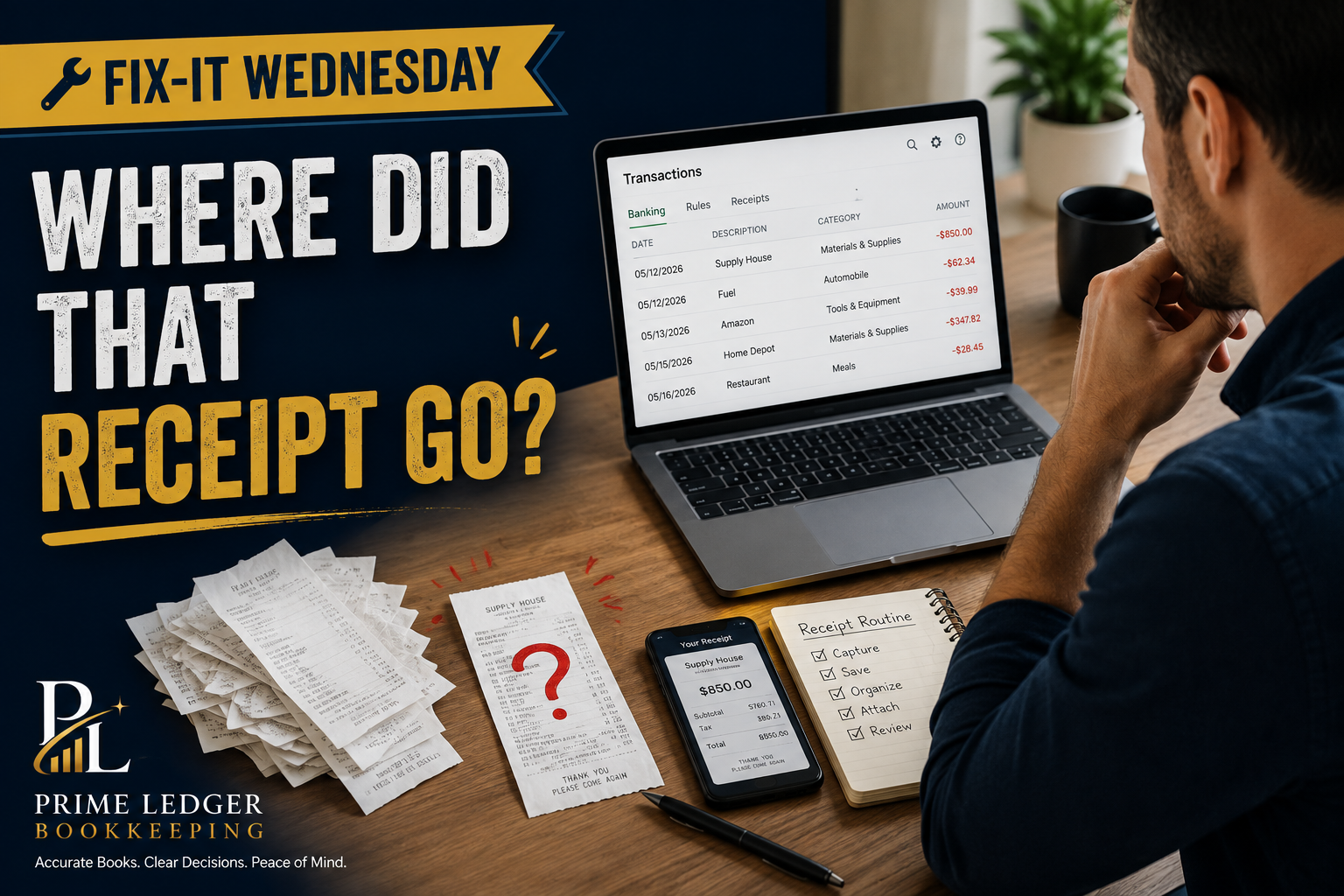
    $850.00 in materials

    The business bank account shows:

    SUPPLY HOUSE — $850.00

    Six months later, the owner is reviewing the books.

    Without the receipt, the owner may know:

    Where the money went: Supply House

    How much was spent: $850

    But they may not know:

    • Exactly what was purchased
    • Which job it was for
    • Whether the purchase was materials or equipment
    • Whether sales tax was included
    • Whether the entire purchase was business-related

    Now imagine doing this for 50 or 100 transactions.

    That’s where missing receipts become a real bookkeeping problem.

    A simple receipt saved when the purchase happened could have answered these questions immediately.


    What Does the IRS Say About Business Records?

    The IRS recommends that businesses keep records that support the information reported on their tax returns, including income, deductions, and credits.

    The IRS also explains that good records can help you monitor your business and prepare financial statements.

    You can review the official IRS recordkeeping guidance for more information about the types of records businesses should maintain.

    The key takeaway isn’t that you need to keep every scrap of paper forever.

    It’s that you should have adequate records to support your business transactions and tax reporting.

    And the appropriate documentation can vary depending on the type of expense.


    How Long Should You Keep Business Receipts?

    There’s no single “keep every receipt for exactly X years” rule that applies to every situation.

    The appropriate retention period can depend on the type of record, the tax issue involved, and other circumstances.

    That’s why it’s better to establish a consistent recordkeeping policy rather than relying on a one-size-fits-all rule.

    When in doubt about a specific tax-record retention requirement, consult your tax professional or review the applicable IRS recordkeeping guidance.


    How to Stop Losing Your Receipts

    The good news?

    You don’t need a complicated system.

    You need a consistent one.

    1. Capture Receipts Immediately

    Don’t put a receipt in your truck, glove compartment, or desk and promise yourself you’ll deal with it later.

    Take a photo as soon as possible.

    2. Use Digital Receipts

    Many vendors now provide receipts by email or through online accounts.

    Save them in a consistent location.

    3. Attach Receipts to Transactions

    If your bookkeeping system allows it, attach the supporting document directly to the transaction.

    That makes it much easier to find later.

    4. Create a Weekly Receipt Routine

    Spend a few minutes each week checking:

    Did every recent business purchase get documented?

    It’s much easier to fix one missing receipt this week than fifty missing receipts six months from now.

    5. Create a Simple Naming System

    If you’re storing receipts digitally, use consistent names.

    For example:

    2026-08-29_SupplyHouse_$850

    Now you can quickly search for the document when you need it.


    Paper vs. Digital Receipts

    You don’t necessarily need a filing cabinet overflowing with paper.

    Digital recordkeeping can make receipts easier to organize, search, and retrieve.

    The important thing is not whether the receipt is printed or digital.

    The important thing is that your records are:

    • Organized
    • Accessible
    • Legible
    • Complete
    • Retained appropriately

    Your recordkeeping system should make it easier to find information, not create another administrative burden.


    Why Receipts Matter to Your Monthly Bookkeeping

    Here’s where receipts connect directly to your bookkeeping.

    A monthly bookkeeping process isn’t simply about entering numbers into accounting software.

    Your bookkeeper also needs enough information to understand what those transactions represent.

    When receipts and supporting documentation are available:

    • Transactions can be categorized more accurately
    • Reconciliations can be completed more efficiently
    • Unusual purchases can be investigated
    • Business expenses are easier to document
    • Financial reports can be more reliable

    This is particularly important when you’re trying to understand the financial performance of your business each month.

    Accurate bookkeeping starts with accurate information.


    What to Do If You’re Already Missing Receipts

    Don’t panic.

    If you have a backlog of transactions without supporting documentation, start by identifying which ones need attention.

    Step 1: Review your bank and credit-card transactions

    Identify purchases without supporting documentation.

    Step 2: Contact vendors

    Many businesses can provide duplicate receipts or invoices.

    Step 3: Search your email

    Look for digital receipts, invoices, order confirmations, or vendor communications.

    Step 4: Document what you can

    For transactions where the original receipt can’t be recovered, discuss appropriate documentation with your bookkeeper or tax professional.

    Step 5: Establish a better process going forward

    The goal isn’t simply to clean up the past.

    It’s to prevent the same problem from happening again.

    If the books have accumulated a significant backlog of undocumented or unclear transactions, a bookkeeping cleanup may be a good place to start.


    Key Takeaways

    Missing receipts can cost your business more than the price printed on the receipt.

    They can:

    ✅ Make expenses harder to substantiate

    ✅ Make transaction categorization more difficult

    ✅ Slow down bank and credit-card reconciliation

    ✅ Reduce visibility into business spending

    ✅ Create more work when records need to be reconstructed later

    The solution doesn’t need to be complicated.

    Capture receipts when purchases happen. Organize them consistently. Attach them to your bookkeeping records when possible.

    Most importantly, don’t wait until tax time to discover that half your receipts are missing.

    A little organization throughout the year can save you significant time later.


    Frequently Asked Questions

    Why are receipts important for a small business?

    Receipts provide supporting details about business purchases, including what was purchased, when it was purchased, and how much it cost. They can help businesses maintain accurate records and substantiate expenses when appropriate.

    Do I need a receipt for every business expense?

    Not necessarily. The documentation required can depend on the type and amount of the expense and the applicable rules. However, maintaining receipts and other supporting records can make it easier to document and manage business expenses.

    Can I deduct a business expense if I lost the receipt?

    A lost receipt does not automatically mean an expense is nondeductible. However, you should maintain adequate records to substantiate the expense. If you’re unsure whether your documentation is sufficient, consult your tax professional.

    How should I organize business receipts?

    You can organize receipts digitally or physically. A consistent system that makes records easy to locate is most important. Many businesses photograph receipts and attach them directly to bookkeeping transactions.

    Should I keep paper or digital receipts?

    Either may work depending on your recordkeeping system and the applicable requirements. Digital receipts can make documents easier to search and retrieve, but they should be stored securely and remain accessible and legible.

    How long should a business keep receipts?

    Record-retention requirements vary depending on the type of record and circumstances. Rather than relying on one universal timeframe, review the applicable IRS guidance or consult your tax professional.

    Can QuickBooks store receipts?

    Many bookkeeping and accounting platforms provide tools for attaching or storing receipt images with transactions. The exact features depend on the software and subscription you’re using.

    What should I do if I have a lot of missing receipts?

    Start by reviewing your bank and credit-card transactions, contacting vendors for duplicate documentation, and searching your email for digital receipts. For transactions that cannot be fully reconstructed, consult your bookkeeper or tax professional about appropriate documentation.


    Conclusion

    A missing receipt may seem like a small problem.

    But when missing receipts become a pattern, they can create bigger bookkeeping problems—more time spent investigating transactions, less visibility into spending, and greater difficulty maintaining complete supporting records.

    The good news is that you don’t need a complicated system.

    Capture the receipt. Save it. Organize it. Connect it to the transaction.

    And do it consistently.

    Your future self—and your bookkeeper—will thank you.

    If your business already has a backlog of missing receipts, unexplained transactions, or disorganized records, you don’t have to sort through everything alone.

    Prime Ledger Bookkeeping helps HVAC and service-based businesses keep their books organized and their monthly bookkeeping process on track.

    Accurate Books. Clear Decisions. Peace of Mind.


    Related Articles

    Why Accurate Books Matter

    Learn why accurate and current financial records are essential for making better business decisions.

    Still Using Spreadsheets? Here’s the Risk.

    See how manual bookkeeping can become harder to manage as your business grows.

    The Monthly Financial Reports Every Owner Needs

    Learn which monthly reports can help you understand your business’s profitability, cash flow, receivables, and obligations.

    Cash vs. Accrual Accounting: What’s the Difference?

    Understand how cash and accrual accounting differ and why the timing of income and expenses matters.


  • Cash vs. Accrual Accounting: What’s the Difference?

    Cash vs. Accrual Accounting: What’s the Difference?

    When Should Your Business Count the Money?

    Imagine this:

    You complete a $5,000 HVAC installation in December.

    You send the customer an invoice, but they don’t pay you until January.

    So which month should that $5,000 belong to?

    December, when you earned it?

    Or January, when you received the cash?

    The answer depends, in part, on the accounting method your business uses.

    This is where cash vs accrual accounting becomes important.

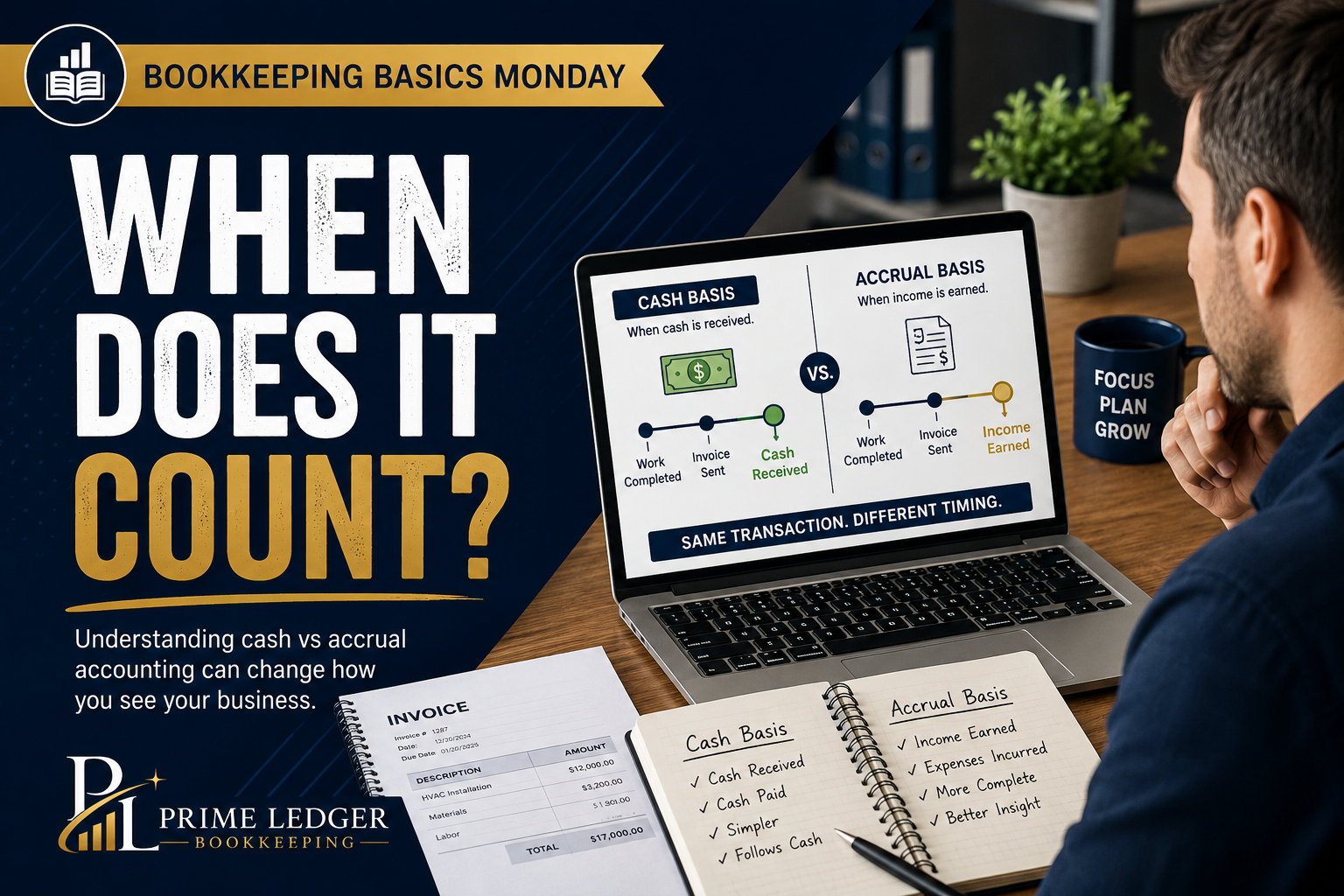
    The two methods approach the timing of income and expenses differently. Under the cash method, income is generally reported when received and expenses when paid. Under the accrual method, income is generally reported when earned and expenses when incurred.

    For a business owner, this isn’t just an accounting technicality.

    The method you use can affect how you understand your revenue, expenses, profitability, accounts receivable, and accounts payable.

    In this guide, we’ll break down cash vs accrual accounting in plain English so you can understand how each method works, why the difference matters, and what to consider for your business.

    Important: This article is for general educational purposes and isn’t tax advice. Accounting-method rules can depend on your business structure and circumstances. Consult your tax professional for advice specific to your situation.


    Table of Contents

    1. What Is Cash-Basis Accounting?
    2. What Is Accrual-Basis Accounting?
    3. Cash vs. Accrual Accounting: What’s the Difference?
    4. A Simple HVAC Example
    5. Why the Accounting Method Matters
    6. Is Cash or Accrual Accounting Better for a Small Business?
    7. What About Accounts Receivable and Accounts Payable?
    8. Can You Change Your Accounting Method?
    9. What Accounting Method Should Your Business Use?
    10. How Your Bookkeeping Supports Your Accounting Method
    11. Key Takeaways
    12. Frequently Asked Questions
    13. Conclusion

    What Is Cash-Basis Accounting?

    Cash-basis accounting is generally the simpler of the two methods.

    Under the cash method, income is generally reported when you actually or constructively receive it, while business expenses are generally deducted when you pay them, subject to applicable rules.

    In simple terms:

    Cash basis generally follows the movement of money.

    Here’s an example.

    You complete a $5,000 HVAC repair in December.

    You invoice the customer on December 20.

    The customer pays you on January 10.

    Under the cash method, the $5,000 would generally be recognized as income when you receive the payment in January.

    The work happened in December.

    The cash arrived in January.

    Cash accounting generally follows the cash.

    Why some businesses like cash accounting

    Cash-basis accounting can be easier to understand and maintain, which is one reason many individuals and small businesses use it.

    It can provide a straightforward view of:

    • Money received
    • Money paid
    • Cash activity during the period

    But there’s an important limitation.

    Cash in the bank doesn’t necessarily tell you everything about your business’s financial performance.


    What Is Accrual-Basis Accounting?

    Accrual accounting approaches the timing differently.

    Under the accrual method, income is generally reported when it is earned, regardless of when payment is received, while expenses are generally recognized when incurred, subject to applicable rules.

    In simple terms:

    Accrual basis generally follows when economic activity happens, not simply when cash changes hands.

    Let’s return to our HVAC example.

    You complete the $5,000 installation in December and invoice the customer.

    The customer pays you in January.

    Under accrual accounting, the revenue would generally be recognized in December because that’s when the income was earned.

    The cash arrives later.

    Why does that matter?

    Because the December financial statements can show the revenue associated with the work completed in December.

    This can give the owner a different view of business activity than cash-basis reporting.


    Cash vs. Accrual Accounting: What’s the Difference?

    Here’s the simplest way to think about it:

    Cash BasisAccrual Basis
    RevenueGenerally recognized when cash is receivedGenerally recognized when earned
    ExpensesGenerally recognized when paidGenerally recognized when incurred
    Accounts ReceivableLess central to revenue recognitionImportant
    Accounts PayableLess central to expense timingImportant
    ComplexityGenerally simplerGenerally more involved
    TimingFollows cash movementFollows economic activity

    The IRS describes cash and accrual as the two most commonly used accounting methods and notes that businesses generally must use a consistent method that clearly reflects income.

    Think of it this way:

    Cash basis asks:

    “Did we get paid?”

    Accrual basis asks:

    “Did we earn it?”

    Neither question is inherently wrong.

    They’re simply looking at the financial activity from different perspectives.


    A Simple HVAC Example

    Let’s make this even more practical.

    Imagine an HVAC company completes a $12,000 system installation in December.

    The customer is invoiced in December but doesn’t pay until January.

    At the same time, the HVAC company receives a $4,000 supplier bill in December but doesn’t pay the vendor until January.

    Under cash basis

    The timing generally follows when the money actually changes hands.

    The customer payment is generally recognized in January, when received.

    The supplier expense is generally recognized when paid, subject to applicable tax rules.

    Under accrual basis

    The revenue is generally recognized when earned, and the expense is generally recognized when incurred, subject to the applicable rules.

    So the December financial statements can reflect both the revenue from the completed installation and the related expense.

    This is one reason accrual accounting can provide a more complete picture of activity during a particular period.


    Why the Accounting Method Matters

    You might be wondering:

    “Why should I care when the transaction is recorded if I know how much money I have?”

    Because cash and profitability are not the same thing.

    Imagine your business has:

    • $100,000 in completed work
    • $80,000 in expenses
    • $50,000 still waiting to be collected from customers

    Your bank balance won’t necessarily tell you the full story.

    You could have a profitable business while experiencing tight cash flow.

    You could also have plenty of cash in the bank because of a loan or other financing without that meaning the business is profitable.

    Understanding your accounting method helps you interpret your financial reports correctly.


    Is Cash or Accrual Accounting Better for a Small Business?

    There’s no universal answer.

    The better question is:

    Which accounting method is appropriate for your business and circumstances?

    Cash basis may be attractive when:

    • The business has relatively simple transactions
    • The owner wants a simpler bookkeeping process
    • There isn’t significant complexity around receivables and payables
    • The business meets the applicable requirements for using the method

    Accrual basis may be useful when:

    • The business has significant accounts receivable
    • The business has substantial accounts payable
    • The timing of revenue and expenses matters for understanding performance
    • The business has become more financially complex
    • The owner wants financial statements that reflect activity when it occurs

    However, don’t choose an accounting method simply because one sounds easier.

    Tax rules can affect which method a business may use.

    The IRS states that businesses generally use a consistent accounting method that clearly reflects income, and certain businesses or transactions may be subject to additional rules.


    What About Accounts Receivable and Accounts Payable?

    This is where the difference can become especially noticeable.

    Accounts Receivable

    Accounts receivable represents money customers owe your business.

    Under accrual accounting, revenue can be recognized before the customer actually pays, which means accounts receivable can play an important role in understanding the business’s financial position.

    For example:

    You complete a $10,000 job in March.

    The customer pays in April.

    Under accrual accounting, the revenue is generally recognized when earned, while the unpaid amount remains an account receivable until collected.

    That gives the owner visibility into both:

    Revenue earned

    and

    Money still owed.

    Accounts Payable

    Accounts payable represents amounts your business owes to vendors and other parties.

    Suppose you receive $3,000 worth of materials in March but don’t pay the vendor until April.

    Under accrual accounting, the expense or liability is generally recognized based on when the applicable requirements for recognition are met, rather than simply waiting for the cash payment.

    This helps the financial statements reflect obligations associated with the period in which they arise.


    Can You Change Your Accounting Method?

    This is where business owners need to be careful.

    Changing from cash to accrual—or from accrual to cash—isn’t necessarily something you should simply switch inside your bookkeeping software and move on.

    The IRS says that once an accounting method is established, a business generally must obtain IRS approval to change methods, although certain automatic change procedures may apply.

    A change can affect:

    • Tax reporting
    • Timing of income
    • Timing of deductions
    • Financial statements
    • Accounts receivable
    • Accounts payable
    • Opening balances

    That’s why you should discuss a potential accounting-method change with your CPA or tax professional before making the switch.

    Authoritative resource

    The IRS provides detailed information about accounting periods and methods in Publication 538, Accounting Periods and Methods.

    This is the authoritative resource we’d recommend reviewing for the tax rules surrounding accounting methods.


    What Accounting Method Should Your Business Use?

    If you’re not sure which method your business uses, start by asking your bookkeeper or tax professional.

    You can also look at how your financial records behave.

    For example:

    Ask yourself:

    Do invoices affect my income before customers pay?

    Do unpaid vendor bills appear in my expenses or liabilities?

    Do my reports show revenue when I earn it or when I collect it?

    If you’re still unsure, don’t guess.

    Your bookkeeping and tax reporting should be consistent with the accounting method your business is using and the applicable rules.

    And remember:

    Your bookkeeping software doesn’t automatically determine the correct accounting method for your business.

    The setup and reporting basis need to be appropriate for your circumstances.


    How Your Bookkeeping Supports Your Accounting Method

    Your accounting method is only useful if your bookkeeping records are maintained consistently.

    That means your books need to correctly handle things such as:

    • Customer invoices
    • Customer payments
    • Vendor bills
    • Vendor payments
    • Bank transactions
    • Credit card transactions
    • Reconciliations
    • Adjustments
    • Financial reporting

    If these records aren’t maintained properly, your financial reports may not give you a reliable picture of the business.

    That’s why accurate bookkeeping matters regardless of whether your business uses cash or accrual accounting.

    For a deeper look at why reliable records matter, see our article:

    Why Accurate Books Matter


    Key Takeaways

    Cash vs accrual accounting is primarily about timing.

    Cash basis

    Generally recognizes income when received and expenses when paid.

    Accrual basis

    Generally recognizes income when earned and expenses when incurred, subject to applicable rules.

    Neither method should be viewed as automatically “better” for every business.

    The right method depends on your business, its circumstances, applicable tax rules, and the financial information you need to manage it.

    Most importantly:

    ✅ Know which accounting method your business is using.

    ✅ Understand how that method affects your financial reports.

    ✅ Keep your bookkeeping consistent.

    ✅ Don’t change accounting methods without understanding the tax and reporting implications.

    ✅ Ask your CPA or tax professional before making a tax accounting-method change.

    Understanding your accounting method is one more step toward understanding your numbers.


    Frequently Asked Questions

    What is the difference between cash and accrual accounting?

    Cash accounting generally recognizes income when cash is received and expenses when they are paid. Accrual accounting generally recognizes income when earned and expenses when incurred, subject to applicable rules.

    Is cash or accrual accounting better?

    Neither method is universally better. The appropriate method depends on the business, its circumstances, applicable rules, and the type of financial information needed.

    Do small businesses use cash accounting?

    Many small businesses use the cash method, but eligibility and requirements vary. The IRS provides specific rules governing accounting methods and certain exceptions.

    Why does accrual accounting show income before I receive the money?

    Under accrual accounting, income is generally recognized when it is earned rather than waiting for payment. The unpaid amount can then appear as accounts receivable until the customer pays.

    Can I switch from cash to accrual accounting?

    A change in accounting method can have tax and reporting implications. The IRS generally requires approval for a change, although certain automatic procedures may apply. Consult your tax professional before changing methods.

    Does QuickBooks determine whether I use cash or accrual accounting?

    Not necessarily. Accounting software can generate reports on different bases, but your business’s accounting method and tax treatment depend on how the books are established and the applicable rules. Your tax professional can confirm the appropriate method.

    Does cash accounting mean I don’t need to track unpaid invoices?

    Not necessarily. Even businesses using cash-basis reporting may benefit from tracking outstanding customer invoices for operational and collection purposes. Your bookkeeping system should provide the information you need to manage the business.

    Why does accounting method matter for financial reports?

    The accounting method affects when revenue and expenses appear in financial statements. That timing can change how you interpret profitability and financial performance for a particular period.


    Conclusion

    Cash vs accrual accounting can sound complicated at first.

    But the basic difference is relatively simple:

    Cash basis generally follows when money changes hands.

    Accrual basis generally follows when income is earned and expenses are incurred.

    The important part isn’t memorizing accounting terminology.

    It’s understanding how your accounting method affects the numbers you’re looking at.

    If your business completed a large job but hasn’t been paid yet, or if you have significant vendor bills waiting to be paid, the accounting method can make a meaningful difference in how that activity appears in your financial reports.

    And if you’re considering changing your accounting method, don’t make the decision based solely on which method seems easier. Tax and accounting rules can apply, and the IRS generally requires approval for many accounting-method changes.

    When in doubt, talk with your CPA or tax professional about the method that’s appropriate for your business.

    And whatever method you use, one thing remains true:

    Your books need to be accurate, consistent, and useful.

    At Prime Ledger Bookkeeping, we help HVAC and service-based businesses keep their bookkeeping organized and their financial information reliable.

    Accurate Books. Clear Decisions. Peace of Mind.


    Related Articles

    Why Accurate Books Matter

    Learn why accurate and current financial records are essential for making better business decisions.

    The Monthly Financial Reports Every Owner Needs

    Understand the financial reports that can help you monitor profitability, cash flow, receivables, and obligations each month.

    Still Using Spreadsheets? Here’s the Risk.

    Learn the warning signs that your spreadsheet-based bookkeeping system may no longer be keeping up with your business.

    What Does a Bookkeeper Do? A Complete Guide for Small Business Owners

    Learn how a bookkeeper helps maintain organized financial records and support your business.


  • The Monthly Financial Reports Every Owner Needs

    The Monthly Financial Reports Every Owner Needs

    Your Business Numbers Should Tell You More Than What You Earned

    As a business owner, you probably look at your bank account regularly.

    You may also keep an eye on sales, invoices, and expenses.

    But here’s a question worth asking:

    Do you really know how your business is performing financially?

    A healthy bank balance doesn’t necessarily mean your business is profitable.

    Strong sales don’t necessarily mean you’re keeping enough money.

    And having money in the bank today doesn’t necessarily mean you’ll have enough to cover next month’s payroll, vendor bills, or other obligations.

    That’s where monthly financial reports become valuable.

    These reports turn the transactions recorded in your books into information you can actually use.

    They can help you understand:

    • Whether your business is profitable
    • What your business owns and owes
    • Where your cash is coming from and going
    • Which customers still owe you money
    • Which bills and obligations are coming due

    You don’t need to be an accountant to use financial reports.

    You just need to understand what each report is telling you and why it matters.

    In this guide, we’ll look at five important reports every small-business owner should understand and explain how they can help you make better decisions.


    Table of Contents

    1. Why Monthly Financial Reports Matter
    2. 5 Monthly Financial Reports Every Owner Should Know
    3. How to Read These Reports Together
    4. How Often Should You Review Your Financial Reports?
    5. The Reports You Need Depend on Your Business
    6. What If Your Financial Reports Don’t Look Right?
    7. How Monthly Bookkeeping Makes Reporting Easier
    8. Why Financial Reports Matter for HVAC and Service Businesses
    9. How a Bookkeeper Can Help
    10. Key Takeaways
    11. Frequently Asked Questions
    12. Conclusion

    Why Monthly Financial Reports Matter

    Financial reports aren’t just documents you look at during tax season.

    They’re management tools.

    When you review your financial information regularly, you can start seeing patterns instead of simply reacting to what’s happening.

    The IRS notes that good business records can help owners monitor the progress of their business and prepare accurate financial statements, including income statements and balance sheets.

    You can learn more from the IRS guidance on keeping business records.

    For example, you may discover that:

    • Revenue is increasing but profit margins are declining
    • One expense category is growing faster than expected
    • Customers are taking longer to pay
    • Vendor obligations are increasing
    • Cash is tightening even though the business is profitable

    These are things you want to know while you still have time to respond.

    Waiting until the end of the year to review your numbers can mean missing opportunities to correct problems or take advantage of positive trends.

    Monthly reporting gives you a more timely view of what’s happening in your business—and gives you information you can actually use to make decisions.


    5 Monthly Financial Reports Every Owner Should Know

    1. Profit & Loss Statement

    What does it tell you?

    Are we making money?

    The Profit & Loss statement, often called the P&L, summarizes your business’s revenue and expenses over a specific period.

    It generally shows:

    • Revenue
    • Cost of goods or services
    • Gross profit
    • Operating expenses
    • Net profit or loss

    For example, an HVAC business may generate strong sales during a busy month.

    But after accounting for technician wages, materials, vehicle costs, insurance, advertising, and other expenses, the actual profit may be much lower than expected.

    The P&L helps you see that difference.

    What should you look for?

    Don’t just look at the bottom-line profit.

    Compare your results with previous months and ask:

    • Is revenue increasing?
    • Are expenses increasing faster than revenue?
    • Are margins changing?
    • Which expenses are unusually high?
    • Is the business becoming more or less profitable?

    The goal isn’t simply to know whether you made money.

    It’s to understand why.

    2. Balance Sheet

    What does it tell you?

    What does the business own, owe, and have invested in it?

    While the P&L focuses on income and expenses over a period, the Balance Sheet gives you a snapshot of your financial position at a specific point in time.

    It generally includes:

    Assets

    What the business owns or controls.

    Examples include:

    • Cash
    • Accounts receivable
    • Equipment
    • Vehicles
    • Other business assets

    Liabilities

    What the business owes.

    Examples include:

    • Vendor bills
    • Loans
    • Credit cards
    • Other obligations

    Equity

    The owner’s financial interest in the business after liabilities are considered.

    What should you look for?

    Pay attention to significant changes.

    For example:

    • Is cash increasing or declining?
    • Are customer receivables growing?
    • Are liabilities increasing?
    • Are loans being paid down?
    • Are there unusual or unexplained balances?

    The Balance Sheet can reveal things that aren’t obvious from the P&L alone.

    3. Cash Flow Statement

    What does it tell you?

    Where is the cash coming from, and where is it going?

    This is particularly important because profit and cash are not the same thing.

    You can have a profitable month and still experience cash-flow pressure.

    For example, imagine your HVAC business completes $50,000 of work in June.

    You record the revenue.

    But if several customers don’t pay until July or August, you may not actually have that $50,000 available in June.

    Meanwhile, payroll, materials, fuel, rent, and vendor bills still need to be paid.

    A cash flow report helps you understand how cash is moving through the business.

    What should you look for?

    Ask:

    • Is the business generating enough operating cash?
    • Are large amounts of cash tied up in receivables?
    • Are loan payments affecting cash?
    • Are there significant equipment purchases?
    • Is cash consistently declining?

    Understanding cash flow can help you avoid being caught off guard by a shortage of available cash.

    4. Accounts Receivable Aging Report

    What does it tell you?

    Who owes you money—and how long have they owed it?

    If you invoice customers, this report can be extremely useful.

    An A/R aging report typically organizes outstanding invoices based on how long they’ve been unpaid.

    For example:

    • Current
    • 1–30 days
    • 31–60 days
    • 61–90 days
    • 90+ days

    Imagine you have $80,000 in outstanding customer invoices.

    That number alone doesn’t tell you everything.

    If $70,000 is current and only $10,000 is significantly overdue, the situation is very different from having $50,000 sitting unpaid for more than 90 days.

    What should you look for?

    Pay particular attention to older balances.

    Ask:

    • Which customers are overdue?
    • How long have they been outstanding?
    • Are there customers who consistently pay late?
    • Are there invoices that need follow-up?
    • Are there balances that may need investigation?

    Getting paid for the work you’ve already completed is an important part of managing cash flow.

    5. Accounts Payable Aging Report

    What does it tell you?

    What does your business owe—and when is it due?

    An A/P aging report helps you understand outstanding vendor obligations.

    It can show:

    • Current bills
    • Upcoming payments
    • Past-due bills
    • Vendor balances
    • Aging of outstanding obligations

    For a service business, this might include suppliers for materials, equipment vendors, software providers, and other business expenses.

    What should you look for?

    Ask:

    • What bills are due soon?
    • Are any bills overdue?
    • Are vendor balances unusually high?
    • Are there duplicate or old bills?
    • Do you have enough cash to cover upcoming obligations?

    Knowing what you owe can help you plan rather than react.


    How to Read These Reports Together

    One of the biggest mistakes business owners make is looking at each report in isolation.

    The real value comes from connecting the information.

    Imagine your P&L shows a healthy profit.

    That sounds good.

    But then you look at your Balance Sheet and see that accounts receivable has increased significantly.

    Your A/R aging report shows that several large invoices are more than 60 days old.

    Your cash flow report shows that available cash is tightening.

    Now you have a much clearer picture.

    The business may be profitable—but cash is being tied up in unpaid customer invoices.

    That’s the kind of insight that individual reports may not provide on their own.

    Think of the reports as pieces of the same financial picture:

    P&L → Profitability

    Balance Sheet → Financial position

    Cash Flow → Movement of cash

    A/R Aging → Money customers owe you

    A/P Aging → Money you owe others

    Together, they can give you a much more complete view of your business.


    How Often Should You Review Your Financial Reports?

    For many small businesses, monthly is a practical starting point.

    Monthly reporting gives you enough information to identify trends without overwhelming you with daily fluctuations.

    However, some businesses may benefit from reviewing certain information more frequently.

    For example:

    • Cash position may need weekly monitoring
    • A/R may need frequent follow-up
    • High-volume businesses may review sales more often
    • Large businesses may use daily or weekly dashboards

    The important thing is consistency.

    A report isn’t very useful if you generate it once and never look at it again.


    The Reports You Need Depend on Your Business

    The five reports discussed here provide a strong foundation for many small businesses.

    But your business may need additional information.

    Depending on your operations, you might also benefit from:

    • Sales by customer
    • Sales by service
    • Job profitability
    • Budget vs. actual
    • Expense analysis
    • Inventory reports
    • Technician or department performance
    • Customer concentration reports

    For example, an HVAC business may want to understand whether certain service types or jobs are producing stronger margins.

    The goal isn’t to create dozens of reports.

    The goal is to have the right information for the decisions you need to make.


    What If Your Financial Reports Don’t Look Right?

    Sometimes the problem isn’t the report.

    It’s the bookkeeping behind it.

    If your financial reports contain unusual numbers, unexplained balances, or results that don’t match what you know about the business, don’t simply ignore them.

    Start by asking:

    • Are all transactions recorded?
    • Are bank accounts reconciled?
    • Are credit cards reconciled?
    • Are transactions categorized correctly?
    • Is A/R current?
    • Is A/P current?
    • Are there duplicate transactions?
    • Are there old or unexplained balances?

    Reliable reports depend on reliable underlying records.

    That’s one reason we emphasize the importance of accurate books.


    How Monthly Bookkeeping Makes Reporting Easier

    Financial reports don’t appear out of nowhere.

    They depend on the bookkeeping process behind them.

    A consistent monthly bookkeeping process can include:

    • Recording transactions
    • Categorizing income and expenses
    • Reconciling bank accounts
    • Reconciling credit cards
    • Reviewing accounts receivable
    • Reviewing accounts payable
    • Investigating unusual transactions
    • Reviewing financial reports

    When these tasks are completed consistently, your monthly financial reports become much more useful.

    Instead of spending hours trying to reconstruct what happened, you can focus on understanding the numbers and deciding what to do next.


    Why Financial Reports Matter for HVAC and Service Businesses

    For HVAC and service-based businesses, financial reports can provide insight into areas that directly affect profitability and cash flow.

    Profit & Loss

    Are labor and material costs growing faster than revenue?

    Balance Sheet

    How much cash, equipment, and receivables does the business have?

    Cash Flow

    Can you cover payroll, vendors, vehicle expenses, and other upcoming obligations?

    A/R Aging

    Are customers paying promptly after services are completed?

    A/P Aging

    Are vendor obligations increasing?

    These reports can help answer practical questions such as:

    Can we afford another technician?

    Can we purchase another service vehicle?

    Are our margins improving?

    Do we have enough cash for a slower season?

    Are customers taking too long to pay?

    Those aren’t just accounting questions.

    They’re business decisions.


    How a Bookkeeper Can Help

    You don’t need to become an accountant to understand your business finances.

    A professional bookkeeper can help maintain the records that produce your monthly financial reports and help ensure those reports are based on organized, current information.

    For HVAC and service-based businesses, monthly bookkeeping support may include:

    • Transaction categorization
    • Bank reconciliation
    • Credit card reconciliation
    • Accounts receivable
    • Accounts payable
    • Monthly financial reporting

    The goal isn’t to overwhelm you with accounting terminology.

    It’s to give you clear financial information you can actually use.

    At Prime Ledger Bookkeeping, we help HVAC and service-based businesses maintain organized books and monthly financial reports so owners can spend less time worrying about their numbers and more time running their businesses.


    Key Takeaways

    Monthly financial reports aren’t just for tax preparation. They’re tools for running your business.

    The five reports every owner should understand are:

    Profit & Loss — shows profitability

    Balance Sheet — shows financial position

    Cash Flow Statement — shows how cash moves

    A/R Aging — shows who owes you and how overdue those balances are

    A/P Aging — shows what you owe and what’s coming due

    But don’t stop at simply generating the reports.

    Review them. Compare them. Ask questions. Look for changes.

    The real value comes from using the information to make better decisions.


    Frequently Asked Questions

    What financial reports should a small business review monthly?

    Many small businesses can benefit from reviewing the Profit & Loss, Balance Sheet, Cash Flow Statement, Accounts Receivable Aging, and Accounts Payable Aging reports each month. The exact reports needed depend on the business.

    What is the most important financial report for a small business?

    There isn’t one report that is most important for every business. The Profit & Loss is useful for understanding profitability, while the Balance Sheet, Cash Flow, A/R, and A/P reports provide other important parts of the financial picture.

    How often should a business review financial reports?

    Many small businesses should review their financial reports monthly. Certain information, such as cash and accounts receivable, may need to be monitored more frequently depending on the business.

    Why is a Profit & Loss statement important?

    A Profit & Loss statement shows revenue, expenses, and resulting profit or loss over a specific period. It can help business owners understand whether the business is profitable and identify changes in income and expenses.

    Why is the Balance Sheet important?

    The Balance Sheet provides a snapshot of what a business owns, what it owes, and its equity at a specific point in time. It can reveal financial changes that may not be obvious from the Profit & Loss statement.

    Do small businesses need a Cash Flow Statement?

    Not every small business needs a formal Cash Flow Statement every month, but understanding cash inflows and outflows is important for virtually every business. Cash flow information can help owners anticipate shortages and plan for upcoming obligations.

    What is an A/R aging report?

    An Accounts Receivable Aging report shows outstanding customer invoices and categorizes them based on how long they have been unpaid. It can help business owners identify overdue invoices that may require follow-up.

    What is an A/P aging report?

    An Accounts Payable Aging report shows outstanding vendor bills and organizes them according to how long they have been unpaid. It helps business owners understand upcoming and overdue obligations.

    Can a bookkeeper prepare monthly financial reports?

    Yes. A bookkeeper can maintain the underlying financial records, reconcile accounts, review A/R and A/P, and prepare or provide monthly financial reports based on the bookkeeping system.


    Conclusion

    You don’t need to be an accountant to understand your business finances.

    But you do need reliable information.

    Monthly financial reports can help you move beyond simply looking at your bank balance or total sales and start understanding what’s actually happening inside your business.

    Your Profit & Loss can show whether you’re profitable.

    Your Balance Sheet can show what you own and owe.

    Your cash flow information can show how money is moving.

    Your A/R report can show who still owes you.

    And your A/P report can show what you need to pay.

    Together, these reports give you a clearer financial picture—and that picture can help you make better decisions.

    If you’re not currently receiving and reviewing these reports each month, it may be time to establish a more consistent bookkeeping process.

    At Prime Ledger Bookkeeping, we help HVAC and service-based businesses maintain accurate books and receive useful monthly financial reports without having to manage the bookkeeping themselves.

    Your numbers should do more than record what happened. They should help you decide what to do next.

    Accurate Books. Clear Decisions. Peace of Mind.


    Related Articles

    Why Accurate Books Matter

    Learn why reliable and current financial records are essential for making better business decisions.

    What Does a Bookkeeper Do? A Complete Guide for Small Business Owners

    Understand what a bookkeeper does and how ongoing bookkeeping supports your business.

    Still Using Spreadsheets? Here’s the Risk.

    Learn the warning signs that your spreadsheet-based bookkeeping system may no longer be keeping up with your business.

    Let’s Get Your Books Back on Track

    If your financial records aren’t accurate or current, learn how bookkeeping cleanup can help.

    5 Signs It’s Time to Hire a Bookkeeper

    Not sure whether professional bookkeeping support makes sense for your business? Start here.


  • Still Using Spreadsheets? Here’s the Risk

    Still Using Spreadsheets? Here’s the Risk

    Your Spreadsheet Worked. Until Your Business Started Growing.

    When you started your business, a spreadsheet probably made perfect sense.

    You had fewer customers.

    Fewer transactions.

    Fewer expenses.

    Maybe you only needed a simple list of income and expenses to understand what was happening.

    And for a small business with simple finances, that may have worked just fine.

    But businesses change.

    You add more customers.

    You hire employees.

    You purchase equipment.

    You have more vendors.

    You send more invoices.

    You make more payments.

    Suddenly, the spreadsheet that once took 20 minutes to update is taking hours.

    And you may find yourself asking:

    “Is there a better way to manage my books?”

    The problem isn’t that spreadsheets are inherently bad.

    The problem is that spreadsheet bookkeeping can become increasingly difficult to manage as your business grows.

    Manual data entry, multiple versions of files, complicated formulas, missed transactions, and time-consuming reconciliations can create risks that aren’t always obvious until something goes wrong.

    If you’re still using a bookkeeping spreadsheet, that doesn’t necessarily mean you need to change immediately.

    But it may be time to ask whether your current system is still serving your business—or creating unnecessary risk.


    Table of Contents

    1. What Makes Spreadsheet Bookkeeping Risky?
    2. 7 Warning Signs It’s Time to Move Beyond Spreadsheets
    3. When Spreadsheets May Still Be Enough
    4. What Should You Use Instead?
    5. Why QuickBooks May Be a Better Fit for a Growing Business
    6. Why This Matters for HVAC and Service Businesses
    7. How to Transition From Spreadsheets to a Better Bookkeeping System
    8. What If Your Existing Spreadsheet Records Are Messy?
    9. How Professional Bookkeeping Can Help
    10. Key Takeaways
    11. Frequently Asked Questions
    12. Conclusion

    What Makes Spreadsheet Bookkeeping Risky?

    Let’s be clear:

    Spreadsheets aren’t automatically bad bookkeeping tools.

    Excel and other spreadsheet programs can be useful for budgeting, planning, analysis, and tracking certain types of information.

    The problem comes when a bookkeeping spreadsheet becomes the primary system for managing an increasingly complex set of financial records.

    Unlike a dedicated bookkeeping system, a spreadsheet often depends heavily on manual processes.

    Someone may need to:

    • Enter transactions
    • Update formulas
    • Check calculations
    • Reconcile balances
    • Track invoices
    • Track bills
    • Update reports
    • Save files
    • Share files
    • Make sure everyone is using the correct version

    Every additional manual step creates another opportunity for something to be missed or entered incorrectly.

    And the more your business grows, the more financial activity you have to manage.

    That’s when the risks start becoming more significant.


    7 Warning Signs It’s Time to Move Beyond Spreadsheets

    1. You’re Entering More Transactions Manually

    Manual data entry is one of the biggest challenges of spreadsheet bookkeeping.

    Every transaction has to be recorded correctly.

    That means entering the:

    • Date
    • Amount
    • Description
    • Account or category
    • Customer or vendor information, when applicable

    As transaction volume increases, so does the amount of time required.

    And manual entry creates opportunities for:

    • Typing errors
    • Incorrect amounts
    • Wrong dates
    • Duplicate transactions
    • Missed transactions
    • Incorrect classifications

    A small business with 30 transactions a month may be able to manage this comfortably.

    A growing service business with hundreds of transactions can have a very different experience.

    2. You’re Not Sure Which Bookkeeping Spreadsheet Is the “Real” One

    Have you ever seen files named:

    Bookkeeping.xlsx

    Then:

    Bookkeeping Updated.xlsx

    Then:

    Bookkeeping Final.xlsx

    Then:

    Bookkeeping Final FINAL.xlsx

    It may sound funny, but multiple versions can create a real business problem.

    If two people are working with different copies, which one contains the most current information?

    What happens if someone makes changes to one file but not the other?

    What happens if an older version gets used to prepare a financial report?

    A centralized bookkeeping system reduces the risk of having multiple competing versions of your financial records.

    3. Reconciliation Takes Too Much Time

    Bank reconciliation is an important part of maintaining reliable books.

    You need to compare the transactions in your records against the activity shown on your bank statement.

    With a spreadsheet, much of that process may be manual.

    As your transaction volume grows, finding differences can become increasingly time-consuming.

    You may spend hours trying to determine:

    • Which transaction is missing
    • Why the balances don’t match
    • Whether something was entered twice
    • Whether an amount was entered incorrectly
    • Where a discrepancy originally occurred

    And the longer you wait to reconcile, the harder some discrepancies can be to trace.

    For more on this issue, see our guide:

    Why Your Bank Balance Doesn’t Match Your Books

    4. You’re Maintaining Separate Spreadsheets for Everything

    One spreadsheet for income.

    Another for expenses.

    Another for customer invoices.

    Another for vendor bills.

    Another for payroll information.

    Another for cash flow.

    Another for your monthly financial report.

    At some point, you’re no longer maintaining one spreadsheet.

    You’re maintaining an entire spreadsheet system.

    And the more separate files you have, the harder it becomes to ensure that the information agrees across all of them.

    A centralized bookkeeping system can bring more of this information together.

    5. You Can’t Easily See Your Current Financial Position

    A business owner shouldn’t have to spend half a day updating bookkeeping spreadsheets before answering a simple question like:

    “How are we doing financially this month?”

    If your reports require extensive manual updating before they reflect current activity, your bookkeeping system may be holding you back.

    You want financial information that is:

    Accurate + Current + Accessible

    That’s one of the reasons we discussed in Why Accurate Books Matter.

    Your books are supposed to help you understand the business—not create another administrative project.

    6. Accounts Receivable and Payable Are Getting Harder to Track

    A bookkeeping spreadsheet can track customer invoices and vendor bills.

    But as the business grows, maintaining those records manually can become increasingly difficult.

    You may need to know:

    • Which customers still owe you?
    • How old are their invoices?
    • Has a payment been received?
    • Was the payment applied correctly?
    • Which vendor bills are unpaid?
    • When are those bills due?
    • Did you record the same bill twice?
    • Are there vendor credits that haven’t been applied?

    If you’re spending significant time manually maintaining A/R and A/P spreadsheets, it may be time for a more structured solution.

    7. Your Business Depends on One Person Knowing How Everything Works

    This may be the biggest risk of all.

    Imagine that one person knows:

    • Where every spreadsheet is stored
    • Which formulas are important
    • How the files are connected
    • Which tabs need updating
    • How transactions are categorized
    • How monthly reports are prepared
    • Which version is current

    Then that person takes a vacation.

    Or leaves the company.

    Or becomes unavailable.

    Suddenly, the business has a financial information problem.

    A good bookkeeping system should make the process more structured and less dependent on one person’s memory.


    When Spreadsheets May Still Be Enough

    This is important because we don’t want to make an exaggerated claim.

    Not every small business needs sophisticated bookkeeping software.

    A bookkeeping spreadsheet may still be appropriate when a business has:

    • Very few transactions
    • Simple finances
    • Few customers
    • Few vendors
    • Limited accounts
    • No complicated A/R or A/P
    • One person maintaining the records
    • A low risk of multiple people editing the information

    If your business is genuinely simple and your spreadsheet system is accurate, current, and manageable, there’s no need to change simply because someone says you should.

    The question isn’t:

    “Are spreadsheets bad?”

    The better question is:

    “Is my current bookkeeping process reliable enough for the business I’m running today?”

    That’s the question that matters.


    What Should You Use Instead?

    When a bookkeeping spreadsheet stops being practical, the solution is usually a dedicated bookkeeping or accounting system.

    A good system can provide:

    Centralized Financial Records

    Your financial information has one primary home rather than being spread across multiple files.

    Bank Connections

    Bank and credit card transactions can often be imported for review instead of manually entering every transaction.

    Reconciliation Tools

    You have structured tools for comparing your records against financial statements.

    Accounts Receivable

    Customer invoices and outstanding balances can be tracked more systematically.

    Accounts Payable

    Vendor bills and outstanding obligations can be managed in one place.

    Financial Reporting

    Reports such as the Profit & Loss and Balance Sheet can be generated without rebuilding them manually every month.

    Controlled Access

    Authorized users can access the same current information without emailing different versions of spreadsheets.

    The software doesn’t eliminate the need for good bookkeeping.

    It provides a better framework for doing it consistently.

    Whatever system you use, your records still need to clearly support your business income and expenses. The IRS explains that a business recordkeeping system should summarize business transactions and that supporting documents should be retained to support those records.

    IRS guidance on business recordkeeping


    Why QuickBooks May Be a Better Fit for a Growing Business

    For many small businesses, QuickBooks Online provides a more structured environment than manually maintained spreadsheets.

    It can help centralize:

    • Income
    • Expenses
    • Bank transactions
    • Credit card activity
    • Customer invoices
    • Vendor bills
    • Financial reports

    It also provides tools for reconciliation and financial reporting.

    But there’s an important point to remember:

    Software doesn’t automatically make your books accurate.

    A bookkeeping system is only as useful as the information being entered, the accounts being set up, and the processes used to maintain it.

    Moving from Excel to QuickBooks without cleaning up the underlying records can simply move the same problems into a new system.

    That’s why the transition should be planned carefully.


    Why This Matters for HVAC and Service Businesses

    Let’s say you own an HVAC company.

    When the business was small, you may have been able to track everything in a few spreadsheets.

    You might have had:

    • One spreadsheet for customer invoices
    • One for expenses
    • One for vendor bills
    • One for monthly revenue
    • One for cash flow

    But now you’ve added technicians.

    You’re purchasing more materials.

    You have multiple vehicles.

    You’re serving more customers.

    You have more vendor relationships.

    You’re processing more invoices and payments.

    Your bookkeeping spreadsheet hasn’t changed much—but the business has.

    Now you’re spending more time maintaining the spreadsheets and less time running the business.

    That’s often the point where a more structured bookkeeping system becomes valuable.


    How to Transition From Spreadsheets to a Better Bookkeeping System

    If you’ve decided your bookkeeping spreadsheet system has reached its limits, don’t simply start entering everything into new software without a plan.

    Step 1: Review Your Existing Records

    Determine what information you currently have and how reliable it is.

    Step 2: Identify Missing or Incorrect Information

    Look for:

    • Missing transactions
    • Duplicate transactions
    • Incorrect classifications
    • Unreconciled accounts
    • Old balances
    • Incomplete customer or vendor records

    Step 3: Clean Up the Existing Records

    Don’t transfer known problems into the new system.

    If your books need significant correction, consider completing a bookkeeping cleanup before or as part of the transition.

    Step 4: Set Up the New Bookkeeping System Properly

    Your chart of accounts, bank connections, customer records, vendor records, and opening balances should be established carefully.

    Step 5: Reconcile Your Starting Balances

    Make sure the new system starts with numbers you can reasonably trust.

    Step 6: Establish a Monthly Process

    Once you’re moved over, don’t let the new system become another place where transactions pile up.

    Set a regular process for:

    • Recording transactions
    • Reconciling accounts
    • Reviewing A/R
    • Reviewing A/P
    • Reviewing financial reports

    The goal isn’t simply to leave spreadsheets behind.

    The goal is to create a bookkeeping process that stays reliable as your business grows.


    What If Your Existing Spreadsheet Records Are Messy?

    This is where many business owners get stuck.

    You may know that the bookkeeping spreadsheet isn’t working anymore, but you’re afraid to move because you aren’t sure whether the information inside it is accurate.

    Don’t assume you need to fix everything alone before asking for help.

    Start by determining:

    What period does the spreadsheet cover?

    Which accounts are included?

    Are all transactions recorded?

    Do the balances agree with your bank statements?

    Are customer invoices current?

    Are vendor bills current?

    Are there duplicate or missing transactions?

    If the records need substantial work, a bookkeeping cleanup may be the appropriate first step.

    Our guide Let’s Get Your Books Back on Track explains how a cleanup can help organize and reconcile financial records before establishing a regular bookkeeping process.


    How Professional Bookkeeping Can Help

    Moving away from spreadsheets isn’t just a software decision.

    It’s a process decision.

    A bookkeeper can help you:

    • Review your existing records
    • Identify bookkeeping problems
    • Clean up inaccurate information
    • Set up or improve your bookkeeping system
    • Reconcile accounts
    • Maintain A/R and A/P
    • Prepare monthly financial reports
    • Keep the books current

    At Prime Ledger Bookkeeping, we help HVAC and service-based businesses establish organized, reliable bookkeeping processes in QuickBooks.

    Our goal isn’t to tell every business owner to stop using spreadsheets.

    It’s to help you determine whether your current system still makes sense for the business you’ve built.


    Key Takeaways

    If you’re still using a bookkeeping spreadsheet, that doesn’t automatically mean you have a problem.

    But pay attention when:

    ✅ Manual data entry is taking too much time

    ✅ You’re making frequent errors

    ✅ You have multiple versions of your files

    ✅ Reconciliation has become difficult

    ✅ You’re maintaining several spreadsheets for different financial tasks

    ✅ A/R and A/P are difficult to keep current

    ✅ You can’t easily see your current financial position

    ✅ Your bookkeeping depends heavily on one person

    When your business outgrows your spreadsheet system, moving to a dedicated bookkeeping platform can provide a more structured and sustainable process.

    And remember:

    The goal isn’t to stop using spreadsheets just because they’re spreadsheets. The goal is to use a bookkeeping system that can keep up with your business.


    Frequently Asked Questions

    Are spreadsheets bad for bookkeeping?

    No. Spreadsheets can be useful for very small businesses with simple financial activity. The risk increases when transaction volume, customers, vendors, employees, and financial complexity grow beyond what can be reliably managed manually.

    When should a small business stop using spreadsheets for bookkeeping?

    Consider moving to a dedicated bookkeeping system when manual entry takes too much time, errors become common, reconciliation is difficult, multiple files are being maintained, or you no longer have an easy way to see your current financial position.

    Can I use Excel for small-business bookkeeping?

    Yes. Excel can work for a small business with relatively simple financial activity. However, as transaction volume and business complexity increase, a dedicated bookkeeping system may provide better tools for reconciliation, reporting, A/R, A/P, and centralized records.

    Is QuickBooks better than Excel for bookkeeping?

    For many growing small businesses, QuickBooks Online provides more structured bookkeeping capabilities than a spreadsheet, including bank connections, reconciliation tools, A/R, A/P, and financial reporting. Whether it’s better depends on the business’s needs.

    What are the risks of spreadsheet bookkeeping?

    Common risks include manual entry errors, duplicate or missing transactions, outdated information, multiple versions of files, difficult reconciliation, limited reporting, and excessive dependence on one person to maintain the system.

    How do I move my bookkeeping from Excel to QuickBooks?

    Start by reviewing and cleaning your existing records, then establish the new QuickBooks structure, transfer reliable information, set up appropriate accounts and connections, reconcile opening balances, and establish a monthly bookkeeping process.

    Can a bookkeeper help me switch from spreadsheets to QuickBooks?

    Yes. A bookkeeper can help review existing spreadsheet records, identify issues, clean up the information, establish the bookkeeping system, and maintain the books going forward.


    Conclusion

    Spreadsheets can be a great place to start.

    They are inexpensive, flexible, and familiar.

    But as your business grows, the same flexibility that made spreadsheets useful can also become a source of risk.

    More transactions mean more manual work.

    More customers mean more invoices to track.

    More vendors mean more bills to manage.

    More employees mean more people who may need access to financial information.

    And more complexity means more opportunities for something to be missed.

    The question isn’t whether spreadsheets are good or bad.

    The question is whether your current bookkeeping process can reliably support the business you have today.

    If your spreadsheets are becoming difficult to manage, it may be time to consider a more structured bookkeeping system.

    And if you’re not sure where to start, you don’t have to figure it out alone.

    Prime Ledger Bookkeeping helps HVAC and service-based businesses organize, maintain, and improve their bookkeeping processes in QuickBooks.

    Your business is growing. Your bookkeeping system should be able to grow with it.

    Accurate Books. Clear Decisions. Peace of Mind.


    Related Articles

    Why Accurate Books Matter

    Learn why reliable and current financial records are so important for making better business decisions.

    Why Your Bank Balance Doesn’t Match Your Books

    Understand common reasons your bank balance and bookkeeping records may not agree.

    What Does a Bookkeeper Do? A Complete Guide for Small Business Owners

    Learn what a professional bookkeeper can take off your plate and how bookkeeping supports your business.

    Let’s Get Your Books Back on Track

    If your spreadsheet records are already messy or behind, learn how bookkeeping cleanup can help.

    5 Signs It’s Time to Hire a Bookkeeper

    Not sure whether it’s time to bring in professional bookkeeping support? Start with these five signs.

  • Why Accurate Books Matter

    Why Accurate Books Matter

    Your Books Are More Than a Record of What Happened

    Imagine you’re considering hiring another technician.

    You think the business can afford it.

    Revenue has been strong. Customers are coming in. Your bank account looks healthy.

    But then you look at your financial reports—and you’re not completely sure the numbers are right.

    Are your expenses fully recorded?

    Have all your customer payments been entered?

    Are your bank accounts reconciled?

    Are there old transactions sitting in the wrong accounts?

    If you’re not confident in your numbers, making an important business decision becomes a guessing game.

    That’s why accurate books matter.

    Your books aren’t simply a record of what happened in the past. They provide the financial information you use to understand your business today and make decisions about tomorrow.

    For small-business owners, especially those running HVAC and other service-based businesses, reliable financial records can help answer some important questions:

    Are we actually profitable?

    Where is our money going?

    Can we afford to hire?

    Which parts of the business are performing well?

    Do we have enough cash for our upcoming obligations?

    Let’s look at seven practical reasons accurate financial records can make such a difference.


    Table of Contents

    1. What Does It Mean to Have Accurate Books?
    2. 7 Reasons Accurate Books Matter
    3. What Happens When Your Books Aren’t Accurate?
    4. Accurate Books vs. Current Books
    5. How Do You Know If Your Books Are Accurate?
    6. How Regular Bookkeeping Helps
    7. Why Accurate Books Matter for HVAC and Service Businesses
    8. What Can You Do If Your Books Aren’t Accurate?
    9. Why Professional Bookkeeping Can Help
    10. A Simple Monthly Bookkeeping Checklist
    11. Key Takeaways
    12. Frequently Asked Questions
    13. Conclusion

    What Does It Mean to Have Accurate Books?

    Before discussing why accuracy matters, let’s clarify what we mean by accurate books.

    Accurate bookkeeping doesn’t mean your financial records will never need an adjustment.

    The IRS also emphasizes that businesses should maintain records that clearly show their income and expenses and support the transactions recorded in their books. IRS: What Kind of Records Should I Keep?

    It means your records reasonably reflect the financial activity of your business and are supported by the underlying transactions and documentation.

    Generally, this means:

    • Transactions are recorded completely
    • Transactions are categorized appropriately
    • Bank and credit card accounts are reconciled
    • Customer payments are properly recorded
    • Vendor bills and payments are properly recorded
    • Duplicate transactions are identified
    • Unusual balances are investigated
    • Financial reports reflect the underlying records
    • Books are updated consistently

    There’s another important distinction:

    Accurate Doesn’t Necessarily Mean Current

    Your books could be accurate through March—but if it’s August and nothing has been recorded since March, those books aren’t very useful for understanding what’s happening today.

    For business decision-making, you want both:

    Accurate + Current


    7 Reasons Accurate Books Matter

    1. Accurate Books Help You Understand Your True Profitability

    Revenue is only part of the story.

    A business might generate $100,000 in sales and still struggle financially because of labor, materials, vehicle expenses, insurance, rent, software, and other operating costs.

    Your Profit & Loss statement helps you see the relationship between your revenue and expenses.

    But that only works when the underlying records are reliable.

    If expenses are missing or transactions are categorized incorrectly, your reported profit may not reflect your actual results.

    For an HVAC business, this could make it harder to determine whether the business is truly profitable after considering labor, materials, fuel, equipment, and other operating costs.

    Accurate books help you see the difference between making sales and actually making money.

    2. They Help You Understand Where Your Money Is Going

    Have you ever looked at your bank account and wondered:

    “Where did all the money go?”

    Your bank statement can show you that money left the account.

    But your bookkeeping should help explain why.

    Was it:

    • Payroll?
    • Materials?
    • Fuel?
    • Equipment?
    • Advertising?
    • Insurance?
    • Vendor payments?
    • Owner draws?
    • Loan payments?

    When transactions are properly categorized, your financial reports can reveal spending patterns that aren’t obvious from a bank statement alone.

    That information can help you identify expenses that are increasing, areas where you may be overspending, and opportunities to improve profitability.

    3. Accurate Books Help You Make Better Business Decisions

    Small-business owners make decisions every day.

    Should you hire another employee?

    Should you purchase another service vehicle?

    Can you afford new equipment?

    Should you expand into another service area?

    Should you increase your marketing budget?

    These decisions have financial consequences.

    You don’t need perfect financial information to make every decision—but you need information you can reasonably trust.

    When your books are accurate and current, you have a much stronger foundation for evaluating your options.

    Instead of asking:

    “I think we can afford this.”

    You can ask:

    “Based on our current revenue, expenses, cash flow, and upcoming obligations, can we reasonably afford this?”

    That’s a much better business conversation.

    4. They Help You Manage Cash Flow

    Profit and cash are not the same thing.

    A business can show a profit and still experience cash-flow pressure.

    For example, an HVAC company may complete several large jobs and record the revenue, but if customers haven’t paid yet, that money isn’t necessarily available in the bank.

    At the same time, payroll, vendor bills, loan payments, and other obligations may still be due.

    Accurate bookkeeping helps you understand both sides:

    What’s coming in?

    What’s going out?

    What’s still owed to you?

    What do you need to pay?

    This gives you a clearer picture of your cash position and upcoming obligations.

    5. They Help You Stay on Top of Customer Payments

    For many service businesses, getting paid doesn’t always happen at the same time the work is completed.

    You may invoice a customer today and receive payment weeks later.

    That’s why accounts receivable matters.

    Accurate records can help you see:

    • Which invoices are outstanding
    • How much customers owe
    • How long invoices have been outstanding
    • Whether payments were properly applied
    • Which customers may need follow-up

    Without reliable A/R records, it’s easier for outstanding invoices to get overlooked.

    And overlooked invoices can eventually become a cash-flow problem.

    6. They Help You Know What You Owe

    The same principle applies to your vendors.

    Your accounts payable records should help you understand your outstanding obligations.

    For example:

    • Which vendor bills are unpaid?
    • When are payments due?
    • Have payments been recorded correctly?
    • Are there duplicate bills?
    • Are vendor credits properly applied?

    Reliable A/P information can help you plan upcoming payments and avoid unpleasant surprises.

    It also gives you a clearer picture of your actual business obligations.

    7. They Help You Spot Problems Earlier

    Perhaps one of the biggest benefits of accurate books is that they can help you identify problems before they become bigger problems.

    Imagine your financial reports show that:

    • Labor costs are increasing
    • Material costs are eating into margins
    • Customer payments are slowing down
    • A particular expense category has suddenly increased
    • Cash reserves are declining
    • A Balance Sheet account has an unusual balance

    If your books are current and reliable, you have a chance to investigate.

    If your books are six months behind, you may not discover the problem until much later.

    Good bookkeeping doesn’t just tell you what happened. It helps you notice what needs your attention.


    What Happens When Your Books Aren’t Accurate?

    The opposite of accurate bookkeeping can create more than an accounting headache.

    It can affect the way you run your business.

    You May Overestimate Profitability

    If expenses are missing, your reported profit could look better than reality.

    You May Underestimate Expenses

    Poor categorization can make it difficult to see where money is actually being spent.

    You May Make Decisions Using Outdated Information

    If your books aren’t current, your financial reports may not reflect the business you’re running today.

    You May Miss Outstanding Customer Payments

    If A/R isn’t maintained properly, invoices can slip through the cracks.

    You May Be Surprised by Upcoming Obligations

    If A/P isn’t accurate, you may not have a clear picture of what you owe.

    You May Spend More Time Fixing Problems Later

    Small bookkeeping issues can become harder to resolve when they’re allowed to accumulate.


    Accurate Books vs. Current Books

    This distinction deserves special attention.

    You can have accurate but outdated books.

    For example:

    Your bookkeeping is complete and accurate through March.

    Today is August.

    Nothing has been recorded since March.

    The March numbers may be accurate—but they don’t tell you what’s happening in August.

    You can also have current but inaccurate books.

    Maybe transactions are being entered every week, but they’re being categorized incorrectly or the bank accounts aren’t being reconciled.

    In that case, your books are current but still unreliable.

    The goal is both.

    Accurate books + Current books = Useful financial information

    That’s why consistent bookkeeping matters.


    How Do You Know If Your Books Are Accurate?

    You don’t have to be an accountant to perform a basic health check of your books.

    Ask yourself:

    Are your bank accounts reconciled?

    Your book balance should be compared against your bank statements regularly.

    Are your credit cards reconciled?

    Credit card activity should also be reviewed and reconciled.

    Are transactions categorized appropriately?

    Expenses should be recorded in accounts that accurately represent the nature of the spending.

    Are there unexplained balances?

    Unusual or old balances should be investigated rather than ignored.

    Is your accounts receivable current?

    You should have a reasonable understanding of what customers owe you.

    Is your accounts payable current?

    You should know what you owe vendors and when payments are due.

    Do your financial reports make sense?

    Look at your Profit & Loss and Balance Sheet.

    If something looks unusual, investigate it.

    Are your books updated consistently?

    Financial information is much more useful when it reflects recent business activity.

    If several of these questions make you uncomfortable, it may be time to take a closer look at your bookkeeping.


    How Regular Bookkeeping Helps

    Accurate books aren’t created once a year.

    They’re maintained through a consistent process.

    For many small businesses, monthly bookkeeping can include:

    • Recording and categorizing transactions
    • Reconciling bank accounts
    • Reconciling credit cards
    • Reviewing accounts receivable
    • Reviewing accounts payable
    • Updating financial reports
    • Investigating unusual transactions
    • Reviewing financial trends

    The benefit isn’t simply having someone enter transactions.

    It’s having a repeatable process that keeps your financial information reliable.

    That means fewer surprises and less time trying to reconstruct what happened months ago.


    Why Accurate Books Matter for HVAC and Service Businesses

    Every business is different, but HVAC and other service-based businesses often deal with financial activity that makes good bookkeeping particularly useful.

    For example:

    Labor

    Are labor costs increasing faster than revenue?

    Materials

    Are material costs affecting your margins?

    Service Vehicles

    Can you afford another vehicle or the replacement of an existing one?

    Customer Payments

    Are customers paying within the expected timeframe?

    Seasonal Cash Flow

    Do you have enough cash available during slower periods?

    Job Profitability

    Are certain types of jobs or services producing stronger margins?

    Growth

    Can the business realistically support another technician or additional equipment?

    You don’t want to answer these questions based on assumptions.

    You want your financial records to give you useful information.


    What Can You Do If Your Books Aren’t Accurate?

    If you discover that your books aren’t where they should be, don’t panic.

    Start by determining the scope of the problem.

    Ask:

    1. When were the books last reconciled?
    2. Which accounts need attention?
    3. Are transactions missing or duplicated?
    4. Are there unusual or unexplained balances?
    5. Is accounts receivable accurate?
    6. Is accounts payable accurate?
    7. Do the financial reports reflect what you know about the business?

    If the problems are minor, you may be able to address them as part of your regular bookkeeping.

    If the books are significantly behind or contain multiple issues, a bookkeeping cleanup may be a better starting point.

    For more on that process, see:

    Let’s Get Your Books Back on Track


    Why Professional Bookkeeping Can Help

    You don’t necessarily need to become an accounting expert to understand your business finances.

    A professional bookkeeper can help maintain the records behind your financial reports so you can spend more time using the information rather than trying to create it.

    For HVAC and service-based businesses, that can mean having someone regularly handle:

    • Transaction categorization
    • Bank reconciliations
    • Credit card reconciliations
    • Accounts receivable
    • Accounts payable
    • Monthly financial reports
    • Bookkeeping cleanup when needed

    The goal isn’t simply to keep your books busy.

    It’s to keep them useful.


    A Simple Monthly Bookkeeping Checklist

    If you manage your own bookkeeping, here’s a simple checklist to help keep your records reliable.

    Every month:

    ☐ Record all business transactions

    ☐ Review and categorize transactions

    ☐ Reconcile bank accounts

    ☐ Reconcile credit cards

    ☐ Review accounts receivable

    ☐ Review accounts payable

    ☐ Investigate unusual balances

    ☐ Review your Profit & Loss

    ☐ Review your Balance Sheet

    ☐ Compare results with previous months

    ☐ Address problems before moving into the next month

    You don’t need a complicated system.

    You need a consistent one.


    Key Takeaways

    Accurate bookkeeping isn’t just about keeping financial records organized.

    It’s about having information you can use.

    Accurate books can help you:

    ✅ Understand your true profitability

    ✅ See where your money is going

    ✅ Make better business decisions

    ✅ Manage cash flow

    ✅ Stay on top of customer payments

    ✅ Understand vendor obligations

    ✅ Spot potential problems earlier

    And remember:

    Accurate books that are six months behind still aren’t giving you the information you need today.

    The goal is to maintain financial records that are both accurate and current.


    Frequently Asked Questions

    Why are accurate books important for a small business?

    Accurate books give business owners reliable financial information about revenue, expenses, profitability, cash flow, customer balances, and vendor obligations. This information can support better business decisions.

    What happens if my books aren’t accurate?

    Inaccurate books can lead to misleading financial reports and make it harder to understand profitability, cash flow, expenses, receivables, and obligations. They can also make it more difficult to identify problems early.

    How often should bookkeeping be updated?

    The appropriate frequency depends on the business, but many small businesses benefit from maintaining their books monthly or more frequently when transaction volume requires it. The important thing is that the records remain both accurate and current.

    Can my books be accurate but outdated?

    Yes. Your books can be accurate through a particular date but still be outdated if more recent transactions haven’t been recorded. Accurate and current records are both important for useful financial reporting.

    How can I tell if my books are accurate?

    Start by checking whether your bank and credit card accounts are reconciled, transactions are properly categorized, A/R and A/P are current, unusual balances have been investigated, and your financial reports make sense based on what you know about the business.

    Can a bookkeeper help keep my books accurate?

    Yes. A bookkeeper can maintain transactions, reconcile accounts, review A/R and A/P, and prepare regular financial reports. A consistent bookkeeping process can help keep your records accurate and current.

    What if my books are already inaccurate?

    Start by identifying the scope of the problem. If there are significant errors, unreconciled accounts, missing transactions, or old balances, a bookkeeping cleanup may be appropriate before establishing a regular monthly bookkeeping process.


    Conclusion

    Accurate books give you more than organized financial records—they give you a clearer view of your business.

    When your books are accurate and current, you can better understand your profitability, manage cash flow, stay on top of customer and vendor balances, and make decisions based on reliable information rather than guesswork.

    For HVAC and service-based business owners, that clarity can make a real difference.

    Whether you’re deciding whether to hire another technician, purchase equipment, take on a new project, or simply understand where your money is going, your financial records should give you confidence in the numbers you’re using.

    And if your books aren’t where they should be, you don’t have to figure everything out at once.

    Start by identifying what’s inaccurate, what’s outdated, and what needs attention. From there, you can work toward getting your books clean, current, and reliable.

    If maintaining accurate books has become difficult to manage on your own, professional monthly bookkeeping can help you stay organized and keep your financial information current.

    Prime Ledger Bookkeeping helps HVAC and service-based businesses maintain organized, reliable financial records so they can spend less time worrying about their books and more time running their business.

    Accurate Books. Clear Decisions. Peace of Mind.


    Related Articles

    What Does a Bookkeeper Do? A Complete Guide for Small Business Owners

    Learn what a bookkeeper actually does and how consistent bookkeeping can support your business.

    Bookkeeping vs. Accounting Explained

    Understand the difference between bookkeeping and accounting and how the two functions work together.

    Why Your Bank Balance Doesn’t Match Your Books

    Learn why your bank balance and books may show different numbers and how to investigate the difference.

    Let’s Get Your Books Back on Track

    Learn how bookkeeping cleanup can help identify problems, organize your records, and get your books back on track.

    5 Signs It’s Time to Hire a Bookkeeper

    Not sure whether it’s time to get professional bookkeeping help? These five signs can help you decide.

  • Let’s Get Your Books Back on Track

    Let’s Get Your Books Back on Track

    Your Books Are Behind. That’s Okay.

    You meant to catch up last month.

    Then work got busy.

    A few more weeks passed.

    Now you’re opening QuickBooks and realizing your books are several months behind.

    Maybe your bank accounts haven’t been reconciled.

    Maybe there are transactions sitting in Uncategorized.

    Maybe you’re not sure whether your Profit & Loss is accurate.

    Maybe you’ve started avoiding your financial reports altogether.

    And now you’re thinking:

    “Where do I even start?”

    First, take a breath.

    You’re not alone.

    Small-business owners don’t usually fall behind because they don’t care about their finances. More often, bookkeeping gets pushed aside while they’re busy serving customers, managing employees, handling operations, and trying to grow the business.

    But eventually, the backlog becomes too large to ignore.

    That’s where bookkeeping cleanup can help.

    A cleanup project is designed to bring disorganized, incomplete, or inaccurate financial records back to a reliable condition. Depending on the situation, that may include correcting existing errors, reconciling accounts, and catching up transactions that were never recorded.

    The goal isn’t simply to make your QuickBooks file look neat.

    The goal is to get your books to a point where you can trust the numbers again.

    And then, just as importantly, establish a process that keeps them current going forward.


    Table of Contents

    1. Your Books Are Behind. Now What?
    2. You’re Not Alone
    3. What Is Bookkeeping Cleanup?
    4. Signs Your Business May Need Bookkeeping Cleanup
    5. What Happens During a Bookkeeping Cleanup?
    6. Cleanup vs. Catch-Up Bookkeeping
    7. What If Your Books Are Really Behind?
    8. Why Accurate Books Matter
    9. How Prime Ledger Can Help
    10. Ready to Get Your Books Back on Track?
    11. Key Takeaways
    12. Frequently Asked Questions
    13. Conclusion

    Your Books Are Behind. Now What?

    The first thing to do is stop adding to the problem.

    If your books are months behind, continuing to postpone the work won’t make the backlog easier to handle.

    But you also don’t need to panic and start randomly entering transactions.

    The first step is to understand the condition of your books.

    Ask yourself:

    • When were my books last fully reconciled?
    • Which bank accounts need attention?
    • Which credit cards need to be reconciled?
    • Are there missing transactions?
    • Are there duplicate transactions?
    • Are there large Uncategorized balances?
    • Are accounts receivable and accounts payable current?
    • Do my financial reports appear reasonable?
    • Are there previous bookkeeping errors that need correction?

    Once you know what’s wrong, you can create a plan to fix it.

    The goal isn’t “make QuickBooks look current.”

    The goal is:

    Accurate → Reconciled → Organized → Current → Maintainable

    That distinction matters.


    You’re Not Alone

    Running a small business means wearing a lot of hats.

    You may be responsible for:

    • Finding customers
    • Scheduling jobs
    • Managing employees
    • Purchasing supplies
    • Paying vendors
    • Answering customer questions
    • Handling emergencies
    • Managing cash flow
    • Growing the business

    Bookkeeping can easily become the task that gets pushed to tomorrow.

    And then tomorrow becomes next week.

    Next week becomes next month.

    Before you know it, you’re looking at months of transactions that haven’t been properly reviewed.

    This is especially common when a business grows quickly.

    More customers mean more transactions.

    More employees create more financial activity.

    More vendors mean more bills.

    More vehicles and equipment create additional expenses and accounts to track.

    The bookkeeping system that worked when the business was small may simply no longer be enough.

    Falling behind doesn’t mean your business is failing.

    It means your bookkeeping process needs attention.


    What Is Bookkeeping Cleanup?

    Bookkeeping cleanup is the process of reviewing and correcting financial records so they accurately reflect the business’s activity.

    Depending on the condition of your books, cleanup may involve:

    • Reviewing transactions
    • Categorizing transactions
    • Correcting misclassified transactions
    • Identifying duplicate entries
    • Finding missing transactions
    • Reconciling bank accounts
    • Reconciling credit cards
    • Reviewing accounts receivable
    • Reviewing accounts payable
    • Investigating unusual balances
    • Reviewing financial reports
    • Correcting other bookkeeping inconsistencies

    A cleanup project can also include catch-up work when transactions from previous periods were never entered.

    That’s an important distinction.

    Cleanup fixes what’s wrong.

    Catch-up fills in what’s missing.

    Many businesses need some combination of both.


    Signs Your Business May Need Bookkeeping Cleanup

    Not sure whether your books actually need professional attention?

    Here are some signs to look for.

    Your Books Are Months Behind

    If your last completed reconciliation was several months ago, your financial records aren’t giving you a current picture of the business.

    The longer you wait, the more transactions accumulate.

    Your Bank Accounts Aren’t Reconciled

    Bank reconciliation is one of the best ways to verify that your financial records agree with your bank statements.

    If several months remain unreconciled, it can become difficult to determine where a discrepancy began.

    And as we discussed in [Why Your Bank Balance Doesn’t Match Your Books], not every difference is an error—but unexplained differences need to be investigated.

    Your Financial Reports Don’t Look Right

    You open your Profit & Loss and think:

    “That doesn’t look right.”

    Maybe expenses are unusually high.

    Maybe revenue seems wrong.

    Maybe certain accounts have strange balances.

    Maybe your Balance Sheet contains numbers you don’t understand.

    Financial reports are only useful when the underlying records are reliable.

    You Have a Large Uncategorized Balance

    If transactions are sitting in Uncategorized Income or Uncategorized Expenses, you may not have a clear picture of where your money is actually coming from or going.

    A cleanup can help determine what those transactions actually represent and place them in the appropriate accounts.

    You Have Duplicate Transactions

    Duplicate transactions can distort your revenue, expenses, bank balances, and financial reports.

    They can happen when transactions are entered manually and also imported through a bank feed, among other situations.

    Identifying and removing duplicates is an important part of restoring reliable records.

    You Don’t Know Who Owes You Money

    Your accounts receivable should help you understand what customers owe your business.

    If old invoices, payments, credits, or unapplied amounts haven’t been reviewed, your A/R balance may not accurately reflect what is actually collectible.

    You Don’t Know What You Owe Vendors

    The same principle applies to accounts payable.

    Old bills, duplicate bills, vendor credits, or payments that haven’t been properly applied can make your A/P balance difficult to understand.

    You’ve Started Avoiding Your Financial Reports

    This one may sound simple, but it’s important.

    If opening your financial reports makes you uncomfortable because you don’t trust what you’re seeing, that’s a sign your books deserve attention.

    You shouldn’t have to avoid your numbers because you’re afraid they won’t make sense.


    What Happens During a Bookkeeping Cleanup?

    A professional cleanup shouldn’t be a random process of fixing whatever happens to appear first.

    It should follow a structured approach.

    Step 1: Assess the Current Books

    First, we determine:

    • How far behind the books are
    • Which accounts need attention
    • What information is missing
    • Whether previous reconciliations exist
    • What types of errors may be present
    • What needs to be corrected

    This establishes the scope of the project.

    Step 2: Gather the Source Documents

    Depending on the business, this may include:

    • Bank statements
    • Credit card statements
    • Loan statements
    • Invoices
    • Vendor bills
    • Receipts
    • Payment processor records
    • Payroll information
    • Other financial records

    Having complete source information is important because the goal is to reconstruct what actually happened—not simply make assumptions.

    Step 3: Review and Categorize Transactions

    Transactions are reviewed and assigned to appropriate accounts.

    This can include:

    • Revenue
    • Operating expenses
    • Cost of goods sold
    • Transfers
    • Owner transactions
    • Equipment purchases
    • Other business activity

    The exact treatment depends on the business and its accounting setup.

    Step 4: Reconcile Bank and Credit Card Accounts

    The accounts are reconciled against the appropriate statements.

    This helps identify:

    • Missing transactions
    • Duplicate transactions
    • Incorrect amounts
    • Unexplained differences
    • Other discrepancies

    Working chronologically is generally important because unresolved issues in an earlier period can affect later periods.

    Step 5: Review Accounts Receivable and Accounts Payable

    The cleanup should also look beyond the bank accounts.

    We want to understand:

    Who owes the business money?

    and:

    Who does the business owe money to?

    Old balances may need investigation before the financial reports can be considered reliable.

    Step 6: Review the Financial Reports

    Once the records have been cleaned and reconciled, the financial reports can be reviewed for reasonableness.

    The goal isn’t just to have transactions entered.

    It’s to make sure the resulting financial information makes sense.

    Step 7: Establish a Monthly Process

    This may be the most important step.

    Because there’s no point spending time getting your books caught up if they immediately fall behind again.

    The end goal should be:

    Cleanup → Current Books → Consistent Monthly Process

    That’s how a one-time cleanup becomes a long-term improvement.


    Cleanup vs. Catch-Up Bookkeeping

    These terms are often used interchangeably, but there is a useful distinction.

    Catch-Up Bookkeeping

    Catch-up bookkeeping generally means bringing missing periods up to date.

    For example:

    Your business operated throughout 2025, but transactions from April through December were never entered.

    The missing work needs to be reconstructed.

    That’s catch-up.

    Bookkeeping Cleanup

    Cleanup generally focuses on correcting existing records that are inaccurate, inconsistent, or unreliable.

    For example:

    Your transactions were entered, but:

    • Bank accounts weren’t reconciled
    • Transactions were categorized incorrectly
    • Duplicates exist
    • Old balances are unexplained

    That’s cleanup.

    Many businesses need both.

    A business can have six months of missing transactions and errors in the transactions that were already entered.

    In that situation, catch-up and cleanup work together.

    The exact scope depends on the condition of the books.


    What If Your Books Are REALLY Behind?

    Maybe you’re two months behind.

    Maybe six months.

    Maybe you’re looking at an entire year.

    Don’t assume it’s too late.

    The process is still fundamentally the same:

    Determine the starting point → gather records → work through the transactions → reconcile → review → establish an ongoing process.

    What changes is the amount of work involved.

    A business with fewer transactions and fewer accounts may have a much smaller cleanup project than a business with multiple bank accounts, credit cards, employees, payment processors, vehicles, and hundreds of monthly transactions.

    That’s why we don’t recommend promising a universal timeline before reviewing the books.

    Every cleanup project is different.


    Why Accurate Books Matter

    Getting caught up isn’t just about feeling better when you open QuickBooks.

    Accurate, current books give you information you can actually use.

    You can better understand:

    Revenue

    How much money is the business generating?

    Expenses

    Where is the money going?

    Profitability

    Is the business actually making money?

    Cash Flow

    What’s happening with the money moving through the business?

    Accounts Receivable

    Who still owes you money?

    Accounts Payable

    What obligations does the business have?

    Trends

    Are revenue, expenses, or profitability moving in the right direction?

    This is why bookkeeping isn’t simply administrative work.

    Your books are part of your business’s decision-making foundation.


    Why Prime Ledger Can Help

    At Prime Ledger Bookkeeping, we understand that business owners don’t always fall behind because they don’t care.

    Sometimes you simply have more important things demanding your attention.

    That’s why our approach to bookkeeping cleanup is practical and judgment-free.

    We help HVAC and service-based businesses organize their financial records, reconcile accounts, identify bookkeeping issues, and get their books back to a reliable starting point.

    Our services include:

    • Bookkeeping cleanup
    • Catch-up bookkeeping
    • Monthly bookkeeping
    • Bank and credit card reconciliations
    • Accounts receivable
    • Accounts payable
    • Financial reporting
    • QuickBooks Online support

    Our goal isn’t just to clean up yesterday’s problems.

    We want to help you establish a bookkeeping process that keeps your books current going forward.


    Ready to Get Your Books Back on Track?

    You don’t need to spend another weekend trying to figure out months of transactions.

    You don’t need to keep avoiding your financial reports.

    And you don’t need to be embarrassed about how far behind your books have gotten.

    We’ve seen it before. And it’s fixable.

    The first step is simply understanding where your books stand and what needs to be done.

    If you’re ready to get your financial records organized and back on track, let’s talk.


    📈 Key Takeaways

    If your books are behind or unreliable:

    Don’t panic. Falling behind is common, especially as businesses grow.

    Determine what’s wrong first. Know how far behind you are and which accounts need attention.

    Gather your source documents. Bank statements, credit card statements, invoices, bills, and other records provide the foundation for the cleanup.

    Reconcile accounts. Bank and credit card reconciliations help verify that the records agree with the underlying statements.

    Fix the underlying problems. Don’t simply make balances look right.

    Understand cleanup vs. catch-up. Cleanup generally corrects inaccurate records; catch-up brings missing periods up to date. Many businesses need both.

    Don’t stop at cleanup. Establish a monthly bookkeeping process so the backlog doesn’t return.

    Most importantly:

    Your books don’t have to be perfect today for you to start getting them back on track.

    You just need a clear starting point and a plan.


    Frequently Asked Questions

    What is bookkeeping cleanup?

    Bookkeeping cleanup is the process of reviewing and correcting financial records so they are accurate, organized, reconciled, and reliable. Depending on the situation, it may include correcting errors, removing duplicates, reconciling accounts, and resolving unexplained balances.

    What is catch-up bookkeeping?

    Catch-up bookkeeping generally refers to bringing previously incomplete or missing bookkeeping periods up to date. It involves recording and categorizing transactions for periods that were not properly maintained.

    What’s the difference between cleanup and catch-up bookkeeping?

    Catch-up bookkeeping focuses primarily on missing work, while cleanup focuses primarily on correcting inaccurate or unreliable existing records. Many businesses that have fallen behind need both.

    Can you clean up QuickBooks?

    Yes. A QuickBooks cleanup project may involve reviewing transactions, correcting classifications, removing duplicates, reconciling accounts, reviewing outstanding balances, and addressing other issues affecting the reliability of the books.

    The exact work depends on the condition of the QuickBooks file.

    How far back can bookkeeping be cleaned up?

    There isn’t a universal number of months. The appropriate cleanup period depends on when the books were last accurate, what records are available, the business’s transaction volume, and what financial information needs to be reconstructed.

    How long does bookkeeping cleanup take?

    It depends on factors such as how far behind the books are, the number of accounts and transactions, the availability of source documents, and the condition of the existing records.

    A simple cleanup may be relatively limited, while a business with many months of unreconciled accounts and multiple financial systems can require substantially more work.

    What happens after bookkeeping cleanup?

    Ideally, cleanup should be followed by a consistent monthly bookkeeping process.

    The goal is to move from:

    Behind → Cleanup → Current → Stay Current

    rather than repeatedly allowing the books to fall behind.

    Can I hire a bookkeeper if my books are months behind?

    Absolutely.

    In fact, being behind is one of the reasons a business may seek professional bookkeeping support.

    You don’t need to clean everything up yourself before contacting a bookkeeper.

    A professional can assess the condition of the books and determine what needs to be done.

    How much does bookkeeping cleanup cost?

    There isn’t a universal price because cleanup projects vary significantly.

    Cost can depend on:

    • Number of months involved
    • Transaction volume
    • Number of bank and credit card accounts
    • Condition of the books
    • Amount of missing information
    • Complexity of the business
    • Scope of cleanup required

    The best way to determine the cost is to first assess the condition and scope of the books.


    Conclusion

    If your books are behind, you’re not alone.

    Maybe you got busy.

    Maybe your business grew faster than your bookkeeping system.

    Maybe your previous bookkeeper left.

    Or maybe you simply kept telling yourself you’d catch up next month.

    Whatever happened, you can move forward from here.

    A professional bookkeeping cleanup can help identify what’s missing, correct what’s wrong, reconcile your accounts, and bring your financial records back to a reliable starting point.

    But the ultimate goal isn’t simply to clean up the past.

    It’s to create a bookkeeping process that keeps your financial records current going forward.

    So if you’re looking at months of unfinished bookkeeping and wondering where to begin, don’t spend another weekend stressing over it.

    Let’s get your books back on track.


    Ready to Get Your Books Back on Track?

    If your books are behind, messy, or simply not giving you information you can trust, Prime Ledger Bookkeeping can help.

    We provide bookkeeping cleanup and catch-up bookkeeping services for HVAC and service-based businesses, helping owners get their financial records organized, reconciled, and ready for reliable monthly bookkeeping.

    Schedule Your Free Bookkeeping Consultation

    Let’s look at where your books are today and determine what it will take to get them back on track.

    Accurate Books. Clear Decisions. Peace of Mind.


    Related Articles

    📚 Bookkeeping Basics Monday

    What Does a Bookkeeper Do? A Complete Guide for Small Business Owners
    Understand what a professional bookkeeper actually does and how bookkeeping supports your business.

    Bookkeeping vs. Accounting Explained
    Learn how bookkeeping and accounting differ—and how the two functions can work together.

    🔧 Fix-It Wednesday

    Your Books Are Months Behind—Now What?
    If you’re staring at months of unfinished bookkeeping, start here for practical steps to get caught up.

    Why Your Bank Balance Doesn’t Match Your Books
    Learn why your bank and book balances can differ and how to investigate reconciliation problems.

    📈 Finance Friday

    5 Signs It’s Time to Hire a Bookkeeper
    Recognize the signs that your business may have outgrown DIY bookkeeping.

  • Why Your Bank Balance Doesn’t Match Your Books

    Why Your Bank Balance Doesn’t Match Your Books

    Your Bank Says One Number. Your Books Say Another.

    You check your business bank account.

    The balance says $18,450.

    Then you open your accounting software.

    The balance says $20,150.

    And you immediately wonder:

    “Which number is wrong?”

    When your bank balance doesn’t match books, it’s easy to wonder which number is wrong.

    For many small-business owners, seeing two different numbers can be alarming.

    But here’s the good news:

    A difference doesn’t automatically mean your bookkeeping is wrong.

    Sometimes the difference is simply caused by timing.

    A check may have been recorded in your books but hasn’t cleared the bank yet.

    A deposit may have been recorded but hasn’t reached the bank account.

    A bank fee may have appeared on your statement before it was entered into your accounting system.

    Other times, however, the difference really does indicate a bookkeeping problem.

    The key is knowing why the numbers don’t match.

    In this guide, we’ll walk through seven common reasons your bank balance and books may be different, how to investigate the difference, and what you should avoid doing when trying to reconcile your accounts.

    Table of Contents

    1. Should Your Bank Balance and Books Match?
    2. The 7 Common Reasons Your Balances Don’t Match
    3. How to Find the Difference
    4. Don’t Just Force the Reconciliation
    5. An HVAC Business Example
    6. When a Difference Is a Red Flag
    7. How to Prevent Reconciliation Problems
    8. When to Get Professional Bookkeeping Help
    9. How Prime Ledger Can Help
    10. Key Takeaways
    11. Frequently Asked Questions
    12. Conclusion

    Should Your Bank Balance and Books Match?

    This is the first thing to understand.

    Your bank balance and your book balance don’t necessarily have to be identical at every moment.

    There can be legitimate differences between the two.

    For example, you may write a check today and record it in your accounting system.

    Your books immediately reflect the payment.

    But the recipient may not deposit the check for several days.

    Until the bank processes it, your bank balance won’t reflect the withdrawal.

    That’s a timing difference.

    The same thing can happen with deposits.

    You might record a customer payment in your books on Friday, but the bank may not credit the account until Monday.

    So when your bank balance doesn’t match your books, the first question isn’t:

    “Which number is wrong?”

    It’s:

    “Can I explain the difference?”

    If you can explain it through legitimate timing differences or known transactions that haven’t yet been recorded, that’s very different from an unexplained discrepancy.


    The 7 Common Reasons Your Balances Don’t Match

    1. Outstanding Checks

    An outstanding check is a payment that has been recorded in your books but hasn’t cleared the bank yet.

    For example:

    You issue a $2,000 check to a vendor on August 10.

    You record the payment in your books that day.

    Your book balance decreases by $2,000.

    But the vendor doesn’t deposit the check until August 15.

    Until the check clears, your bank statement won’t reflect that $2,000 withdrawal.

    What happens?

    Books: Payment recorded

    Bank: Payment not yet cleared

    That’s a normal timing difference.

    It doesn’t necessarily mean anything is wrong.

    2. Deposits in Transit

    Deposits in transit are essentially the opposite situation.

    You may have recorded a deposit in your books, but the bank hasn’t processed it yet.

    Imagine an HVAC customer pays a $4,500 invoice on Friday.

    You record the payment and deposit in your accounting system.

    But the funds don’t appear in the bank until Monday.

    Your books show the additional $4,500.

    Your bank doesn’t yet.

    Again, this can be a normal timing difference.

    3. Bank Fees Were Not Recorded

    Sometimes the bank balance is lower than the balance in your books because the bank has charged a fee that hasn’t been recorded in your accounting system.

    Examples could include:

    • Monthly service fees
    • Wire fees
    • Transaction fees
    • Stop-payment fees
    • Other bank charges

    Suppose your bank deducts a $35 service fee.

    Your bank balance decreases immediately.

    But if you haven’t entered the $35 expense into your books, your accounting balance won’t reflect it.

    Now you have a difference that needs to be recorded and reconciled.

    4. Interest or Other Bank Credits Were Missed

    The difference can also work in the opposite direction.

    Your bank may add:

    • Interest income
    • Refunds
    • Credits
    • Other adjustments

    If those amounts haven’t been recorded in your accounting system, your bank balance may be higher than your book balance.

    For example, if your bank adds $25 of interest but your books don’t include it, you’ll have a $25 difference to investigate.

    The solution isn’t complicated in principle:

    Identify the transaction, record it appropriately, and reconcile the account.

    5. Duplicate or Missing Transactions

    Now we’re getting into actual bookkeeping errors.

    A transaction may have been:

    • Entered twice
    • Never entered
    • Recorded for the wrong amount
    • Recorded on the wrong date

    Imagine your business purchased $600 of equipment.

    The transaction accidentally gets entered twice.

    Your books now show a $1,200 expense.

    The bank only shows the actual $600 payment.

    Your balances won’t reconcile because the books contain an extra transaction.

    The same problem can happen when a transaction is missing completely.

    6. A Transaction Was Recorded in the Wrong Account

    This can become particularly confusing when a business has multiple bank accounts.

    Suppose your company has:

    • Operating checking
    • Payroll checking
    • Savings
    • Business credit card

    A $1,000 payment actually came out of your operating account.

    But it was mistakenly recorded against the payroll account.

    The transaction exists in your books.

    The amount may even be correct.

    But it’s associated with the wrong account.

    As a result, one account may appear too high while another appears too low.

    This is one reason it’s important to review which account a transaction was posted to, not just whether the transaction exists.

    7. A Previous Reconciliation Was Incorrect

    Sometimes today’s problem started months ago.

    A previous reconciliation may have been completed incorrectly.

    Perhaps:

    • A transaction was accidentally deleted.
    • A reconciled transaction was changed.
    • A duplicate transaction was created.
    • An opening balance was altered.
    • An adjustment was entered incorrectly.

    If the prior reconciliation was wrong, the current reconciliation may continue to show a difference.

    This is why unexplained reconciliation discrepancies can sometimes require looking backward rather than only reviewing the current month.


    How to Find the Difference

    So what should you actually do when your bank balance doesn’t match books?

    Don’t start by changing random transactions.

    Instead, work through the problem systematically.

    Step 1: Confirm the Correct Bank Statement

    Make sure you’re comparing the correct:

    • Bank account
    • Statement period
    • Statement ending date
    • Statement ending balance

    It sounds obvious, but using the wrong statement period can make a reconciliation impossible.

    Step 2: Compare the Ending Balance

    Look at the ending balance shown on your bank statement.

    Then compare it with the corresponding balance in your accounting system.

    Determine exactly how much the difference is.

    For example:

    Bank: $18,450

    Books: $20,150

    Difference: $1,700

    Now you have a specific number to investigate.

    Step 3: Look for Outstanding Transactions

    Review transactions that have been recorded in your books but haven’t cleared the bank.

    These may include:

    • Outstanding checks
    • Recent electronic payments
    • Deposits in transit

    Timing differences may explain part or all of the discrepancy.

    Step 4: Review Bank Charges and Credits

    Look carefully at your bank statement.

    Check for transactions that aren’t currently recorded in your books.

    Look for:

    • Service fees
    • Interest
    • Bank charges
    • Refunds
    • Other credits or adjustments

    These are often easy to overlook.

    Step 5: Look for Duplicates

    Review your accounting records for duplicate entries.

    Pay particular attention to:

    • Large transactions
    • Recently imported transactions
    • Manually entered transactions
    • Transactions entered both manually and through a bank feed

    A duplicate transaction can create a difference even though the original transaction is correct.

    Step 6: Look for Missing Transactions

    Now work in the opposite direction.

    Is there something on the bank statement that isn’t in your books?

    Go through the statement and compare it with the accounting records.

    Pay attention to:

    • Checks
    • Deposits
    • Electronic payments
    • Bank fees
    • Transfers
    • Interest

    Step 7: Check the Account

    If the transaction exists but the balance still doesn’t make sense, verify that it was recorded in the correct bank account.

    This becomes especially important when the business has multiple accounts.

    Step 8: Review Previous Reconciliations

    If you still can’t explain the difference, don’t assume the current month is the problem.

    Review earlier reconciliations.

    A previous error can carry forward into subsequent periods.


    Don’t Just Force the Reconciliation

    This deserves its own section because it’s one of the most important lessons in this article.

    When your accounting software shows a reconciliation difference, it can be tempting to make an adjustment just to get the numbers to zero.

    But zero isn’t the goal.

    Accuracy is the goal.

    If you enter a random adjustment simply to make the reconciliation balance, you may hide the real problem.

    The books might appear reconciled, but the underlying financial information could still be incorrect.

    That can create additional problems later when you’re reviewing:

    • Profitability
    • Cash flow
    • Financial statements
    • Tax information
    • Accounts receivable
    • Accounts payable

    If you don’t understand why the difference exists, investigate it before making an adjustment.


    An HVAC Business Example

    Let’s look at a realistic example.

    Imagine an HVAC company has a bank balance of $25,000.

    Its accounting system shows $27,500.

    At first, the owner is concerned.

    But the bookkeeper reviews the transactions and finds:

    $2,000 outstanding vendor check

    The check was recorded in the books but hasn’t cleared the bank.

    And:

    $500 deposit in transit

    A customer payment was recorded but hasn’t reached the bank yet.

    Now the difference is understandable.

    The two balances aren’t identical because of timing.

    That is very different from discovering that:

    • A $500 payment was recorded twice
    • A $1,000 bank fee was never recorded
    • A $750 transaction was posted to the wrong bank account

    Those are bookkeeping issues that need to be corrected.

    The important point is:

    Don’t assume every difference is an error—but don’t ignore unexplained differences either.


    When a Difference Is a Red Flag

    A difference deserves closer attention when:

    The amount is significant.

    A small timing difference may be normal.

    A large unexplained difference deserves investigation.

    The difference has no clear explanation.

    If you can’t identify why the balances differ, don’t simply move on.

    The discrepancy keeps appearing.

    If you’re constantly carrying unexplained differences from month to month, your reconciliation process may need attention.

    Previous reconciliations were changed.

    Changes to previously reconciled transactions can create problems that aren’t immediately obvious.

    Your books haven’t been reconciled regularly.

    The longer you go without reconciliation, the harder it can become to identify when the problem started.

    Multiple accounts are affected.

    If money is moving between several bank accounts and the balances don’t make sense, the issue may be more complicated than a simple timing difference.


    How to Prevent Reconciliation Problems

    The best reconciliation problem is the one you don’t have to fix later.

    A consistent monthly bookkeeping process can help.

    Reconcile Your Accounts Regularly

    Don’t wait several months before comparing your books with your bank statements.

    Regular reconciliation makes discrepancies easier to identify while the transactions are still fresh.

    Keep Business and Personal Transactions Separate

    Mixing personal and business activity can make your financial records much more difficult to maintain and reconcile.

    Keeping business activity in dedicated business accounts can simplify the bookkeeping process.

    Review Your Books Before Closing the Month

    Look for unusual transactions, duplicate entries, missing transactions, and unexplained balances before considering the month complete.

    Don’t Ignore Small Differences

    A $10 difference may not seem important.

    But if you repeatedly ignore small discrepancies, they can become much harder to trace later.

    The goal isn’t to obsess over every cent.

    It’s to establish a process that makes unexplained differences visible and manageable.


    When to Get Professional Bookkeeping Help

    If you’re comfortable working through simple reconciliation differences, you may be able to resolve many issues yourself.

    But professional help may make sense when:

    • You have several months of unreconciled accounts.
    • Your books don’t balance consistently.
    • You have multiple bank and credit card accounts.
    • Previous reconciliations contain errors.
    • Transactions have been deleted or changed after reconciliation.
    • You have a large number of unexplained transactions.
    • You aren’t confident in the accuracy of your financial reports.

    The longer a bookkeeping problem remains unresolved, the more difficult it can become to determine where it started.

    Getting help early can sometimes save considerable time and cleanup work later.


    How Prime Ledger Can Help

    At Prime Ledger Bookkeeping, we help HVAC and service-based businesses keep their financial records organized, reconciled, and current.

    Our services include:

    • Monthly bookkeeping
    • Bank and credit card reconciliations
    • Accounts receivable
    • Accounts payable
    • Bookkeeping cleanup and catch-up
    • Financial reporting
    • QuickBooks Online support

    We don’t believe reconciliation is simply about making two numbers match.

    It’s about making sure the financial records behind those numbers are accurate.

    Because when you can trust your books, you can make better decisions about your business.

    Accurate Books. Clear Decisions. Peace of Mind.


    🔧 Key Takeaways

    If your bank balance doesn’t match your books, don’t panic—and don’t immediately force the reconciliation.

    Remember:

    Not every difference is an error. Timing differences can occur because of outstanding checks and deposits in transit.

    Some differences require correction. Missing transactions, duplicate entries, bank fees, and incorrectly posted transactions can create real discrepancies.

    Find the reason before making an adjustment. Making a random adjustment just to reach zero can hide an underlying problem.

    Review previous reconciliations if the current difference can’t be explained.

    Reconcile regularly to catch problems while they’re still easy to investigate.

    Most importantly:

    A reconciled account should be accurate—not simply made to balance.


    Frequently Asked Questions

    Why doesn’t my bank balance match my books?

    Your bank balance may differ from your book balance because of timing differences, such as outstanding checks or deposits in transit, or because of bookkeeping issues such as missing, duplicate, or incorrectly recorded transactions.

    Should my bank balance and book balance always match?

    Not necessarily. Legitimate timing differences can cause the balances to differ temporarily. The important thing is that the difference can be explained and properly accounted for during reconciliation.

    Why doesn’t my bank balance match QuickBooks?

    Common reasons include outstanding transactions, deposits that haven’t cleared, bank fees that haven’t been recorded, duplicate or missing transactions, transactions posted to the wrong account, or errors from previous reconciliations.

    What is a bank reconciliation?

    A bank reconciliation is the process of comparing the transactions and balance in your accounting records with the information on your bank statement and identifying differences that need to be explained or corrected.

    What are outstanding checks?

    Outstanding checks are checks that have been recorded in your books but have not yet cleared your bank account. They can create a temporary difference between the bank balance and book balance.

    What are deposits in transit?

    Deposits in transit are deposits recorded in your books that have not yet been processed or credited by the bank. They can create a temporary difference during reconciliation.

    How do I fix a bank reconciliation discrepancy?

    Start by confirming the correct account and statement period, then compare the ending balances and review outstanding transactions, deposits, bank fees, missing or duplicate transactions, and account assignments. If the difference remains unexplained, review previous reconciliations or seek professional bookkeeping assistance.

    Should I force QuickBooks to reconcile?

    No. You should generally identify and understand the reason for a reconciliation difference rather than making an arbitrary adjustment simply to force the account to balance. An unexplained adjustment can hide an underlying bookkeeping error.


    Conclusion

    Seeing your bank balance and books show different numbers can be unsettling.

    But a difference doesn’t automatically mean something is wrong.

    Sometimes the explanation is simple:

    A check hasn’t cleared.

    A deposit is still in transit.

    A bank fee hasn’t been recorded yet.

    Other times, the difference points to a genuine bookkeeping problem.

    The important thing is to understand the difference instead of simply making it disappear.

    When your bank balance doesn’t match your books, work through the reconciliation systematically. Check for timing differences, missing transactions, duplicates, bank charges, incorrect account assignments, and previous reconciliation issues.

    And if you can’t determine why the numbers don’t match, don’t be afraid to get professional help.

    Because the goal of bookkeeping isn’t simply to make the numbers balance.

    The goal is to make sure the numbers are accurate enough to trust.

    And when you can trust your books, you can make business decisions with greater confidence.


    🔧 Can’t Figure Out Why Your Numbers Don’t Match?

    If your bank balance and books don’t match—and you can’t determine why—Prime Ledger Bookkeeping can help.

    We help HVAC and service-based businesses with bank reconciliations, bookkeeping cleanup, monthly bookkeeping, accounts receivable, accounts payable, and financial reporting.

    Schedule a free bookkeeping consultation.

    Let’s identify what’s happening with your books and help you get your financial records back on track.

    Accurate Books. Clear Decisions. Peace of Mind.


    Related Articles

    📚 Bookkeeping Basics Monday

    What Does a Bookkeeper Do? A Complete Guide for Small Business Owners

    Learn what a professional bookkeeper does, including how regular reconciliations help keep financial records accurate.

    Bookkeeping vs. Accounting Explained

    Understand where bookkeeping fits within your broader financial system and how it works alongside accounting.

    🔧 Fix-It Wednesday

    Your Books Are Months Behind—Now What?

    If your reconciliations haven’t been done in months, start here with our practical catch-up bookkeeping guide.

    📈 Finance Friday

    5 Signs It’s Time to Hire a Bookkeeper

    Recurring reconciliation problems may be one sign that your business has outgrown DIY bookkeeping.

  • Bookkeeping vs. Accounting Explained

    Bookkeeping vs. Accounting Explained

    Bookkeeping and Accounting Are Not the Same Thing

    If you’ve ever wondered about bookkeeping vs. accounting, you’re not alone.

    Small-business owners often hear the two terms used interchangeably.

    You might even have an accountant who handles your taxes while someone else handles your QuickBooks—and wonder:

    “So what’s the difference?”

    The simplest explanation is this:

    Bookkeeping focuses on recording and organizing your business’s financial transactions. Accounting takes that financial information and uses it for analysis, reporting, tax work, planning, and decision-making.

    Think of it this way:

    Bookkeeping records the financial story.

    Accounting helps you understand what the story means.

    The two functions are different, but they work closely together.

    And understanding the difference can help you determine what kind of financial support your business actually needs.

    In this guide, we’ll explain bookkeeping vs. accounting in plain English, look at what bookkeepers and accountants typically do, and explain when your small business may need one—or both.


    Table of Contents

    1. The Simple Difference Between Bookkeeping and Accounting
    2. What Does a Bookkeeper Do?
    3. What Does an Accountant Do?
    4. Bookkeeper vs. Accountant: Side-by-Side
    5. How Bookkeeping and Accounting Work Together
    6. What Does This Look Like for an HVAC Business?
    7. Do I Need a Bookkeeper, an Accountant, or Both?
    8. Can One Person Do Both?
    9. When Should You Hire a Bookkeeper?
    10. Key Takeaways
    11. Frequently Asked Questions
    12. Conclusion

    The Simple Difference Between Bookkeeping and Accounting

    Let’s start with the simplest possible explanation.

    Bookkeeping is primarily about recording and organizing financial information.

    A bookkeeper helps maintain the day-to-day financial records of a business.

    That can include:

    • Recording income and expenses
    • Categorizing transactions
    • Reconciling bank accounts
    • Reconciling credit cards
    • Tracking customer invoices
    • Tracking vendor bills
    • Maintaining financial records
    • Preparing routine financial reports

    Accounting goes a step further.

    An accountant may take those organized records and use them for:

    • Financial analysis
    • Tax preparation
    • Tax planning
    • Financial statement analysis
    • Budgeting
    • Forecasting
    • Business planning
    • Advisory services

    This is the basic distinction behind bookkeeping vs. accounting.

    But there’s more overlap between the two than this simple definition might suggest.


    What Does a Bookkeeper Do?

    A bookkeeper’s primary responsibility is maintaining accurate and organized financial records.

    Think about everything that happens financially in a business every day.

    A customer pays an invoice.

    A vendor sends a bill.

    The business purchases supplies.

    An employee-related transaction occurs.

    A credit card is charged.

    Money moves between accounts.

    All of these activities need to be recorded correctly.

    That’s where bookkeeping comes in.


    Recording and Categorizing Transactions

    A bookkeeper records financial transactions and assigns them to the appropriate accounts.

    For example, an HVAC business might purchase:

    • Refrigerant
    • Replacement parts
    • Tools
    • Fuel
    • Office supplies
    • Equipment

    Those transactions need to be recorded and categorized appropriately so that the business’s financial reports accurately reflect its activity.


    Reconciling Bank and Credit Card Accounts

    Reconciliation involves comparing the transactions in the accounting system with the actual activity shown on bank and credit card statements.

    This helps identify:

    • Missing transactions
    • Duplicate transactions
    • Incorrect amounts
    • Incorrect classifications
    • Other discrepancies

    Regular reconciliations are an important part of maintaining reliable books.


    Managing Accounts Receivable

    Accounts receivable represents money customers owe the business.

    A bookkeeper may help track:

    • Customer invoices
    • Payments received
    • Outstanding balances
    • Overdue invoices
    • Unapplied payments

    For a service business, keeping track of what customers owe can be particularly important for maintaining healthy cash flow.

    Managing Accounts Payable

    Accounts payable is essentially the other side of the equation: money the business owes to vendors and suppliers.

    A bookkeeper may track:

    • Vendor bills
    • Payment dates
    • Outstanding balances
    • Vendor payments

    This gives the business owner better visibility into upcoming obligations.


    Preparing Financial Reports

    A bookkeeper may also prepare routine financial reports such as:

    • Profit & Loss statements
    • Balance Sheets
    • Accounts receivable reports
    • Accounts payable reports
    • Other management reports

    These reports provide the financial information that can later be analyzed for planning and decision-making.


    What Does an Accountant Do?

    Now let’s look at the other side of bookkeeping vs. accounting.

    Accountants generally work with financial information at a higher analytical level, although exact responsibilities vary by accountant and firm.

    An accountant may use the financial records maintained through bookkeeping to perform work such as:

    Tax Preparation

    An accountant may prepare federal, state, or local tax returns, depending on their services and qualifications.

    Tax Planning

    An accountant may help a business consider strategies for managing its tax obligations.

    Financial Analysis

    Accountants can analyze financial statements and financial trends to help business owners better understand performance.

    Budgeting and Forecasting

    Accounting professionals may help businesses develop budgets, forecasts, and financial projections.

    Business Advisory

    Some accountants provide advisory services that help owners evaluate financial decisions and plan for growth.

    The important point is that accounting generally builds on financial information that must first be recorded accurately.

    If the underlying records are incomplete or inaccurate, the analysis built on them may also be affected.


    Bookkeeper vs. Accountant: Side-by-Side

    One of the easiest ways to understand bookkeeping vs. accounting is to compare their typical responsibilities.

    AreaBookkeeperAccountant
    Record transactions✅ Primary responsibilityMay review
    Categorize transactionsMay review
    Bank reconciliationMay review
    Credit card reconciliationMay review
    Accounts receivableMay review
    Accounts payableMay review
    Routine financial reports✅ Often prepares✅ Reviews/analyzes
    Financial analysisLimited/routine
    Tax preparationGenerally not primary role
    Tax planningGenerally not primary role
    Budgeting/forecastingMay provide information✅ Often provides
    Business advisoryLimitedOften offered

    An important caveat

    These responsibilities aren’t universal.

    Some bookkeepers offer additional financial services.

    Some accountants provide extensive bookkeeping.

    Some firms offer both.

    So when choosing a professional, don’t rely solely on their job title.

    Look at the actual services they provide and whether they have the appropriate expertise for the work you need.


    How Bookkeeping and Accounting Work Together

    This is where bookkeeping vs. accounting becomes less about choosing one and more about understanding how the two functions connect.

    Think of the process like this:

    Business transactions

    Bookkeeping

    Accurate, organized financial records

    Accounting

    Analysis, reporting, planning, and tax work

    Better-informed business decisions

    A bookkeeper helps make sure the financial information is captured and organized.

    An accountant can then use that information for higher-level financial work.

    That’s why the two functions are often complementary rather than competing.


    What Does This Look Like for an HVAC Business?

    Let’s use a real-world example.

    Imagine you own an HVAC company.

    Your technicians are completing service calls and installations every day.

    Your business may have:

    • Customer invoices
    • Customer payments
    • Parts purchases
    • Equipment purchases
    • Fuel expenses
    • Service vehicles
    • Payroll
    • Vendor bills
    • Credit card transactions
    • Bank transactions

    The bookkeeping side

    Your bookkeeper may record and categorize those transactions, reconcile your accounts, track outstanding invoices, manage vendor bills, and prepare monthly financial reports.

    The accounting side

    Your accountant may use those records for tax preparation, tax planning, financial analysis, forecasting, or other advisory work.

    This illustrates the relationship clearly.

    The bookkeeper helps ensure the financial data is organized and current.

    The accountant can then use that information for higher-level financial work.

    For a growing HVAC business, having both functions working properly can provide a much stronger financial foundation.


    Do I Need a Bookkeeper, an Accountant, or Both?

    This is probably the question most small-business owners really want answered.

    The answer depends on your business.

    You May Primarily Need Bookkeeping Support If:

    Your books aren’t being maintained consistently.

    Your bank accounts aren’t reconciled.

    Your books are months behind.

    Your accounts receivable isn’t current.

    Your vendor bills aren’t being tracked properly.

    You need reliable monthly financial reports.

    You’re spending too much time trying to keep up with QuickBooks.

    In these situations, getting the bookkeeping foundation in order may be your first priority.


    You May Need Accounting Support If:

    You need tax preparation.

    You need tax planning.

    You need more advanced financial analysis.

    You’re preparing financial projections.

    You’re considering a major business transaction.

    You need specialized financial or tax advice.

    In these situations, an accountant may be the appropriate professional to consult.


    Many Businesses Benefit From Both

    It’s not necessarily an either-or decision.

    A small business can have a bookkeeper maintaining its day-to-day financial records while an accountant handles tax and higher-level financial work.

    This arrangement can actually make everyone’s job easier.

    The bookkeeper keeps the records organized and current.

    The accountant receives better-quality information to work with.

    And the business owner gets a clearer financial picture.

    That’s one of the biggest practical benefits of understanding bookkeeping vs. accounting.


    Can One Person Do Both?

    Yes.

    In some small businesses, one professional may provide both bookkeeping and accounting services.

    That’s perfectly possible.

    However, the important question isn’t simply:

    “What is this person’s title?”

    Instead, ask:

    “Does this person have the skills and qualifications needed for the specific work I need?”

    Someone may be excellent at bookkeeping but not provide tax services.

    Another professional may offer both bookkeeping and accounting.

    Another may focus primarily on tax and advisory work.

    The services and qualifications matter more than the label.


    When Should You Hire a Bookkeeper?

    Understanding bookkeeping vs. accounting can also help you recognize when it’s time to bring in professional bookkeeping support.

    Consider getting help if:

    You’re spending too much time on your books.

    If bookkeeping is taking evenings or weekends away from running your business, your time may be better spent elsewhere.

    Your books are consistently behind.

    If your financial records are weeks or months behind, you may be operating without reliable current information.

    Your financial reports don’t make sense.

    If you’re constantly questioning whether your numbers are correct, your bookkeeping system may need attention.

    Your business is becoming more complex.

    More employees, customers, vendors, vehicles, bank accounts, credit cards, and transactions create additional bookkeeping responsibilities.

    You’re making decisions without reliable financial information.

    If you don’t trust your numbers when deciding whether to hire, expand, purchase equipment, or change pricing, it’s worth addressing the underlying financial records.

    For a deeper look at these signs, see:

    5 Signs It’s Time to Hire a Bookkeeper

    Why the Difference Matters for Your Business

    You might be wondering:

    “Why do I even need to know the difference?”

    Because hiring the right professional starts with understanding what problem you’re actually trying to solve.

    If your problem is:

    “My books haven’t been reconciled in four months.”

    You may need bookkeeping help.

    If your problem is:

    “I need help preparing my business tax return.”

    You may need an accountant.

    If your problem is:

    “I want to know whether I can afford to expand to another location.”

    You may need accounting or advisory support.

    And sometimes, you need all three levels of support at different stages.

    Understanding bookkeeping vs. accounting helps you ask better questions and find the right resource.

    How Prime Ledger Fits Into Your Financial Team

    At Prime Ledger Bookkeeping, our role is focused on the bookkeeping side of the financial process.

    We help HVAC and service-based businesses maintain accurate, organized, and up-to-date financial records.

    Our services include:

    • Monthly bookkeeping
    • Bank and credit card reconciliations
    • Accounts receivable
    • Accounts payable
    • Financial reporting
    • Bookkeeping cleanup and catch-up
    • QuickBooks Online support

    We don’t believe your bookkeeper has to replace your accountant.

    In fact, we believe the opposite.

    A good bookkeeper can be a valuable partner to your CPA or accountant.

    When your financial records are organized and current, your accountant has better information to work with.

    And you, as the business owner, have greater visibility into your financial position.

    That’s the goal:

    Accurate Books. Clear Decisions. Peace of Mind.


    📚 Key Takeaways

    The simplest way to remember bookkeeping vs. accounting is:

    Bookkeeping records and organizes financial transactions.

    Accounting analyzes and interprets that financial information for higher-level financial work.

    Remember:

    ✅ Bookkeepers help maintain accurate financial records.

    ✅ Accountants may use those records for tax, analysis, planning, and advisory work.

    ✅ The two functions often overlap, depending on the professional or firm.

    ✅ A business may benefit from both a bookkeeper and an accountant.

    ✅ Your specific needs—not someone’s job title—should determine which professional you hire.

    Most importantly, good accounting depends on reliable financial information.

    And reliable financial information starts with good bookkeeping.


    Frequently Asked Questions

    What’s the difference between bookkeeping and accounting?

    Bookkeeping primarily focuses on recording, categorizing, and organizing financial transactions. Accounting generally involves analyzing and interpreting financial information for purposes such as tax preparation, planning, forecasting, reporting, and decision-making.

    Is bookkeeping part of accounting?

    Bookkeeping and accounting are closely related, but they aren’t exactly the same function. Bookkeeping focuses primarily on maintaining financial records, while accounting generally uses those records for analysis and higher-level financial work.

    Do I need a bookkeeper if I have an accountant?

    Possibly. Some accountants provide bookkeeping services, while others focus primarily on tax, analysis, and advisory work. If your accountant doesn’t maintain your day-to-day books, a bookkeeper can help keep the records organized and current.

    Can a bookkeeper prepare financial statements?

    A bookkeeper may prepare routine financial statements and management reports, depending on their services and expertise. More complex financial statement work may involve an accountant.

    Can a bookkeeper do my taxes?

    Tax preparation is generally considered an accounting or tax professional function rather than the primary role of a bookkeeper. However, individual professionals may offer different combinations of services. Always confirm that the professional you hire is qualified for the specific tax work you need.

    Should a small business have both a bookkeeper and an accountant?

    Many small businesses can benefit from both. A bookkeeper can maintain accurate day-to-day records while an accountant handles tax preparation, tax planning, financial analysis, or advisory work.

    Is a bookkeeper cheaper than an accountant?

    Generally, bookkeeping and accounting services have different pricing structures based on the scope and complexity of the work. The better comparison is to evaluate what services you actually need rather than choosing solely based on the professional’s title or hourly rate.

    Conclusion

    The difference between bookkeeping and accounting becomes much easier to understand when you think about the roles they play.

    Bookkeeping keeps the financial records organized.

    Accounting helps turn those records into useful financial information.

    Neither function is necessarily more important than the other.

    They simply serve different purposes.

    For a small HVAC or service-based business, reliable bookkeeping can provide the foundation your accountant needs for tax work, analysis, planning, and other financial services.

    And for you as the business owner, it provides something equally important:

    A clearer understanding of what’s happening inside your business.

    So if you’ve been wondering about bookkeeping vs. accounting, remember:

    Good bookkeeping gives you accurate information. Good accounting helps you understand and use it.

    And together, they can give you the financial foundation you need to run your business with greater confidence.


    Not Sure What Financial Support Your Business Needs?

    You don’t have to figure it out alone.

    Prime Ledger Bookkeeping helps HVAC and service-based businesses maintain accurate, organized financial records through reliable monthly bookkeeping, reconciliations, accounts receivable and payable support, and financial reporting.

    If you’re unsure whether your business needs bookkeeping support—or how bookkeeping can work alongside your existing accountant—we’d be happy to discuss your situation.

    Schedule a free bookkeeping consultation.

    Let’s determine what your business needs and how we can help.

    Accurate Books. Clear Decisions. Peace of Mind.


    Related Articles

    📚 Bookkeeping Basics Monday

    What Does a Bookkeeper Do? A Complete Guide for Small Business Owners

    A beginner-friendly guide to the responsibilities and value of a professional bookkeeper.

    🔧 Fix-It Wednesday

    Your Books Are Months Behind—Now What?

    A practical guide to catching up your bookkeeping and getting your financial records back on track.

    📈 Finance Friday

    5 Signs It’s Time to Hire a Bookkeeper

    Five practical signs that your business may have outgrown DIY bookkeeping.

  • 5 Signs It’s Time to Hire a Bookkeeper

    5 Signs It’s Time to Hire a Bookkeeper

    Your Business Is Growing. Is Your Bookkeeping Keeping Up?

    When you started your business, doing your own bookkeeping probably made sense.

    There weren’t many transactions.

    You had only a handful of customers.

    Maybe you had one bank account and one business credit card.

    Keeping your books current didn’t take much time.

    But businesses change.

    You add employees.

    You take on more customers.

    You send more invoices.

    You purchase more supplies.

    You add vehicles.

    You work with more vendors.

    And suddenly, the bookkeeping that once took an hour or two a month starts taking an entire weekend.

    Maybe you’ve even reached the point where you avoid opening QuickBooks because you already know there’s a backlog waiting for you.

    So how do you know when it’s actually time to hire a bookkeeper?

    The answer isn’t simply “when bookkeeping becomes difficult.”

    The better question is:

    Is handling my bookkeeping myself still the best use of my time—and is my current system giving me financial information I can trust?

    For some businesses, doing their own bookkeeping is perfectly reasonable.

    For others, professional bookkeeping can save valuable time, improve financial visibility, and give the owner more confidence in important business decisions.

    In this guide, we’ll walk through five signs that it may be time to hire a bookkeeper, including what those signs can look like for HVAC and other service-based businesses.


    Table of Contents

    1. You’re Spending Too Much Time on Your Books
    2. Your Books Are Always Behind
    3. Your Financial Reports Don’t Make Sense
    4. Your Business Is Becoming More Complex
    5. You’re Making Decisions Without Reliable Numbers
    6. What This Looks Like for an HVAC Business
    7. Do You Actually Need to Hire a Bookkeeper?
    8. Is a Bookkeeper an Expense or an Investment?
    9. How Prime Ledger Can Help
    10. Key Takeaways
    11. Frequently Asked Questions
    12. Conclusion

    1. You’re Spending Too Much Time on Your Books

    One of the clearest signs that it may be time to hire a bookkeeper is simple:

    Bookkeeping is taking too much of your time.

    If you’re wondering whether it’s time to hire a bookkeeper, that question itself may be a sign that your business has outgrown DIY bookkeeping.

    Think about what your time is worth as a business owner.

    You could be:

    • Talking to customers
    • Generating new business
    • Managing employees
    • Scheduling jobs
    • Improving operations
    • Building vendor relationships
    • Planning your next stage of growth

    Instead, you may be spending evenings categorizing transactions and weekends reconciling accounts.

    There’s nothing inherently wrong with doing your own bookkeeping.

    The question is whether it’s still the best use of your time.

    Your Time Has a Cost

    Suppose you’re spending eight hours every month on bookkeeping.

    That’s:

    96 hours a year.

    That’s the equivalent of more than two full 40-hour workweeks.

    Now ask yourself:

    What else could I accomplish with those 96 hours?

    Maybe you could spend more time generating sales.

    Maybe you could improve your operations.

    Maybe you could spend more time with your team.

    Maybe you could simply have some of your evenings and weekends back.

    The point isn’t that every business owner should outsource bookkeeping immediately.

    It’s that your time has value, and bookkeeping should be evaluated alongside everything else competing for that time.


    2. Your Books Are Always Behind

    Another major warning sign is that your bookkeeping is consistently late.

    Maybe you’re a month behind.

    Then two months.

    Then suddenly you realize you haven’t reconciled your accounts in six months.

    This creates a bigger problem than just having unfinished administrative work.

    You lose financial visibility.

    When your books aren’t current, your financial reports aren’t giving you a reliable picture of what’s happening today.

    You may not know:

    • How profitable you are
    • What your cash flow looks like
    • Who owes you money
    • What bills are outstanding
    • Whether expenses are increasing
    • Whether you’re actually on track with your goals

    This is especially important for growing service businesses.

    If you’re busy completing jobs but your financial records are months behind, you’re essentially running part of your business using outdated information.

    When bookkeeping consistently falls behind, it may be time to hire a bookkeeper who can keep your records current while you focus on running the business.

    Being Behind Doesn’t Mean Your Business Is Failing

    It’s worth emphasizing this.

    A bookkeeping backlog doesn’t automatically mean your business is poorly managed.

    It can happen because you’re busy.

    For example, an HVAC owner may spend weeks managing:

    • Emergency service calls
    • Installations
    • Technicians
    • Customer issues
    • Parts
    • Equipment
    • Vendors

    Bookkeeping gets pushed to the bottom of the list.

    The problem begins when “I’ll catch up later” becomes a recurring system.

    If you’re repeatedly falling behind, professional bookkeeping may be worth considering.


    3. Your Financial Reports Don’t Make Sense

    This is another important sign.

    You open your Profit & Loss Statement and think:

    “That doesn’t look right.”

    Maybe revenue seems too high.

    Maybe expenses are in strange categories.

    Maybe there are negative balances you don’t understand.

    Maybe your bank balance doesn’t seem to match what your books are telling you.

    Financial reports are supposed to provide clarity.

    If you’re spending time trying to figure out whether your reports are accurate instead of using them to make decisions, there’s a problem somewhere in the bookkeeping process.


    Your Reports Should Answer Questions

    A useful set of financial reports should help you answer questions such as:

    Are we profitable?

    Where is our money going?

    Which expenses are increasing?

    How much do customers owe us?

    What do we owe our vendors?

    How has the business performed compared with previous periods?

    You don’t need to be an accountant to benefit from your financial reports.

    But your underlying bookkeeping needs to be accurate enough for those reports to mean something.


    4. Your Business Is Becoming More Complex

    Growth is exciting.

    But growth also creates financial complexity.

    Think about a business that started with:

    1 owner → 1 bank account → 1 credit card → a few customers

    Now imagine that same business three years later:

    8 employees → multiple accounts → several credit cards → dozens of vendors → hundreds of customer transactions

    The bookkeeping requirements have changed dramatically.

    More Customers Mean More Transactions

    Every new customer can potentially create:

    • Invoices
    • Payments
    • Refunds
    • Deposits
    • Adjustments
    • Outstanding balances

    More activity means more bookkeeping work.

    More Employees Mean More Complexity

    Payroll creates additional financial activity and recordkeeping requirements.

    As your team grows, your financial records need to keep up.

    More Vendors Mean More Bills

    Service businesses often purchase materials, parts, fuel, equipment, and other supplies.

    As operations expand, accounts payable becomes more important.

    More Accounts Mean More Reconciliations

    A growing business may eventually have:

    • Multiple bank accounts
    • Credit cards
    • Loans
    • Payment processors
    • Financing accounts

    Each one creates additional bookkeeping responsibilities.

    At some point, what worked when your business was small may simply stop working.


    5. You’re Making Decisions Without Reliable Numbers

    This may be the most important sign of all.

    Business owners make financial decisions constantly.

    Should you:

    Hire another technician?

    Purchase another service vehicle?

    Invest in new equipment?

    Raise your prices?

    Expand into another market?

    Take on a larger project?

    These decisions can have significant financial consequences.

    And yet, many business owners make them without having current, reliable financial information.

    That’s risky.

    Your Books Should Help You Decide

    Good bookkeeping doesn’t make the decision for you.

    It gives you better information with which to make the decision.

    For example:

    Instead of asking:

    “Can we afford another technician?”

    you can look at your current revenue, expenses, cash flow, and profitability and ask:

    “Based on our current financial position, what would adding another technician do to the business?”

    That’s a much better question.

    And it starts with accurate books.


    What This Looks Like for an HVAC Business

    Let’s put these five signs into a real-world example.

    Imagine an HVAC company that started with the owner and one technician.

    At first, the owner handled everything.

    Customer calls.

    Service appointments.

    Invoices.

    Vendor bills.

    Bank transactions.

    Bookkeeping.

    It worked.

    Three years later, the company has eight technicians, several service vehicles, dozens of vendors, recurring maintenance customers, and hundreds of transactions every month.

    The owner is still trying to do all the bookkeeping personally.

    What happens?

    The books begin falling behind.

    Bank reconciliations aren’t completed consistently.

    Customer invoices aren’t reviewed as often.

    Vendor bills accumulate.

    Financial reports aren’t reviewed monthly.

    And the owner starts making decisions based primarily on the bank balance.

    The business may be doing well operationally.

    But financially, the owner has lost visibility.

    That’s a strong signal that the bookkeeping system needs to change.

    The answer isn’t necessarily to hire the first bookkeeper you find.

    The answer is to recognize that the business has outgrown the old system.


    Do You Actually Need to Hire a Bookkeeper?

    Here’s something worth saying clearly:

    Not every business needs a bookkeeper immediately.

    If your business is small, your transactions are limited, your books are current, and you have the time and knowledge to maintain them accurately, DIY bookkeeping may work perfectly well.

    But professional bookkeeping may become valuable when one or more of these conditions appear:

    Your time is becoming more valuable.

    Your transaction volume is increasing.

    Your books are consistently behind.

    Your financial reports aren’t reliable.

    Your business is becoming more complex.

    You need better financial visibility to make decisions.

    When several of these happen at the same time, it’s probably worth exploring professional bookkeeping support.


    Is a Bookkeeper an Expense or an Investment?

    This is one of the most important questions business owners should ask.

    Hiring a bookkeeper is an expense.

    But it can also be an investment in your business’s time, organization, and financial visibility.

    Consider the potential value of getting your time back.

    If bookkeeping takes eight hours a month, that’s 96 hours per year.

    What could you do with those hours?

    More sales?

    More customer relationships?

    Better operations?

    Employee development?

    Business planning?

    Or simply more time away from work?

    There is no universal answer because every business owner’s time has a different value.

    That’s why the decision shouldn’t be:

    “Can I afford a bookkeeper?”

    It should also be:

    “What is it costing my business for me to continue doing this myself?”


    How Prime Ledger Can Help

    At Prime Ledger Bookkeeping, we help HVAC and service-based businesses maintain accurate, organized financial records without requiring the business owner to manage every bookkeeping task themselves.

    Our services include:

    • Monthly bookkeeping
    • Bank and credit card reconciliations
    • Accounts receivable
    • Accounts payable
    • Financial reporting
    • Bookkeeping cleanup and catch-up
    • QuickBooks Online support

    Our goal is not simply to take bookkeeping off your to-do list.

    It’s to help you have financial information you can actually use.

    Because when your books are accurate and current, you can make decisions with greater confidence.

    Accurate Books. Clear Decisions. Peace of Mind.


    📈 Key Takeaways

    It may be time to hire a bookkeeper if:

    Bookkeeping is taking too much of your time.

    Your books are consistently behind.

    Your financial reports don’t make sense.

    Your business has become significantly more complex.

    You’re making important decisions without reliable financial information.

    You don’t necessarily need to outsource your bookkeeping simply because you own a business.

    But when bookkeeping begins taking valuable time away from running the business—or when your financial information becomes unreliable—professional support may be worth considering.


    Frequently Asked Questions

    When should a small business hire a bookkeeper?

    A small business should consider hiring a bookkeeper when bookkeeping becomes too time-consuming, the books consistently fall behind, financial transactions become more complex, or the owner needs reliable financial reports to make business decisions.

    Is it worth hiring a bookkeeper for a small business?

    It can be, particularly when the time required to maintain the books becomes significant or the business needs more reliable financial information. The decision should consider both the cost of bookkeeping and the value of the owner’s time and financial visibility.

    Can I do my own bookkeeping?

    Yes. Many small businesses handle their own bookkeeping, especially when transaction volume is low and the owner has the necessary time and knowledge. As the business grows, however, professional bookkeeping may become more practical.

    What does a bookkeeper do for a small business?

    A bookkeeper can record and categorize transactions, reconcile bank and credit card accounts, manage accounts receivable and payable, maintain financial records, and prepare monthly financial reports.

    Should an HVAC business hire a bookkeeper?

    An HVAC business may benefit from professional bookkeeping as its transaction volume and operational complexity increase. Multiple technicians, service vehicles, vendors, customer invoices, equipment purchases, and other expenses can make bookkeeping increasingly time-consuming.

    How much does a bookkeeper cost?

    Bookkeeping costs vary based on factors such as transaction volume, number of accounts, services required, business complexity, and frequency of bookkeeping. The right comparison isn’t simply the monthly fee—it should also consider the value of accurate financial information and the owner’s time.


    Conclusion

    There isn’t a magic revenue number or employee count that means every business suddenly needs a bookkeeper.

    The better indicator is complexity and opportunity cost.

    If you’re spending too much time maintaining your books, falling behind, struggling to understand your financial reports, managing a rapidly growing business, or making decisions without numbers you trust, it may be time to consider professional bookkeeping.

    For an HVAC or service-based business, that decision can become particularly important as the business grows.

    You started your business to build something valuable—not to spend every evening categorizing transactions.

    The goal isn’t to outsource everything.

    The goal is to make sure your time and financial systems are supporting the business you’re trying to build.

    When your books are accurate, your decisions can be clearer.

    And when your decisions are clearer, you can move your business forward with greater confidence.


    Is It Time to Hand Off Your Bookkeeping?

    If you’re spending too much time on your books—or you’re no longer confident in the financial information you’re using to run your business—let’s talk.

    Prime Ledger Bookkeeping helps HVAC and service-based businesses maintain accurate books, understand their financial performance, and spend less time managing bookkeeping.

    Schedule a free bookkeeping consultation today.

    We’ll help you understand where your bookkeeping stands and whether professional bookkeeping is the right fit for your business.

    Accurate Books. Clear Decisions. Peace of Mind.


    Related Articles

    📚 Bookkeeping Basics Monday

    What Does a Bookkeeper Do? A Complete Guide for Small Business Owners

    Learn what professional bookkeeping involves and why accurate financial records matter.

    🔧 Fix-It Wednesday

    Your Books Are Months Behind—Now What?

    A practical guide to catching up your bookkeeping and getting your financial records back on track.

  • Your Books Are Months Behind—Now What?

    Your Books Are Months Behind—Now What?

    Your Books Are Behind. Don’t Panic.

    It’s been a busy few months.

    Customers needed you. Jobs needed to get done. Your team needed you. Vendors needed to be paid. And somewhere along the way, your bookkeeping fell further and further behind.

    Maybe it’s been two months.

    Maybe six.

    Maybe you don’t even want to check.

    If that sounds familiar, you’re not alone.

    For many small business owners—especially owners of busy HVAC, plumbing, electrical, landscaping, and other service-based businesses—bookkeeping is something that gets pushed aside when there’s more immediate work demanding attention.

    The problem is that the longer your books stay behind, the harder it becomes to know what’s actually happening financially.

    You may be making sales without knowing your true profitability.

    You may have customers who haven’t paid their invoices.

    You may have vendor bills that haven’t been recorded.

    And you may be making important business decisions based on financial information that’s months old.

    The good news? Being behind doesn’t mean your books can’t be fixed.

    You don’t need to panic, and you don’t necessarily need to start entering transactions randomly just to get caught up.

    You need a systematic process.

    In this guide, we’ll walk through how to catch up bookkeeping, what to prioritize, when professional help makes sense, and how to keep your books from falling behind again.

    Table of Contents

    • First, Don’t Panic
    • What Happens When Your Books Fall Months Behind?
    • Step-by-Step: How to Catch Up Your Bookkeeping
    • What Catch-Up Bookkeeping Looks Like for an HVAC Business
    • Should You Catch Up Your Books Yourself or Hire a Bookkeeper?
    • How to Keep Your Books From Falling Behind Again
    • How Prime Ledger Can Help
    • Key Takeaways
    • Frequently Asked Questions
    • Conclusion

    First, Don’t Panic

    Being behind on your bookkeeping can feel overwhelming, especially when you don’t know how much work is waiting for you.

    But the first step is surprisingly simple:

    Stop making the problem bigger.

    If your books are three months behind, don’t let them become four months behind while you’re trying to figure out how to fix the first three.

    Start by establishing where you are today.

    Then work backward systematically.

    Being Behind Doesn’t Mean Your Business Is Failing

    A bookkeeping backlog doesn’t necessarily mean your business is poorly managed.

    In fact, it can happen because your business is growing.

    An HVAC owner may spend an entire week managing emergency calls.

    A plumbing company may have technicians working overtime.

    An electrical contractor may be juggling several large projects.

    When you’re busy serving customers, bookkeeping can easily fall to the bottom of the list.

    The important thing is to recognize the problem and address it.

    The Bigger Risk Is Continuing to Ignore It

    The real danger isn’t necessarily that your books are already behind.

    It’s continuing to operate without reliable financial information.

    The longer the backlog grows, the harder it becomes to answer basic questions:

    How profitable are we?

    How much cash do we really have available?

    Who still owes us money?

    What bills do we owe?

    Which expenses are increasing?

    Can we afford to hire another employee?

    When your books are months behind, those answers become much harder to trust.

    What Happens When Your Books Fall Months Behind?

    A bookkeeping backlog affects more than your accounting software.

    It can affect how you run your business.

    You Lose Financial Visibility

    If your books haven’t been updated in months, your Profit & Loss Statement may not reflect your current situation.

    You might be looking at financial information from several months ago while making decisions about today.


    Cash Flow Becomes Harder to Manage

    Your bank balance tells you how much cash is in your account.

    It doesn’t necessarily tell you what cash you need to reserve for upcoming bills, payroll, or other obligations.

    Without current records, cash flow planning becomes much more difficult.


    Outstanding Customer Payments Can Be Missed

    If accounts receivable isn’t current, you may not have a reliable list of customers who still owe your business money.

    That can result in delayed follow-up and slower cash collection.


    Vendor Bills Can Fall Through the Cracks

    The same problem can happen with accounts payable.

    If bills aren’t properly recorded and tracked, you may lose visibility into what your business owes and when payments are due.


    Tax Preparation Becomes More Difficult

    When financial records aren’t current, tax preparation can require additional cleanup before your tax professional can confidently use the information.

    Keeping your books current throughout the year can make that process much smoother.

    Step-by-Step: How to Catch Up Your Bookkeeping

    Now let’s get to the part you’ve been waiting for.

    How do you actually catch up?

    The key is to work systematically instead of trying to fix everything at once.


    Step 1: Stop the Backlog From Growing

    Before you start cleaning up old transactions, make sure new transactions aren’t continuing to pile up.

    Establish a cutoff date.

    For example:

    “Today is August 10. From this point forward, I’m keeping new transactions current while I work backward through the backlog.”

    This prevents you from constantly chasing a moving target.


    Step 2: Gather Your Financial Records

    You’ll need the information necessary to reconstruct the missing periods.

    Depending on your business, that may include:

    • Bank statements
    • Credit card statements
    • Loan statements
    • Customer invoices
    • Vendor bills
    • Sales records
    • Receipts
    • Payroll records
    • Payment processor reports
    • Equipment purchase records

    Don’t worry about organizing everything perfectly at first.

    The goal is to gather the complete source information.


    Step 3: Review Your Accounting Setup

    Before entering months of transactions, take a moment to make sure your accounting system is set up properly.

    Review your:

    • Chart of Accounts
    • Bank and credit card accounts
    • Customer accounts
    • Vendor accounts
    • Income categories
    • Expense categories

    If the underlying structure is wrong, you can spend hours cleaning up transactions only to create more work later.


    Step 4: Work Through Your Bank Accounts

    Start with your oldest unreconciled period and work forward.

    Compare your accounting records against your actual bank statements.

    Look for:

    • Missing transactions
    • Duplicate transactions
    • Incorrect amounts
    • Incorrect dates
    • Unclear transactions
    • Transactions recorded in the wrong account

    Don’t simply mark everything as reconciled to make the problem disappear.

    The goal is to make the books accurate.


    Step 5: Review Uncategorized Transactions

    Once transactions are recorded, look for items sitting in:

    • Uncategorized income
    • Uncategorized expenses
    • Suspense accounts
    • Other temporary categories

    These items deserve attention because they may affect your financial reports.

    If you’re unsure how a transaction should be treated, don’t guess.


    Step 6: Catch Up Accounts Receivable

    Now determine what customers owe your business.

    Review:

    • Outstanding invoices
    • Customer payments
    • Overdue balances
    • Unapplied payments
    • Credit memos, if applicable

    For an HVAC company, this might mean reviewing months of service calls and installations to determine which invoices have been paid and which remain outstanding.


    Step 7: Catch Up Accounts Payable

    Next, review what your business owes.

    Look at:

    • Vendor bills
    • Outstanding balances
    • Payment history
    • Unrecorded bills
    • Duplicate bills

    This gives you a much clearer picture of your current obligations.


    Step 8: Review Your Financial Reports

    Once the books are caught up and reconciled, run your financial reports.

    At minimum, review:

    Profit & Loss Statement

    Understand your revenue, expenses, and profitability.

    Balance Sheet

    Review your assets, liabilities, and equity.

    Cash Flow Information

    Understand how cash has moved through the business.

    Don’t just generate the reports.

    Look at them.

    Ask questions.

    Does the revenue look reasonable?

    Are expenses unusually high?

    Are there negative balances that shouldn’t be there?

    Does the information make sense compared with what actually happened in the business?

    What Catch-Up Bookkeeping Looks Like for an HVAC Business

    Let’s make this real.

    Imagine an HVAC company has been extremely busy for the last six months.

    The owner has been focused on:

    • Emergency service calls
    • New installations
    • Technician schedules
    • Customer complaints
    • Parts
    • Equipment
    • Payroll
    • Vendor relationships

    Bookkeeping kept getting pushed back.

    Now six months have passed.

    The owner opens QuickBooks and realizes the books haven’t been properly reconciled since February.

    What needs to be reviewed?

    Potentially:

    Revenue

    Service calls, maintenance agreements, installations, and other customer payments.

    Accounts Receivable

    Which customers have unpaid invoices?

    Parts and Materials

    How much is being spent on supplies and replacement parts?

    Vehicles

    What expenses are associated with service vehicles?

    Fuel

    How much is being spent on fuel?

    Vendors

    Which supplier bills remain unpaid?

    Payroll

    Are payroll-related transactions properly recorded?

    Credit Cards

    Have all business purchases been captured and categorized?

    This is why catch-up bookkeeping isn’t simply about entering six months of transactions.

    It’s about making sure the financial records tell an accurate story of what happened during those six months.

    Should You Catch Up Your Books Yourself or Hire a Bookkeeper?

    The answer depends on the complexity of your books and how far behind you are.

    DIY May Make Sense If:

    • You’re only slightly behind.
    • Your transaction volume is relatively low.
    • Your accounts are already properly connected.
    • Your reconciliations are straightforward.
    • Your accounting setup is organized.
    • You understand your bookkeeping system.

    If that’s your situation, a focused cleanup project may be manageable.


    Professional Help May Make More Sense If:

    You’re several months behind.

    You have multiple bank and credit card accounts.

    Your reconciliations haven’t been completed.

    Your financial reports don’t make sense.

    You have a large number of uncategorized transactions.

    Accounts receivable or payable are unclear.

    Your business has grown significantly.

    Or you simply don’t have the time to do the cleanup correctly.

    In those situations, trying to fix everything yourself may cost more in time and frustration than getting professional help.

    How to Keep Your Books From Falling Behind Again

    Getting caught up is only half the solution.

    The real goal is to stay caught up.

    Establish a Monthly Bookkeeping Routine

    At the end of each month:

    1. Record transactions.
    2. Reconcile bank accounts.
    3. Reconcile credit cards.
    4. Review accounts receivable.
    5. Review accounts payable.
    6. Review financial reports.
    7. Address unusual or unexplained transactions.

    The exact process will vary depending on the business, but the principle is simple:

    Don’t let months of bookkeeping pile up again.


    Set a Financial Review Date

    Choose one day each month to review your financial reports.

    It doesn’t have to take all day.

    The goal is simply to create a regular habit of looking at your numbers.

    Because financial information is most useful when it’s current.

    How Prime Ledger Can Help

    If your books are months behind, you don’t necessarily need to figure everything out alone.

    At Prime Ledger Bookkeeping, we help HVAC and service-based businesses get their financial records organized and establish a reliable monthly bookkeeping process.

    Our services include:

    • Bookkeeping cleanup and catch-up
    • Monthly bookkeeping
    • Bank and credit card reconciliations
    • Accounts receivable
    • Accounts payable
    • Monthly financial reporting
    • QuickBooks Online support

    Our goal isn’t simply to get your books caught up.

    It’s to help you establish a system that keeps them current.

    Because once your books are accurate, you can start using your financial information to make better decisions.

    Accurate Books. Clear Decisions. Peace of Mind.

    🔧 Key Takeaways

    If your books are months behind, remember:

    Don’t panic. A bookkeeping backlog can be fixed.

    Stop the backlog from growing while you work through the older periods.

    Gather complete financial records before beginning the cleanup.

    Reconcile accounts carefully instead of simply marking them complete.

    Review accounts receivable and payable so you know what you’re owed and what you owe.

    Review your financial reports once the cleanup is complete.

    Establish a monthly routine so your books don’t fall behind again.

    And if the backlog is extensive or complicated, professional help may save you significant time and reduce the risk of costly errors.

    Frequently Asked Questions

    How do I catch up bookkeeping that is months behind?

    Start by stopping the backlog from growing, gathering your financial records, reviewing your accounting setup, and working through your oldest unreconciled period forward. Reconcile your accounts, review outstanding receivables and payables, and verify your financial reports once the cleanup is complete.


    How long does it take to catch up bookkeeping?

    It depends on how many months are behind, the number of transactions, the number of accounts, and how much cleanup is required. A small business with a few accounts may catch up relatively quickly, while a larger or more complex business can require significantly more work.


    Can a bookkeeper catch up my old books?

    Yes. A professional bookkeeper can help reconstruct missing records, reconcile accounts, correct bookkeeping issues, and bring financial records up to date. The amount of work depends on the condition and complexity of the existing records.


    Should I clean up QuickBooks before hiring a bookkeeper?

    Not necessarily. If you’re unsure what is wrong with your QuickBooks file, attempting a major cleanup yourself can sometimes create additional issues. A professional can assess the current condition of the books and determine what needs to be corrected.


    What records do I need to catch up my bookkeeping?

    Depending on your business, you may need bank and credit card statements, invoices, bills, receipts, payroll records, loan statements, payment processor reports, and other financial records.


    How can I prevent my books from falling behind again?

    Establish a consistent monthly bookkeeping routine. Regular transaction recording, account reconciliations, accounts receivable and payable reviews, and monthly financial reporting can help keep your records current.

    Conclusion

    Having months of bookkeeping sitting unfinished can feel overwhelming.

    But being behind doesn’t mean you’re stuck.

    The key is to stop the backlog from growing, gather your records, work through the missing periods systematically, reconcile your accounts, and verify that your financial reports accurately reflect your business.

    And once you’re caught up, don’t stop there.

    Put a monthly process in place so your books stay current.

    Because bookkeeping isn’t just about getting transactions recorded.

    It’s about having financial information you can trust when you need to make important decisions.

    If you’re an HVAC or service-based business owner whose books have fallen behind, getting them back on track can be one of the most valuable steps you take for your business’s financial health.

    🔧 Ready to Get Your Books Back on Track?

    If your bookkeeping is months behind, you don’t have to figure out the cleanup alone.

    Prime Ledger Bookkeeping helps HVAC and service-based businesses catch up their books, organize their financial records, and establish reliable monthly bookkeeping systems.

    Let’s figure out where your books stand and what it will take to get them current.

    Schedule your free bookkeeping consultation today.

    Accurate Books. Clear Decisions. Peace of Mind.

    Related Articles

    📚 Bookkeeping Basics Monday

    What Does a Bookkeeper Do? A Complete Guide for Small Business Owners?
    Our foundational guide explaining what professional bookkeeping involves and why it matters.