

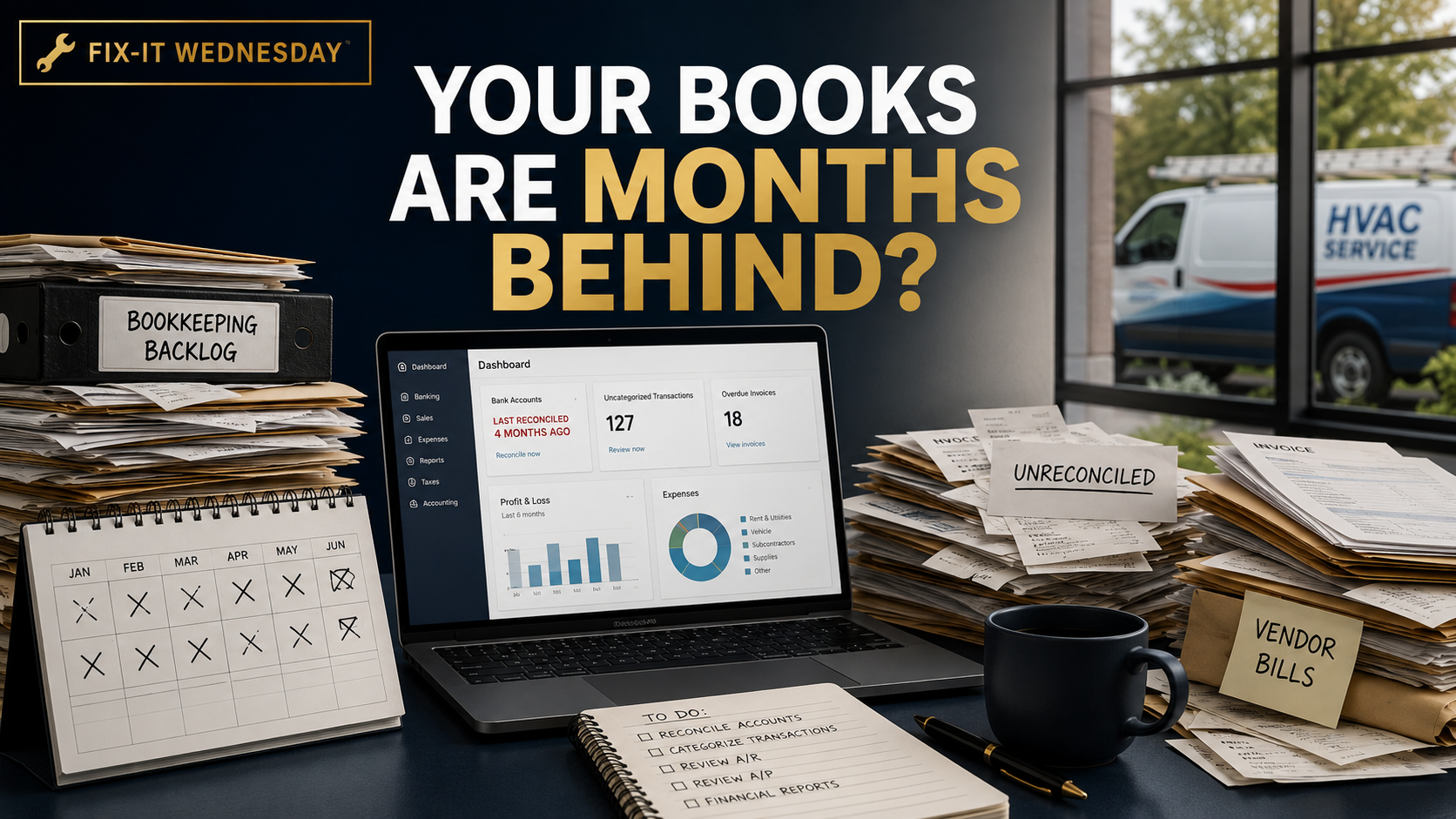
Your Books Are Behind. Don’t Panic.
It’s been a busy few months.
Customers needed you. Jobs needed to get done. Your team needed you. Vendors needed to be paid. And somewhere along the way, your bookkeeping fell further and further behind.
Maybe it’s been two months.
Maybe six.
Maybe you don’t even want to check.
If that sounds familiar, you’re not alone.
For many small business owners—especially owners of busy HVAC, plumbing, electrical, landscaping, and other service-based businesses—bookkeeping is something that gets pushed aside when there’s more immediate work demanding attention.
The problem is that the longer your books stay behind, the harder it becomes to know what’s actually happening financially.
You may be making sales without knowing your true profitability.
You may have customers who haven’t paid their invoices.
You may have vendor bills that haven’t been recorded.
And you may be making important business decisions based on financial information that’s months old.
The good news? Being behind doesn’t mean your books can’t be fixed.
You don’t need to panic, and you don’t necessarily need to start entering transactions randomly just to get caught up.
You need a systematic process.
In this guide, we’ll walk through how to catch up bookkeeping, what to prioritize, when professional help makes sense, and how to keep your books from falling behind again.
Table of Contents
- First, Don’t Panic
- What Happens When Your Books Fall Months Behind?
- Step-by-Step: How to Catch Up Your Bookkeeping
- What Catch-Up Bookkeeping Looks Like for an HVAC Business
- Should You Catch Up Your Books Yourself or Hire a Bookkeeper?
- How to Keep Your Books From Falling Behind Again
- How Prime Ledger Can Help
- Key Takeaways
- Frequently Asked Questions
- Conclusion
First, Don’t Panic
Being behind on your bookkeeping can feel overwhelming, especially when you don’t know how much work is waiting for you.
But the first step is surprisingly simple:
Stop making the problem bigger.
If your books are three months behind, don’t let them become four months behind while you’re trying to figure out how to fix the first three.
Start by establishing where you are today.
Then work backward systematically.
Being Behind Doesn’t Mean Your Business Is Failing
A bookkeeping backlog doesn’t necessarily mean your business is poorly managed.
In fact, it can happen because your business is growing.
An HVAC owner may spend an entire week managing emergency calls.
A plumbing company may have technicians working overtime.
An electrical contractor may be juggling several large projects.
When you’re busy serving customers, bookkeeping can easily fall to the bottom of the list.
The important thing is to recognize the problem and address it.
The Bigger Risk Is Continuing to Ignore It
The real danger isn’t necessarily that your books are already behind.
It’s continuing to operate without reliable financial information.
The longer the backlog grows, the harder it becomes to answer basic questions:
How profitable are we?
How much cash do we really have available?
Who still owes us money?
What bills do we owe?
Which expenses are increasing?
Can we afford to hire another employee?
When your books are months behind, those answers become much harder to trust.
What Happens When Your Books Fall Months Behind?
A bookkeeping backlog affects more than your accounting software.
It can affect how you run your business.
You Lose Financial Visibility
If your books haven’t been updated in months, your Profit & Loss Statement may not reflect your current situation.
You might be looking at financial information from several months ago while making decisions about today.
Cash Flow Becomes Harder to Manage
Your bank balance tells you how much cash is in your account.
It doesn’t necessarily tell you what cash you need to reserve for upcoming bills, payroll, or other obligations.
Without current records, cash flow planning becomes much more difficult.
Outstanding Customer Payments Can Be Missed
If accounts receivable isn’t current, you may not have a reliable list of customers who still owe your business money.
That can result in delayed follow-up and slower cash collection.
Vendor Bills Can Fall Through the Cracks
The same problem can happen with accounts payable.
If bills aren’t properly recorded and tracked, you may lose visibility into what your business owes and when payments are due.
Tax Preparation Becomes More Difficult
When financial records aren’t current, tax preparation can require additional cleanup before your tax professional can confidently use the information.
Keeping your books current throughout the year can make that process much smoother.
Step-by-Step: How to Catch Up Your Bookkeeping
Now let’s get to the part you’ve been waiting for.
How do you actually catch up?
The key is to work systematically instead of trying to fix everything at once.
Step 1: Stop the Backlog From Growing
Before you start cleaning up old transactions, make sure new transactions aren’t continuing to pile up.
Establish a cutoff date.
For example:
“Today is August 10. From this point forward, I’m keeping new transactions current while I work backward through the backlog.”
This prevents you from constantly chasing a moving target.
Step 2: Gather Your Financial Records
You’ll need the information necessary to reconstruct the missing periods.
Depending on your business, that may include:
- Bank statements
- Credit card statements
- Loan statements
- Customer invoices
- Vendor bills
- Sales records
- Receipts
- Payroll records
- Payment processor reports
- Equipment purchase records
Don’t worry about organizing everything perfectly at first.
The goal is to gather the complete source information.
Step 3: Review Your Accounting Setup
Before entering months of transactions, take a moment to make sure your accounting system is set up properly.
Review your:
- Chart of Accounts
- Bank and credit card accounts
- Customer accounts
- Vendor accounts
- Income categories
- Expense categories
If the underlying structure is wrong, you can spend hours cleaning up transactions only to create more work later.
Step 4: Work Through Your Bank Accounts
Start with your oldest unreconciled period and work forward.
Compare your accounting records against your actual bank statements.
Look for:
- Missing transactions
- Duplicate transactions
- Incorrect amounts
- Incorrect dates
- Unclear transactions
- Transactions recorded in the wrong account
Don’t simply mark everything as reconciled to make the problem disappear.
The goal is to make the books accurate.
Step 5: Review Uncategorized Transactions
Once transactions are recorded, look for items sitting in:
- Uncategorized income
- Uncategorized expenses
- Suspense accounts
- Other temporary categories
These items deserve attention because they may affect your financial reports.
If you’re unsure how a transaction should be treated, don’t guess.
Step 6: Catch Up Accounts Receivable
Now determine what customers owe your business.
Review:
- Outstanding invoices
- Customer payments
- Overdue balances
- Unapplied payments
- Credit memos, if applicable
For an HVAC company, this might mean reviewing months of service calls and installations to determine which invoices have been paid and which remain outstanding.
Step 7: Catch Up Accounts Payable
Next, review what your business owes.
Look at:
- Vendor bills
- Outstanding balances
- Payment history
- Unrecorded bills
- Duplicate bills
This gives you a much clearer picture of your current obligations.
Step 8: Review Your Financial Reports
Once the books are caught up and reconciled, run your financial reports.
At minimum, review:
Profit & Loss Statement
Understand your revenue, expenses, and profitability.
Balance Sheet
Review your assets, liabilities, and equity.
Cash Flow Information
Understand how cash has moved through the business.
Don’t just generate the reports.
Look at them.
Ask questions.
Does the revenue look reasonable?
Are expenses unusually high?
Are there negative balances that shouldn’t be there?
Does the information make sense compared with what actually happened in the business?
What Catch-Up Bookkeeping Looks Like for an HVAC Business
Let’s make this real.
Imagine an HVAC company has been extremely busy for the last six months.
The owner has been focused on:
- Emergency service calls
- New installations
- Technician schedules
- Customer complaints
- Parts
- Equipment
- Payroll
- Vendor relationships
Bookkeeping kept getting pushed back.
Now six months have passed.
The owner opens QuickBooks and realizes the books haven’t been properly reconciled since February.
What needs to be reviewed?
Potentially:
Revenue
Service calls, maintenance agreements, installations, and other customer payments.
Accounts Receivable
Which customers have unpaid invoices?
Parts and Materials
How much is being spent on supplies and replacement parts?
Vehicles
What expenses are associated with service vehicles?
Fuel
How much is being spent on fuel?
Vendors
Which supplier bills remain unpaid?
Payroll
Are payroll-related transactions properly recorded?
Credit Cards
Have all business purchases been captured and categorized?
This is why catch-up bookkeeping isn’t simply about entering six months of transactions.
It’s about making sure the financial records tell an accurate story of what happened during those six months.
Should You Catch Up Your Books Yourself or Hire a Bookkeeper?
The answer depends on the complexity of your books and how far behind you are.
DIY May Make Sense If:
- You’re only slightly behind.
- Your transaction volume is relatively low.
- Your accounts are already properly connected.
- Your reconciliations are straightforward.
- Your accounting setup is organized.
- You understand your bookkeeping system.
If that’s your situation, a focused cleanup project may be manageable.
Professional Help May Make More Sense If:
You’re several months behind.
You have multiple bank and credit card accounts.
Your reconciliations haven’t been completed.
Your financial reports don’t make sense.
You have a large number of uncategorized transactions.
Accounts receivable or payable are unclear.
Your business has grown significantly.
Or you simply don’t have the time to do the cleanup correctly.
In those situations, trying to fix everything yourself may cost more in time and frustration than getting professional help.
How to Keep Your Books From Falling Behind Again
Getting caught up is only half the solution.
The real goal is to stay caught up.
Establish a Monthly Bookkeeping Routine
At the end of each month:
- Record transactions.
- Reconcile bank accounts.
- Reconcile credit cards.
- Review accounts receivable.
- Review accounts payable.
- Review financial reports.
- Address unusual or unexplained transactions.
The exact process will vary depending on the business, but the principle is simple:
Don’t let months of bookkeeping pile up again.
Set a Financial Review Date
Choose one day each month to review your financial reports.
It doesn’t have to take all day.
The goal is simply to create a regular habit of looking at your numbers.
Because financial information is most useful when it’s current.
How Prime Ledger Can Help
If your books are months behind, you don’t necessarily need to figure everything out alone.
At Prime Ledger Bookkeeping, we help HVAC and service-based businesses get their financial records organized and establish a reliable monthly bookkeeping process.
Our services include:
- Bookkeeping cleanup and catch-up
- Monthly bookkeeping
- Bank and credit card reconciliations
- Accounts receivable
- Accounts payable
- Monthly financial reporting
- QuickBooks Online support
Our goal isn’t simply to get your books caught up.
It’s to help you establish a system that keeps them current.
Because once your books are accurate, you can start using your financial information to make better decisions.
Accurate Books. Clear Decisions. Peace of Mind.
🔧 Key Takeaways
If your books are months behind, remember:
✅ Don’t panic. A bookkeeping backlog can be fixed.
✅ Stop the backlog from growing while you work through the older periods.
✅ Gather complete financial records before beginning the cleanup.
✅ Reconcile accounts carefully instead of simply marking them complete.
✅ Review accounts receivable and payable so you know what you’re owed and what you owe.
✅ Review your financial reports once the cleanup is complete.
✅ Establish a monthly routine so your books don’t fall behind again.
And if the backlog is extensive or complicated, professional help may save you significant time and reduce the risk of costly errors.
Frequently Asked Questions
How do I catch up bookkeeping that is months behind?
Start by stopping the backlog from growing, gathering your financial records, reviewing your accounting setup, and working through your oldest unreconciled period forward. Reconcile your accounts, review outstanding receivables and payables, and verify your financial reports once the cleanup is complete.
How long does it take to catch up bookkeeping?
It depends on how many months are behind, the number of transactions, the number of accounts, and how much cleanup is required. A small business with a few accounts may catch up relatively quickly, while a larger or more complex business can require significantly more work.
Can a bookkeeper catch up my old books?
Yes. A professional bookkeeper can help reconstruct missing records, reconcile accounts, correct bookkeeping issues, and bring financial records up to date. The amount of work depends on the condition and complexity of the existing records.
Should I clean up QuickBooks before hiring a bookkeeper?
Not necessarily. If you’re unsure what is wrong with your QuickBooks file, attempting a major cleanup yourself can sometimes create additional issues. A professional can assess the current condition of the books and determine what needs to be corrected.
What records do I need to catch up my bookkeeping?
Depending on your business, you may need bank and credit card statements, invoices, bills, receipts, payroll records, loan statements, payment processor reports, and other financial records.
How can I prevent my books from falling behind again?
Establish a consistent monthly bookkeeping routine. Regular transaction recording, account reconciliations, accounts receivable and payable reviews, and monthly financial reporting can help keep your records current.
Conclusion
Having months of bookkeeping sitting unfinished can feel overwhelming.
But being behind doesn’t mean you’re stuck.
The key is to stop the backlog from growing, gather your records, work through the missing periods systematically, reconcile your accounts, and verify that your financial reports accurately reflect your business.
And once you’re caught up, don’t stop there.
Put a monthly process in place so your books stay current.
Because bookkeeping isn’t just about getting transactions recorded.
It’s about having financial information you can trust when you need to make important decisions.
If you’re an HVAC or service-based business owner whose books have fallen behind, getting them back on track can be one of the most valuable steps you take for your business’s financial health.
🔧 Ready to Get Your Books Back on Track?
If your bookkeeping is months behind, you don’t have to figure out the cleanup alone.
Prime Ledger Bookkeeping helps HVAC and service-based businesses catch up their books, organize their financial records, and establish reliable monthly bookkeeping systems.
Let’s figure out where your books stand and what it will take to get them current.
Schedule your free bookkeeping consultation today.
Accurate Books. Clear Decisions. Peace of Mind.
Related Articles
📚 Bookkeeping Basics Monday
What Does a Bookkeeper Do? A Complete Guide for Small Business Owners?
Our foundational guide explaining what professional bookkeeping involves and why it matters.
Leave a Reply