

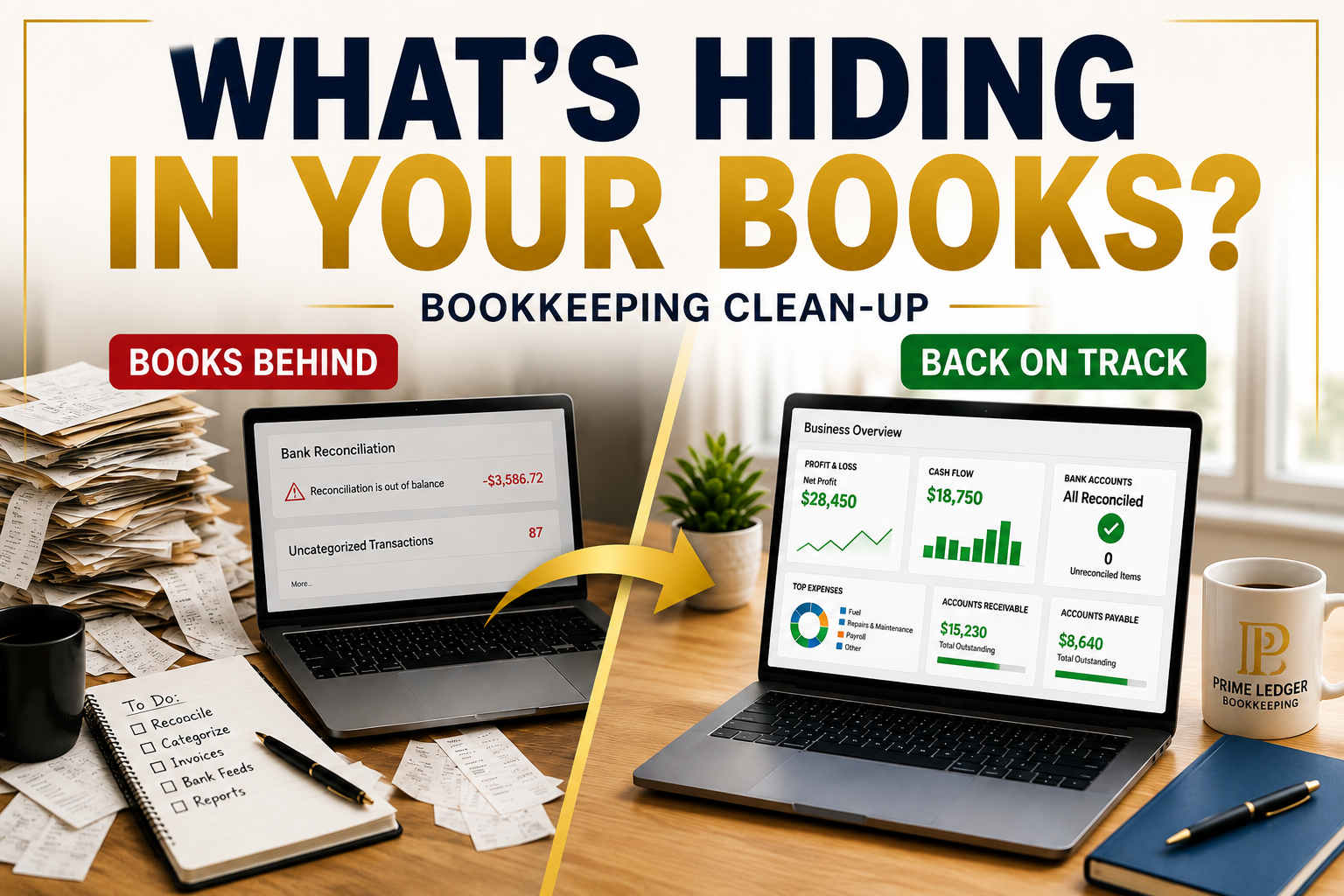
Your Books Are Behind. That’s Okay.
You meant to catch up last month.
Then work got busy.
A few more weeks passed.
Now you’re opening QuickBooks and realizing your books are several months behind.
Maybe your bank accounts haven’t been reconciled.
Maybe there are transactions sitting in Uncategorized.
Maybe you’re not sure whether your Profit & Loss is accurate.
Maybe you’ve started avoiding your financial reports altogether.
And now you’re thinking:
“Where do I even start?”
First, take a breath.
You’re not alone.
Small-business owners don’t usually fall behind because they don’t care about their finances. More often, bookkeeping gets pushed aside while they’re busy serving customers, managing employees, handling operations, and trying to grow the business.
But eventually, the backlog becomes too large to ignore.
That’s where bookkeeping cleanup can help.
A cleanup project is designed to bring disorganized, incomplete, or inaccurate financial records back to a reliable condition. Depending on the situation, that may include correcting existing errors, reconciling accounts, and catching up transactions that were never recorded.
The goal isn’t simply to make your QuickBooks file look neat.
The goal is to get your books to a point where you can trust the numbers again.
And then, just as importantly, establish a process that keeps them current going forward.
Table of Contents
- Your Books Are Behind. Now What?
- You’re Not Alone
- What Is Bookkeeping Cleanup?
- Signs Your Business May Need Bookkeeping Cleanup
- What Happens During a Bookkeeping Cleanup?
- Cleanup vs. Catch-Up Bookkeeping
- What If Your Books Are Really Behind?
- Why Accurate Books Matter
- How Prime Ledger Can Help
- Ready to Get Your Books Back on Track?
- Key Takeaways
- Frequently Asked Questions
- Conclusion
Your Books Are Behind. Now What?
The first thing to do is stop adding to the problem.
If your books are months behind, continuing to postpone the work won’t make the backlog easier to handle.
But you also don’t need to panic and start randomly entering transactions.
The first step is to understand the condition of your books.
Ask yourself:
- When were my books last fully reconciled?
- Which bank accounts need attention?
- Which credit cards need to be reconciled?
- Are there missing transactions?
- Are there duplicate transactions?
- Are there large Uncategorized balances?
- Are accounts receivable and accounts payable current?
- Do my financial reports appear reasonable?
- Are there previous bookkeeping errors that need correction?
Once you know what’s wrong, you can create a plan to fix it.
The goal isn’t “make QuickBooks look current.”
The goal is:
Accurate → Reconciled → Organized → Current → Maintainable
That distinction matters.
You’re Not Alone
Running a small business means wearing a lot of hats.
You may be responsible for:
- Finding customers
- Scheduling jobs
- Managing employees
- Purchasing supplies
- Paying vendors
- Answering customer questions
- Handling emergencies
- Managing cash flow
- Growing the business
Bookkeeping can easily become the task that gets pushed to tomorrow.
And then tomorrow becomes next week.
Next week becomes next month.
Before you know it, you’re looking at months of transactions that haven’t been properly reviewed.
This is especially common when a business grows quickly.
More customers mean more transactions.
More employees create more financial activity.
More vendors mean more bills.
More vehicles and equipment create additional expenses and accounts to track.
The bookkeeping system that worked when the business was small may simply no longer be enough.
Falling behind doesn’t mean your business is failing.
It means your bookkeeping process needs attention.
What Is Bookkeeping Cleanup?
Bookkeeping cleanup is the process of reviewing and correcting financial records so they accurately reflect the business’s activity.
Depending on the condition of your books, cleanup may involve:
- Reviewing transactions
- Categorizing transactions
- Correcting misclassified transactions
- Identifying duplicate entries
- Finding missing transactions
- Reconciling bank accounts
- Reconciling credit cards
- Reviewing accounts receivable
- Reviewing accounts payable
- Investigating unusual balances
- Reviewing financial reports
- Correcting other bookkeeping inconsistencies
A cleanup project can also include catch-up work when transactions from previous periods were never entered.
That’s an important distinction.
Cleanup fixes what’s wrong.
Catch-up fills in what’s missing.
Many businesses need some combination of both.
Signs Your Business May Need Bookkeeping Cleanup
Not sure whether your books actually need professional attention?
Here are some signs to look for.
Your Books Are Months Behind
If your last completed reconciliation was several months ago, your financial records aren’t giving you a current picture of the business.
The longer you wait, the more transactions accumulate.
Your Bank Accounts Aren’t Reconciled
Bank reconciliation is one of the best ways to verify that your financial records agree with your bank statements.
If several months remain unreconciled, it can become difficult to determine where a discrepancy began.
And as we discussed in [Why Your Bank Balance Doesn’t Match Your Books], not every difference is an error—but unexplained differences need to be investigated.
Your Financial Reports Don’t Look Right
You open your Profit & Loss and think:
“That doesn’t look right.”
Maybe expenses are unusually high.
Maybe revenue seems wrong.
Maybe certain accounts have strange balances.
Maybe your Balance Sheet contains numbers you don’t understand.
Financial reports are only useful when the underlying records are reliable.
You Have a Large Uncategorized Balance
If transactions are sitting in Uncategorized Income or Uncategorized Expenses, you may not have a clear picture of where your money is actually coming from or going.
A cleanup can help determine what those transactions actually represent and place them in the appropriate accounts.
You Have Duplicate Transactions
Duplicate transactions can distort your revenue, expenses, bank balances, and financial reports.
They can happen when transactions are entered manually and also imported through a bank feed, among other situations.
Identifying and removing duplicates is an important part of restoring reliable records.
You Don’t Know Who Owes You Money
Your accounts receivable should help you understand what customers owe your business.
If old invoices, payments, credits, or unapplied amounts haven’t been reviewed, your A/R balance may not accurately reflect what is actually collectible.
You Don’t Know What You Owe Vendors
The same principle applies to accounts payable.
Old bills, duplicate bills, vendor credits, or payments that haven’t been properly applied can make your A/P balance difficult to understand.
You’ve Started Avoiding Your Financial Reports
This one may sound simple, but it’s important.
If opening your financial reports makes you uncomfortable because you don’t trust what you’re seeing, that’s a sign your books deserve attention.
You shouldn’t have to avoid your numbers because you’re afraid they won’t make sense.
What Happens During a Bookkeeping Cleanup?
A professional cleanup shouldn’t be a random process of fixing whatever happens to appear first.
It should follow a structured approach.
Step 1: Assess the Current Books
First, we determine:
- How far behind the books are
- Which accounts need attention
- What information is missing
- Whether previous reconciliations exist
- What types of errors may be present
- What needs to be corrected
This establishes the scope of the project.
Step 2: Gather the Source Documents
Depending on the business, this may include:
- Bank statements
- Credit card statements
- Loan statements
- Invoices
- Vendor bills
- Receipts
- Payment processor records
- Payroll information
- Other financial records
Having complete source information is important because the goal is to reconstruct what actually happened—not simply make assumptions.
Step 3: Review and Categorize Transactions
Transactions are reviewed and assigned to appropriate accounts.
This can include:
- Revenue
- Operating expenses
- Cost of goods sold
- Transfers
- Owner transactions
- Equipment purchases
- Other business activity
The exact treatment depends on the business and its accounting setup.
Step 4: Reconcile Bank and Credit Card Accounts
The accounts are reconciled against the appropriate statements.
This helps identify:
- Missing transactions
- Duplicate transactions
- Incorrect amounts
- Unexplained differences
- Other discrepancies
Working chronologically is generally important because unresolved issues in an earlier period can affect later periods.
Step 5: Review Accounts Receivable and Accounts Payable
The cleanup should also look beyond the bank accounts.
We want to understand:
Who owes the business money?
and:
Who does the business owe money to?
Old balances may need investigation before the financial reports can be considered reliable.
Step 6: Review the Financial Reports
Once the records have been cleaned and reconciled, the financial reports can be reviewed for reasonableness.
The goal isn’t just to have transactions entered.
It’s to make sure the resulting financial information makes sense.
Step 7: Establish a Monthly Process
This may be the most important step.
Because there’s no point spending time getting your books caught up if they immediately fall behind again.
The end goal should be:
Cleanup → Current Books → Consistent Monthly Process
That’s how a one-time cleanup becomes a long-term improvement.
Cleanup vs. Catch-Up Bookkeeping
These terms are often used interchangeably, but there is a useful distinction.
Catch-Up Bookkeeping
Catch-up bookkeeping generally means bringing missing periods up to date.
For example:
Your business operated throughout 2025, but transactions from April through December were never entered.
The missing work needs to be reconstructed.
That’s catch-up.
Bookkeeping Cleanup
Cleanup generally focuses on correcting existing records that are inaccurate, inconsistent, or unreliable.
For example:
Your transactions were entered, but:
- Bank accounts weren’t reconciled
- Transactions were categorized incorrectly
- Duplicates exist
- Old balances are unexplained
That’s cleanup.
Many businesses need both.
A business can have six months of missing transactions and errors in the transactions that were already entered.
In that situation, catch-up and cleanup work together.
The exact scope depends on the condition of the books.
What If Your Books Are REALLY Behind?
Maybe you’re two months behind.
Maybe six months.
Maybe you’re looking at an entire year.
Don’t assume it’s too late.
The process is still fundamentally the same:
Determine the starting point → gather records → work through the transactions → reconcile → review → establish an ongoing process.
What changes is the amount of work involved.
A business with fewer transactions and fewer accounts may have a much smaller cleanup project than a business with multiple bank accounts, credit cards, employees, payment processors, vehicles, and hundreds of monthly transactions.
That’s why we don’t recommend promising a universal timeline before reviewing the books.
Every cleanup project is different.
Why Accurate Books Matter
Getting caught up isn’t just about feeling better when you open QuickBooks.
Accurate, current books give you information you can actually use.
You can better understand:
Revenue
How much money is the business generating?
Expenses
Where is the money going?
Profitability
Is the business actually making money?
Cash Flow
What’s happening with the money moving through the business?
Accounts Receivable
Who still owes you money?
Accounts Payable
What obligations does the business have?
Trends
Are revenue, expenses, or profitability moving in the right direction?
This is why bookkeeping isn’t simply administrative work.
Your books are part of your business’s decision-making foundation.
Why Prime Ledger Can Help
At Prime Ledger Bookkeeping, we understand that business owners don’t always fall behind because they don’t care.
Sometimes you simply have more important things demanding your attention.
That’s why our approach to bookkeeping cleanup is practical and judgment-free.
We help HVAC and service-based businesses organize their financial records, reconcile accounts, identify bookkeeping issues, and get their books back to a reliable starting point.
Our services include:
- Bookkeeping cleanup
- Catch-up bookkeeping
- Monthly bookkeeping
- Bank and credit card reconciliations
- Accounts receivable
- Accounts payable
- Financial reporting
- QuickBooks Online support
Our goal isn’t just to clean up yesterday’s problems.
We want to help you establish a bookkeeping process that keeps your books current going forward.
Ready to Get Your Books Back on Track?
You don’t need to spend another weekend trying to figure out months of transactions.
You don’t need to keep avoiding your financial reports.
And you don’t need to be embarrassed about how far behind your books have gotten.
We’ve seen it before. And it’s fixable.
The first step is simply understanding where your books stand and what needs to be done.
If you’re ready to get your financial records organized and back on track, let’s talk.
📈 Key Takeaways
If your books are behind or unreliable:
✅ Don’t panic. Falling behind is common, especially as businesses grow.
✅ Determine what’s wrong first. Know how far behind you are and which accounts need attention.
✅ Gather your source documents. Bank statements, credit card statements, invoices, bills, and other records provide the foundation for the cleanup.
✅ Reconcile accounts. Bank and credit card reconciliations help verify that the records agree with the underlying statements.
✅ Fix the underlying problems. Don’t simply make balances look right.
✅ Understand cleanup vs. catch-up. Cleanup generally corrects inaccurate records; catch-up brings missing periods up to date. Many businesses need both.
✅ Don’t stop at cleanup. Establish a monthly bookkeeping process so the backlog doesn’t return.
Most importantly:
Your books don’t have to be perfect today for you to start getting them back on track.
You just need a clear starting point and a plan.
Frequently Asked Questions
What is bookkeeping cleanup?
Bookkeeping cleanup is the process of reviewing and correcting financial records so they are accurate, organized, reconciled, and reliable. Depending on the situation, it may include correcting errors, removing duplicates, reconciling accounts, and resolving unexplained balances.
What is catch-up bookkeeping?
Catch-up bookkeeping generally refers to bringing previously incomplete or missing bookkeeping periods up to date. It involves recording and categorizing transactions for periods that were not properly maintained.
What’s the difference between cleanup and catch-up bookkeeping?
Catch-up bookkeeping focuses primarily on missing work, while cleanup focuses primarily on correcting inaccurate or unreliable existing records. Many businesses that have fallen behind need both.
Can you clean up QuickBooks?
Yes. A QuickBooks cleanup project may involve reviewing transactions, correcting classifications, removing duplicates, reconciling accounts, reviewing outstanding balances, and addressing other issues affecting the reliability of the books.
The exact work depends on the condition of the QuickBooks file.
How far back can bookkeeping be cleaned up?
There isn’t a universal number of months. The appropriate cleanup period depends on when the books were last accurate, what records are available, the business’s transaction volume, and what financial information needs to be reconstructed.
How long does bookkeeping cleanup take?
It depends on factors such as how far behind the books are, the number of accounts and transactions, the availability of source documents, and the condition of the existing records.
A simple cleanup may be relatively limited, while a business with many months of unreconciled accounts and multiple financial systems can require substantially more work.
What happens after bookkeeping cleanup?
Ideally, cleanup should be followed by a consistent monthly bookkeeping process.
The goal is to move from:
Behind → Cleanup → Current → Stay Current
rather than repeatedly allowing the books to fall behind.
Can I hire a bookkeeper if my books are months behind?
Absolutely.
In fact, being behind is one of the reasons a business may seek professional bookkeeping support.
You don’t need to clean everything up yourself before contacting a bookkeeper.
A professional can assess the condition of the books and determine what needs to be done.
How much does bookkeeping cleanup cost?
There isn’t a universal price because cleanup projects vary significantly.
Cost can depend on:
- Number of months involved
- Transaction volume
- Number of bank and credit card accounts
- Condition of the books
- Amount of missing information
- Complexity of the business
- Scope of cleanup required
The best way to determine the cost is to first assess the condition and scope of the books.
Conclusion
If your books are behind, you’re not alone.
Maybe you got busy.
Maybe your business grew faster than your bookkeeping system.
Maybe your previous bookkeeper left.
Or maybe you simply kept telling yourself you’d catch up next month.
Whatever happened, you can move forward from here.
A professional bookkeeping cleanup can help identify what’s missing, correct what’s wrong, reconcile your accounts, and bring your financial records back to a reliable starting point.
But the ultimate goal isn’t simply to clean up the past.
It’s to create a bookkeeping process that keeps your financial records current going forward.
So if you’re looking at months of unfinished bookkeeping and wondering where to begin, don’t spend another weekend stressing over it.
Let’s get your books back on track.
Ready to Get Your Books Back on Track?
If your books are behind, messy, or simply not giving you information you can trust, Prime Ledger Bookkeeping can help.
We provide bookkeeping cleanup and catch-up bookkeeping services for HVAC and service-based businesses, helping owners get their financial records organized, reconciled, and ready for reliable monthly bookkeeping.
Schedule Your Free Bookkeeping Consultation
Let’s look at where your books are today and determine what it will take to get them back on track.
Accurate Books. Clear Decisions. Peace of Mind.
Related Articles
📚 Bookkeeping Basics Monday
What Does a Bookkeeper Do? A Complete Guide for Small Business Owners
Understand what a professional bookkeeper actually does and how bookkeeping supports your business.
Bookkeeping vs. Accounting Explained
Learn how bookkeeping and accounting differ—and how the two functions can work together.
🔧 Fix-It Wednesday
Your Books Are Months Behind—Now What?
If you’re staring at months of unfinished bookkeeping, start here for practical steps to get caught up.
Why Your Bank Balance Doesn’t Match Your Books
Learn why your bank and book balances can differ and how to investigate reconciliation problems.
📈 Finance Friday
5 Signs It’s Time to Hire a Bookkeeper
Recognize the signs that your business may have outgrown DIY bookkeeping.
Leave a Reply