

Bookkeeping and Accounting Are Not the Same Thing
If you’ve ever wondered about bookkeeping vs. accounting, you’re not alone.
Small-business owners often hear the two terms used interchangeably.
You might even have an accountant who handles your taxes while someone else handles your QuickBooks—and wonder:
“So what’s the difference?”
The simplest explanation is this:
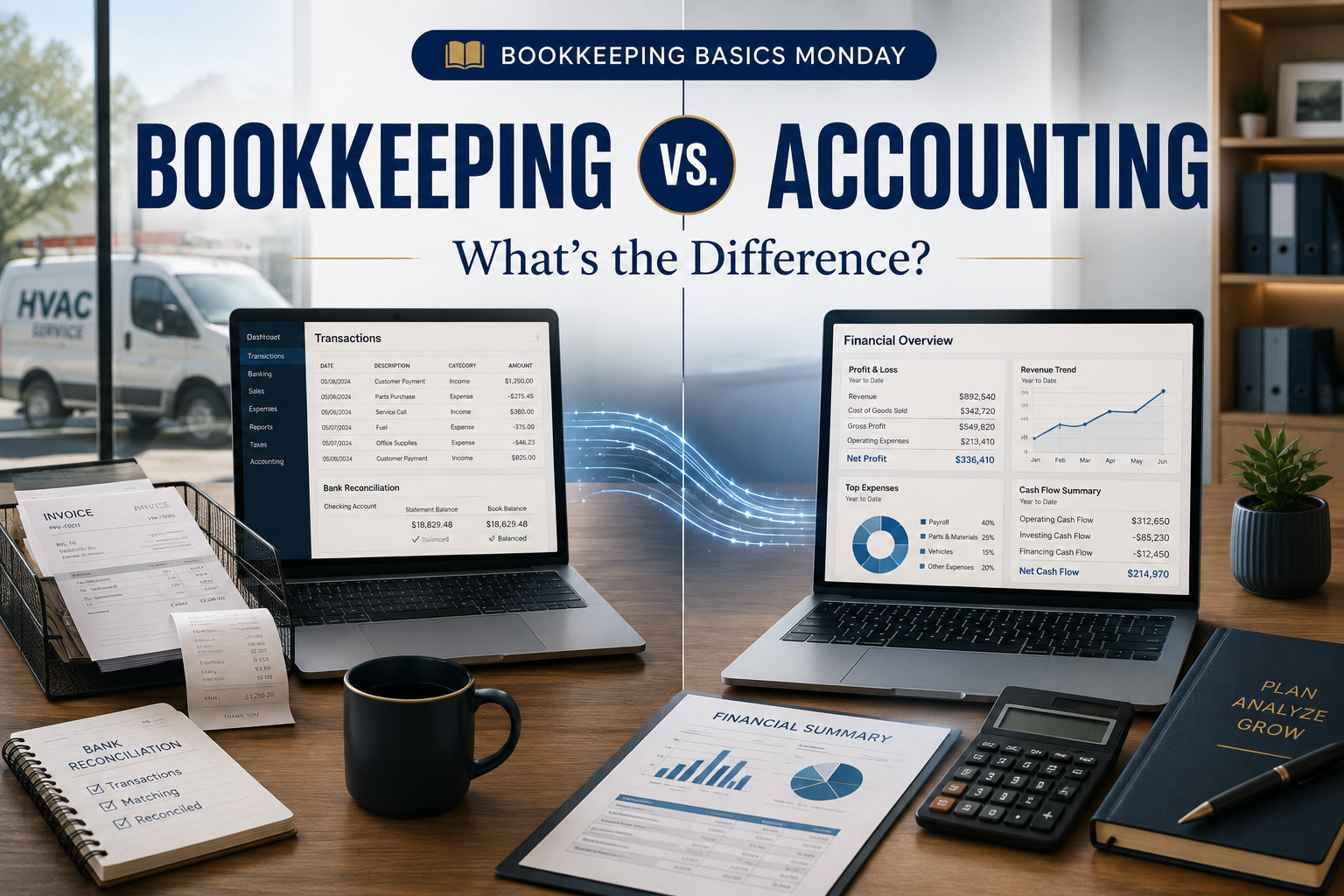
Bookkeeping focuses on recording and organizing your business’s financial transactions. Accounting takes that financial information and uses it for analysis, reporting, tax work, planning, and decision-making.
Think of it this way:
Bookkeeping records the financial story.
Accounting helps you understand what the story means.
The two functions are different, but they work closely together.
And understanding the difference can help you determine what kind of financial support your business actually needs.
In this guide, we’ll explain bookkeeping vs. accounting in plain English, look at what bookkeepers and accountants typically do, and explain when your small business may need one—or both.
Table of Contents
- The Simple Difference Between Bookkeeping and Accounting
- What Does a Bookkeeper Do?
- What Does an Accountant Do?
- Bookkeeper vs. Accountant: Side-by-Side
- How Bookkeeping and Accounting Work Together
- What Does This Look Like for an HVAC Business?
- Do I Need a Bookkeeper, an Accountant, or Both?
- Can One Person Do Both?
- When Should You Hire a Bookkeeper?
- Key Takeaways
- Frequently Asked Questions
- Conclusion
The Simple Difference Between Bookkeeping and Accounting
Let’s start with the simplest possible explanation.
Bookkeeping is primarily about recording and organizing financial information.
A bookkeeper helps maintain the day-to-day financial records of a business.
That can include:
- Recording income and expenses
- Categorizing transactions
- Reconciling bank accounts
- Reconciling credit cards
- Tracking customer invoices
- Tracking vendor bills
- Maintaining financial records
- Preparing routine financial reports
Accounting goes a step further.
An accountant may take those organized records and use them for:
- Financial analysis
- Tax preparation
- Tax planning
- Financial statement analysis
- Budgeting
- Forecasting
- Business planning
- Advisory services
This is the basic distinction behind bookkeeping vs. accounting.
But there’s more overlap between the two than this simple definition might suggest.
What Does a Bookkeeper Do?
A bookkeeper’s primary responsibility is maintaining accurate and organized financial records.
Think about everything that happens financially in a business every day.
A customer pays an invoice.
A vendor sends a bill.
The business purchases supplies.
An employee-related transaction occurs.
A credit card is charged.
Money moves between accounts.
All of these activities need to be recorded correctly.
That’s where bookkeeping comes in.
Recording and Categorizing Transactions
A bookkeeper records financial transactions and assigns them to the appropriate accounts.
For example, an HVAC business might purchase:
- Refrigerant
- Replacement parts
- Tools
- Fuel
- Office supplies
- Equipment
Those transactions need to be recorded and categorized appropriately so that the business’s financial reports accurately reflect its activity.
Reconciling Bank and Credit Card Accounts
Reconciliation involves comparing the transactions in the accounting system with the actual activity shown on bank and credit card statements.
This helps identify:
- Missing transactions
- Duplicate transactions
- Incorrect amounts
- Incorrect classifications
- Other discrepancies
Regular reconciliations are an important part of maintaining reliable books.
Managing Accounts Receivable
Accounts receivable represents money customers owe the business.
A bookkeeper may help track:
- Customer invoices
- Payments received
- Outstanding balances
- Overdue invoices
- Unapplied payments
For a service business, keeping track of what customers owe can be particularly important for maintaining healthy cash flow.
Managing Accounts Payable
Accounts payable is essentially the other side of the equation: money the business owes to vendors and suppliers.
A bookkeeper may track:
- Vendor bills
- Payment dates
- Outstanding balances
- Vendor payments
This gives the business owner better visibility into upcoming obligations.
Preparing Financial Reports
A bookkeeper may also prepare routine financial reports such as:
- Profit & Loss statements
- Balance Sheets
- Accounts receivable reports
- Accounts payable reports
- Other management reports
These reports provide the financial information that can later be analyzed for planning and decision-making.
What Does an Accountant Do?
Now let’s look at the other side of bookkeeping vs. accounting.
Accountants generally work with financial information at a higher analytical level, although exact responsibilities vary by accountant and firm.
An accountant may use the financial records maintained through bookkeeping to perform work such as:
Tax Preparation
An accountant may prepare federal, state, or local tax returns, depending on their services and qualifications.
Tax Planning
An accountant may help a business consider strategies for managing its tax obligations.
Financial Analysis
Accountants can analyze financial statements and financial trends to help business owners better understand performance.
Budgeting and Forecasting
Accounting professionals may help businesses develop budgets, forecasts, and financial projections.
Business Advisory
Some accountants provide advisory services that help owners evaluate financial decisions and plan for growth.
The important point is that accounting generally builds on financial information that must first be recorded accurately.
If the underlying records are incomplete or inaccurate, the analysis built on them may also be affected.
Bookkeeper vs. Accountant: Side-by-Side
One of the easiest ways to understand bookkeeping vs. accounting is to compare their typical responsibilities.
| Area | Bookkeeper | Accountant |
| Record transactions | ✅ Primary responsibility | May review |
| Categorize transactions | ✅ | May review |
| Bank reconciliation | ✅ | May review |
| Credit card reconciliation | ✅ | May review |
| Accounts receivable | ✅ | May review |
| Accounts payable | ✅ | May review |
| Routine financial reports | ✅ Often prepares | ✅ Reviews/analyzes |
| Financial analysis | Limited/routine | ✅ |
| Tax preparation | Generally not primary role | ✅ |
| Tax planning | Generally not primary role | ✅ |
| Budgeting/forecasting | May provide information | ✅ Often provides |
| Business advisory | Limited | Often offered |
An important caveat
These responsibilities aren’t universal.
Some bookkeepers offer additional financial services.
Some accountants provide extensive bookkeeping.
Some firms offer both.
So when choosing a professional, don’t rely solely on their job title.
Look at the actual services they provide and whether they have the appropriate expertise for the work you need.
How Bookkeeping and Accounting Work Together
This is where bookkeeping vs. accounting becomes less about choosing one and more about understanding how the two functions connect.
Think of the process like this:
Business transactions
↓
Bookkeeping
↓
Accurate, organized financial records
↓
Accounting
↓
Analysis, reporting, planning, and tax work
↓
Better-informed business decisions
A bookkeeper helps make sure the financial information is captured and organized.
An accountant can then use that information for higher-level financial work.
That’s why the two functions are often complementary rather than competing.
What Does This Look Like for an HVAC Business?
Let’s use a real-world example.
Imagine you own an HVAC company.
Your technicians are completing service calls and installations every day.
Your business may have:
- Customer invoices
- Customer payments
- Parts purchases
- Equipment purchases
- Fuel expenses
- Service vehicles
- Payroll
- Vendor bills
- Credit card transactions
- Bank transactions
The bookkeeping side
Your bookkeeper may record and categorize those transactions, reconcile your accounts, track outstanding invoices, manage vendor bills, and prepare monthly financial reports.
The accounting side
Your accountant may use those records for tax preparation, tax planning, financial analysis, forecasting, or other advisory work.
This illustrates the relationship clearly.
The bookkeeper helps ensure the financial data is organized and current.
The accountant can then use that information for higher-level financial work.
For a growing HVAC business, having both functions working properly can provide a much stronger financial foundation.
Do I Need a Bookkeeper, an Accountant, or Both?
This is probably the question most small-business owners really want answered.
The answer depends on your business.
You May Primarily Need Bookkeeping Support If:
Your books aren’t being maintained consistently.
Your bank accounts aren’t reconciled.
Your books are months behind.
Your accounts receivable isn’t current.
Your vendor bills aren’t being tracked properly.
You need reliable monthly financial reports.
You’re spending too much time trying to keep up with QuickBooks.
In these situations, getting the bookkeeping foundation in order may be your first priority.
You May Need Accounting Support If:
You need tax preparation.
You need tax planning.
You need more advanced financial analysis.
You’re preparing financial projections.
You’re considering a major business transaction.
You need specialized financial or tax advice.
In these situations, an accountant may be the appropriate professional to consult.
Many Businesses Benefit From Both
It’s not necessarily an either-or decision.
A small business can have a bookkeeper maintaining its day-to-day financial records while an accountant handles tax and higher-level financial work.
This arrangement can actually make everyone’s job easier.
The bookkeeper keeps the records organized and current.
The accountant receives better-quality information to work with.
And the business owner gets a clearer financial picture.
That’s one of the biggest practical benefits of understanding bookkeeping vs. accounting.
Can One Person Do Both?
Yes.
In some small businesses, one professional may provide both bookkeeping and accounting services.
That’s perfectly possible.
However, the important question isn’t simply:
“What is this person’s title?”
Instead, ask:
“Does this person have the skills and qualifications needed for the specific work I need?”
Someone may be excellent at bookkeeping but not provide tax services.
Another professional may offer both bookkeeping and accounting.
Another may focus primarily on tax and advisory work.
The services and qualifications matter more than the label.
When Should You Hire a Bookkeeper?
Understanding bookkeeping vs. accounting can also help you recognize when it’s time to bring in professional bookkeeping support.
Consider getting help if:
You’re spending too much time on your books.
If bookkeeping is taking evenings or weekends away from running your business, your time may be better spent elsewhere.
Your books are consistently behind.
If your financial records are weeks or months behind, you may be operating without reliable current information.
Your financial reports don’t make sense.
If you’re constantly questioning whether your numbers are correct, your bookkeeping system may need attention.
Your business is becoming more complex.
More employees, customers, vendors, vehicles, bank accounts, credit cards, and transactions create additional bookkeeping responsibilities.
You’re making decisions without reliable financial information.
If you don’t trust your numbers when deciding whether to hire, expand, purchase equipment, or change pricing, it’s worth addressing the underlying financial records.
For a deeper look at these signs, see:
5 Signs It’s Time to Hire a Bookkeeper
Why the Difference Matters for Your Business
You might be wondering:
“Why do I even need to know the difference?”
Because hiring the right professional starts with understanding what problem you’re actually trying to solve.
If your problem is:
“My books haven’t been reconciled in four months.”
You may need bookkeeping help.
If your problem is:
“I need help preparing my business tax return.”
You may need an accountant.
If your problem is:
“I want to know whether I can afford to expand to another location.”
You may need accounting or advisory support.
And sometimes, you need all three levels of support at different stages.
Understanding bookkeeping vs. accounting helps you ask better questions and find the right resource.
How Prime Ledger Fits Into Your Financial Team
At Prime Ledger Bookkeeping, our role is focused on the bookkeeping side of the financial process.
We help HVAC and service-based businesses maintain accurate, organized, and up-to-date financial records.
Our services include:
- Monthly bookkeeping
- Bank and credit card reconciliations
- Accounts receivable
- Accounts payable
- Financial reporting
- Bookkeeping cleanup and catch-up
- QuickBooks Online support
We don’t believe your bookkeeper has to replace your accountant.
In fact, we believe the opposite.
A good bookkeeper can be a valuable partner to your CPA or accountant.
When your financial records are organized and current, your accountant has better information to work with.
And you, as the business owner, have greater visibility into your financial position.
That’s the goal:
Accurate Books. Clear Decisions. Peace of Mind.
📚 Key Takeaways
The simplest way to remember bookkeeping vs. accounting is:
Bookkeeping records and organizes financial transactions.
Accounting analyzes and interprets that financial information for higher-level financial work.
Remember:
✅ Bookkeepers help maintain accurate financial records.
✅ Accountants may use those records for tax, analysis, planning, and advisory work.
✅ The two functions often overlap, depending on the professional or firm.
✅ A business may benefit from both a bookkeeper and an accountant.
✅ Your specific needs—not someone’s job title—should determine which professional you hire.
Most importantly, good accounting depends on reliable financial information.
And reliable financial information starts with good bookkeeping.
Frequently Asked Questions
What’s the difference between bookkeeping and accounting?
Bookkeeping primarily focuses on recording, categorizing, and organizing financial transactions. Accounting generally involves analyzing and interpreting financial information for purposes such as tax preparation, planning, forecasting, reporting, and decision-making.
Is bookkeeping part of accounting?
Bookkeeping and accounting are closely related, but they aren’t exactly the same function. Bookkeeping focuses primarily on maintaining financial records, while accounting generally uses those records for analysis and higher-level financial work.
Do I need a bookkeeper if I have an accountant?
Possibly. Some accountants provide bookkeeping services, while others focus primarily on tax, analysis, and advisory work. If your accountant doesn’t maintain your day-to-day books, a bookkeeper can help keep the records organized and current.
Can a bookkeeper prepare financial statements?
A bookkeeper may prepare routine financial statements and management reports, depending on their services and expertise. More complex financial statement work may involve an accountant.
Can a bookkeeper do my taxes?
Tax preparation is generally considered an accounting or tax professional function rather than the primary role of a bookkeeper. However, individual professionals may offer different combinations of services. Always confirm that the professional you hire is qualified for the specific tax work you need.
Should a small business have both a bookkeeper and an accountant?
Many small businesses can benefit from both. A bookkeeper can maintain accurate day-to-day records while an accountant handles tax preparation, tax planning, financial analysis, or advisory work.
Is a bookkeeper cheaper than an accountant?
Generally, bookkeeping and accounting services have different pricing structures based on the scope and complexity of the work. The better comparison is to evaluate what services you actually need rather than choosing solely based on the professional’s title or hourly rate.
Conclusion
The difference between bookkeeping and accounting becomes much easier to understand when you think about the roles they play.
Bookkeeping keeps the financial records organized.
Accounting helps turn those records into useful financial information.
Neither function is necessarily more important than the other.
They simply serve different purposes.
For a small HVAC or service-based business, reliable bookkeeping can provide the foundation your accountant needs for tax work, analysis, planning, and other financial services.
And for you as the business owner, it provides something equally important:
A clearer understanding of what’s happening inside your business.
So if you’ve been wondering about bookkeeping vs. accounting, remember:
Good bookkeeping gives you accurate information. Good accounting helps you understand and use it.
And together, they can give you the financial foundation you need to run your business with greater confidence.
Not Sure What Financial Support Your Business Needs?
You don’t have to figure it out alone.
Prime Ledger Bookkeeping helps HVAC and service-based businesses maintain accurate, organized financial records through reliable monthly bookkeeping, reconciliations, accounts receivable and payable support, and financial reporting.
If you’re unsure whether your business needs bookkeeping support—or how bookkeeping can work alongside your existing accountant—we’d be happy to discuss your situation.
Schedule a free bookkeeping consultation.
Let’s determine what your business needs and how we can help.
Accurate Books. Clear Decisions. Peace of Mind.
Related Articles
📚 Bookkeeping Basics Monday
What Does a Bookkeeper Do? A Complete Guide for Small Business Owners
A beginner-friendly guide to the responsibilities and value of a professional bookkeeper.
🔧 Fix-It Wednesday
Your Books Are Months Behind—Now What?
A practical guide to catching up your bookkeeping and getting your financial records back on track.
📈 Finance Friday
5 Signs It’s Time to Hire a Bookkeeper
Five practical signs that your business may have outgrown DIY bookkeeping.
Leave a Reply